
Most American readers are drawn to stories that not only thrill but also challenge their intellect. The mystery genre delivers exactly that, blending suspense with a game of deduction that invites everyone to play detective. In fact, over 60 percent of American adults say they feel a distinct satisfaction when piecing together clues in a mystery novel. This article explores why mysteries continue to captivate, highlighting the core elements that make these stories so irresistible.
| Point | Details |
|---|---|
| Core Appeal of Mysteries | Mystery fiction engages readers through intellectual challenges and psychological tension, prompting them to become active participants in solving the narrative’s central enigma. |
| Subgenres and Their Varieties | The mystery genre comprises various subgenres, each offering unique storytelling approaches that cater to different reader preferences and emphasize different aspects of human complexity. |
| Engagement Techniques | Successful mysteries leverage mechanisms like incremental revelation and complex character motivations to maintain reader engagement and encourage active participation throughout the story. |
| Understanding Beyond Simplicity | The best mysteries transcend basic formulas, encouraging readers to explore deeper moral and psychological themes rather than merely solving a crime. |
The mystery genre represents a narrative form that captivates readers through intellectual challenge, psychological tension, and the fundamental human desire to solve complex puzzles. At its core, mystery fiction invites readers into a world where seemingly inexplicable events demand careful unraveling, transforming passive observation into an active intellectual pursuit. Mystery fiction terminology reveals that this genre is fundamentally about creating suspense through strategic information revelation and concealment.
Mystery stories are structured around a central enigma – typically a crime, disappearance, or unexplained phenomenon – that propels the narrative forward. The genre’s core appeal lies in its unique psychological contract with readers: an implicit promise that careful observation, logical reasoning, and persistent curiosity will ultimately lead to understanding. Unlike other genres that rely solely on dramatic action, mysteries engage readers’ analytical capabilities, challenging them to become detective-like participants who piece together narrative fragments.
The fundamental elements that define mystery fiction include:
Readers are drawn to mysteries not just for entertainment, but for the intellectual satisfaction of witnessing human intelligence triumph over chaos and uncertainty. Short mystery writing techniques demonstrate that the most powerful mysteries transform abstract intellectual challenges into deeply emotional journeys of understanding human nature.
Beyond pure entertainment, mystery fiction serves a profound psychological function. It allows readers to confront complex moral ambiguities, explore hidden human motivations, and experience the cathartic resolution of seemingly unsolvable problems – all from the safety of a narrative framework. The genre transforms uncertainty from a source of anxiety into an opportunity for intellectual and emotional growth, making it a uniquely powerful storytelling form that speaks to our fundamental need to make sense of a complex world.
Mystery fiction encompasses a rich landscape of distinctive subgenres that cater to different reader preferences and narrative approaches. Detective stories, the most classic form, feature skilled investigators methodically unraveling complex puzzles, while other subgenres explore unique narrative strategies that challenge traditional storytelling conventions.
Some notable mystery subgenres reveal fascinating narrative innovations. The inverted detective story, known as a ‘howcatchem’, presents a radical departure from traditional mystery structures by revealing the criminal’s identity upfront. In these narratives, the intrigue stems not from discovering the perpetrator, but from watching the detective systematically deconstruct and prove the criminal’s guilt through meticulous investigation.
The primary mystery subgenres include:
Each subgenre offers a unique lens for exploring human complexity, moral ambiguity, and the intricate mechanics of problem-solving. Mystery short stories demonstrate how these diverse approaches can compress complex narrative arcs into compact, intense experiences that challenge readers’ perceptual abilities and emotional intelligence.

Beyond categorization, mystery subgenres share a fundamental commitment to intellectual engagement. They transform storytelling from passive consumption into an active, participatory experience where readers become co-investigators, decoding narrative clues and testing their own analytical skills against the story’s central enigma. This interactive quality ensures that mystery fiction remains a perpetually compelling and evolving narrative form, constantly reinventing itself to meet readers’ hunger for intellectual challenge and emotional depth.
Mystery stories possess a unique psychological architecture that transforms readers from passive observers into active participants. Mystery fiction captivates by exploiting fundamental human cognitive drives: our innate curiosity, pattern recognition skills, and deep-seated desire to resolve uncertainty. Unlike other genres, mysteries engage readers through an intricate emotional and intellectual contract that challenges them to solve complex puzzles alongside the protagonist.
The primary mechanisms that hook readers involve carefully constructed narrative techniques. Authors strategically withhold critical information, creating tension that compels readers to lean forward, decoding clues, scrutinizing character motivations, and constructing hypothetical scenarios. This process triggers a neurological reward system, releasing dopamine with each small revelation and potential breakthrough, making the reading experience profoundly engaging.
Key strategies mystery stories employ to maintain reader engagement include:
Mystery fiction writing techniques demonstrate that successful narratives create a delicate balance between providing enough information to maintain interest and withholding sufficient details to sustain suspense. The most compelling mysteries transform reading from a passive consumption of narrative into an interactive experience where readers become co investigators, testing their analytical skills against the story’s central enigma.
Ultimately, mystery stories satisfy readers by offering a structured pathway through chaos. They promise and deliver a sense of resolution that mirrors our deepest psychological needs: understanding complex human behavior, restoring moral order, and proving that intelligence and persistence can triumph over confusion and criminal intent. This fundamental narrative promise explains why mystery fiction remains a perpetually compelling genre, continually adapting to reflect our evolving understanding of human nature and social complexity.
Many readers and aspiring writers harbor misconceptions about mystery fiction that can significantly limit their understanding and appreciation of the genre. Short mystery reading experiences reveal that mysteries are far more nuanced than simplistic whodunit formulas, challenging the common belief that these narratives are merely about solving a crime.
Narrative complexity presents significant challenges in mystery storytelling. Computational analysis of narrative structures demonstrates that mystery narratives demand sophisticated reasoning capabilities, challenging both human readers and artificial intelligence models to navigate intricate plot developments and subtle character motivations. Contrary to popular belief, successful mysteries are not about providing straightforward solutions but about exploring the complex psychological landscapes that generate criminal behavior.
Common misconceptions about mystery fiction include:
The most sophisticated mysteries transcend traditional genre boundaries, using crime narratives as vehicles for exploring deeper human conditions. They challenge readers’ expectations by presenting morally ambiguous characters, unexpected narrative twists, and complex psychological motivations that resist simplistic moral categorizations.
Ultimately, mystery fiction’s greatest strength lies in its ability to transform seemingly formulaic narratives into profound explorations of human nature. The genre invites readers to look beyond surface-level events, encouraging a more nuanced understanding of human behavior, societal dynamics, and the intricate psychological mechanisms that drive human actions. By dismantling stereotypical expectations, mystery stories offer far more than entertainment – they provide a complex lens through which we can examine the intricate moral and psychological landscapes of human experience.
Mystery fiction occupies a unique narrative landscape, distinctly different from other popular literary genres. Mystery fiction for men reveals how this genre strategically differentiates itself through its intellectual and psychological complexity. Comparative genre analysis demonstrates that mysteries fundamentally distinguish themselves by prioritizing puzzles and investigative processes, unlike romance novels that center on relationships or science fiction that explores speculative concepts.
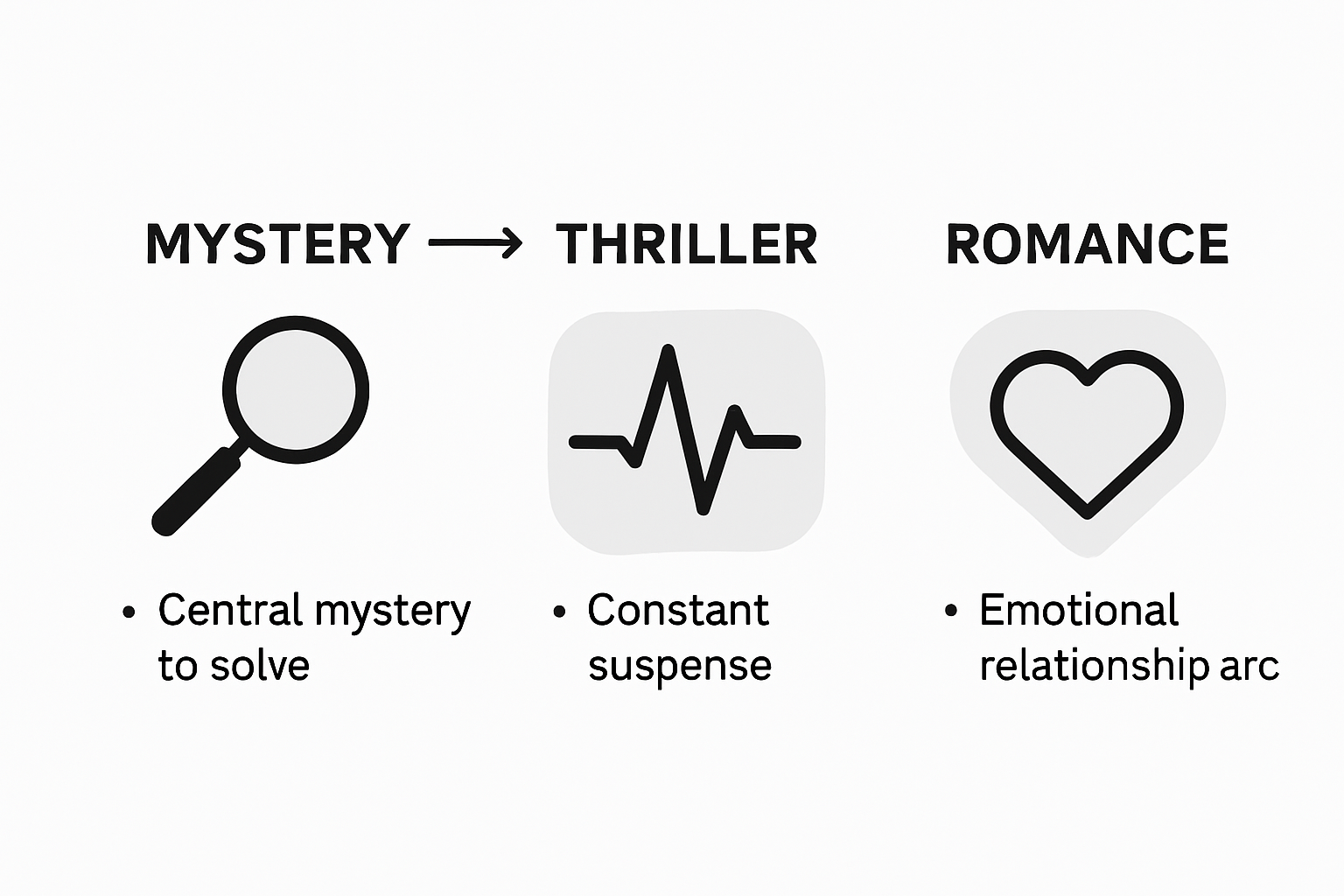
While genres like romance and science fiction transport readers through emotional connections or imaginative worlds, mystery fiction demands active intellectual engagement. Narrative structure becomes a critical differentiator. Comparative genre studies highlight how mysteries diverge from hardboiled detective stories by emphasizing logical problem-solving over pure action, creating a more cerebral reading experience that challenges readers’ analytical capabilities.
Key distinctions between mystery fiction and other genres include:
The most sophisticated mysteries transcend traditional genre boundaries, incorporating elements from psychological thrillers, social commentary, and character studies. They transform the seemingly formulaic investigation into a profound exploration of human motivation, social dynamics, and moral complexity. Unlike genres that offer escapism, mysteries provide a nuanced lens for understanding human behavior, challenging readers to look beyond surface-level narratives.
Ultimately, mystery fiction stands apart as a genre that transforms storytelling from passive consumption into an active intellectual journey. By demanding reader participation, offering complex psychological insights, and presenting narratives that resist simple categorization, mysteries offer a unique reading experience that engages both the mind and the emotions in ways other genres cannot replicate.
The article reveals how mystery stories captivate readers through intellectual challenge and emotional depth while emphasizing core elements like strategic information withholding and complex character motivations. If you have experienced the thrill of decoding puzzles but find it hard to access concise, well-crafted mysteries that respect these storytelling secrets then you are not alone. Mystery fiction requires precisely balanced narratives that maintain suspense and deliver satisfying resolution. Your goal might be to enjoy stories that trigger your curiosity and engage your mind actively without overwhelming time commitments.
Explore our Weekend Mystery Bundle to uncover a rich collection of cozy mystery short reads, psychological thriller short reads, and detective short reads that perfectly embody the principles of the mystery genre explained in the article. This carefully curated selection promises intellectual engagement, unpredictable plot twists, and emotional investment in compact formats designed for quick yet profound enjoyment.

Unlock the storytelling secrets you crave and satisfy your hunger for captivating mysteries now. Experience how our short reads turn passive reading into an interactive pursuit of truth and understanding. Visit Weekend Mystery Bundle and start your journey through mystery fiction crafted for curious minds who refuse to settle for surface level plots.
The key elements of the mystery genre include a compelling central mystery or crime, a protagonist driven by intellectual curiosity, strategic information withholding, complex character motivations, and a structured process of investigation and deduction.
Mystery stories engage readers by inviting them to become active participants in the narrative. Authors withhold information and provide clues, creating tension and stimulating the reader’s curiosity and analytical skills as they work to solve the mystery alongside the protagonist.
Common misconceptions about mystery fiction include the belief that all mysteries follow the same predictable structure, that detective characters are one-dimensional, and that the focus is solely on the final revelation rather than the investigative journey itself.
Mystery subgenres differ in their approaches and narrative styles. For example, classic detective mysteries focus on logical deduction, police procedurals emphasize realistic law enforcement techniques, while cozy mysteries feature amateur sleuths in more lighthearted settings. Each subgenre offers unique elements for exploring human complexity and moral ambiguity.