
Over 60 percent of bestselling thrillers tap into psychological tension rather than physical action. The appeal of psychological thrillers runs deep because they explore the mysteries of the mind, leaving readers questioning reality and their own perceptions. These stories stand out by pushing boundaries, spotlighting unreliable narrators, blurred realities, and moral dilemmas. Discover how the most gripping psychological thrillers use these powerful themes to keep you on the edge of your seat.
| Point | Details |
|---|---|
| Complexity of Psychology | Psychological thrillers explore intricate mental landscapes, focusing on characters’ internal struggles rather than external actions. |
| Narrative Techniques | Techniques like unreliable narrators and non-linear storytelling create psychological tension and engage readers’ intellect. |
| Moral Ambiguity | The genre challenges traditional notions of right and wrong, presenting characters in morally complex situations that reflect human nature. |
| Evolving Genre Trends | Technological advancements and societal anxieties have shaped modern psychological thrillers, making them increasingly immersive and reflective of contemporary issues. |
Psychological thrillers represent a complex narrative genre that delves deep into human consciousness, exploring the intricate landscape of mental and emotional experiences. According to Wikipedia, these stories combine elements of thriller and psychological fiction, focusing intensely on characters’ mental states and the nuanced complexities of human psychology.
At their core, psychological thrillers are distinguished by their profound examination of internal human struggles. StudySmarter highlights that these narratives often employ sophisticated techniques like unreliable narrators and non-linear storytelling to create an atmosphere of sustained psychological tension. The primary aim is not merely to entertain, but to challenge readers’ perceptions of reality and truth.
Key themes in psychological thrillers frequently include:
These narratives are less about external action and more about the intricate psychological journeys characters undertake. They invite readers to question fundamental assumptions about consciousness, presenting characters who are often wrestling with complex internal landscapes. By focusing on psychological depth, these stories transform traditional thriller conventions into profound explorations of human nature.
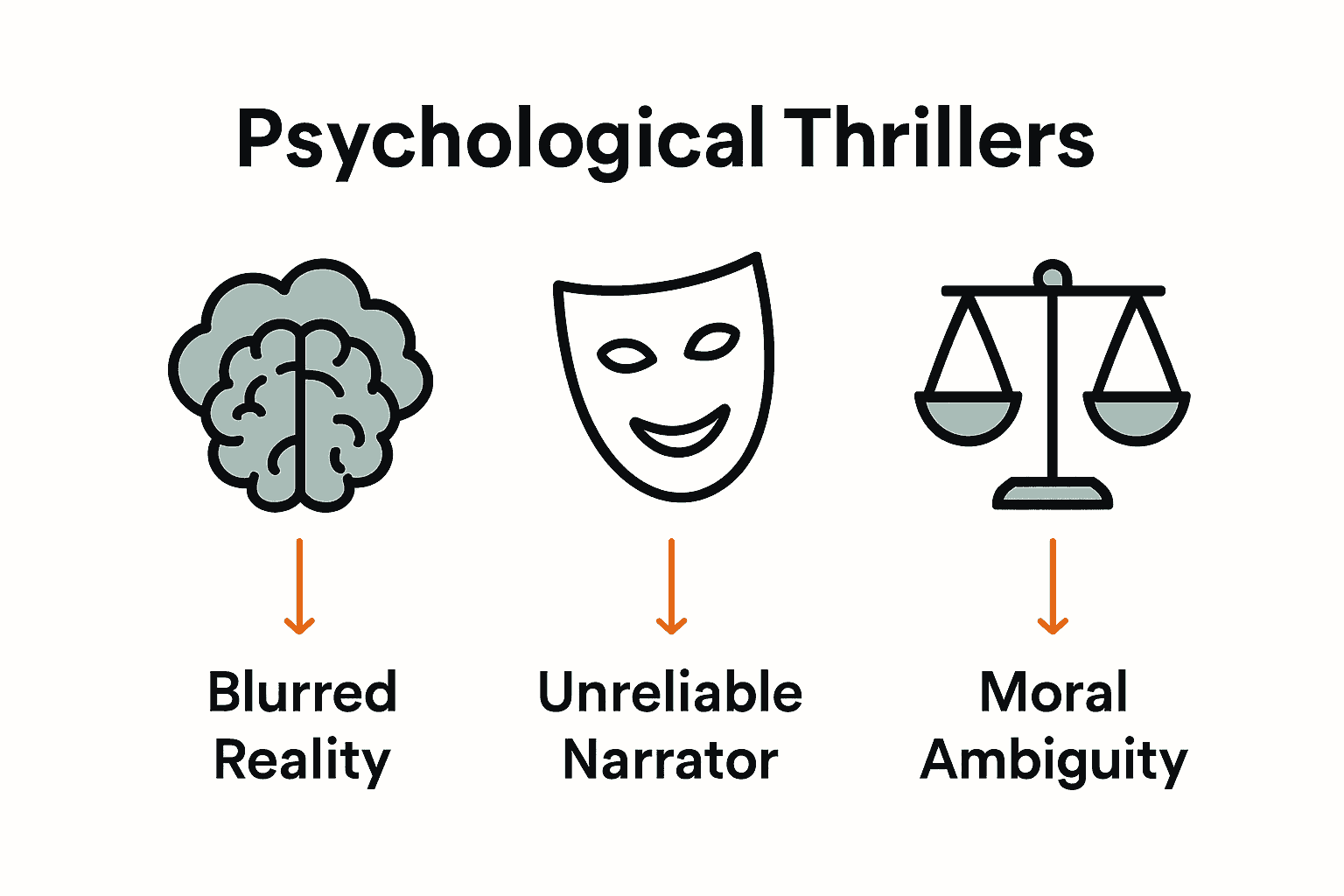
Psychological thrillers are characterized by distinctive narrative techniques and recurring themes that distinguish them from other genres. According to Wikipedia, two critical motifs are the unreliable narrator and the MacGuffin – narrative devices that deliberately challenge audience expectations and create psychological tension.
The concept of an unreliable narrator is particularly fascinating, as it invites readers to constantly question the authenticity of the storytelling. Movie Time Today explores how these narratives frequently revolve around themes of identity crisis, where characters wrestle with complex psychological challenges such as amnesia or multiple personalities. This narrative strategy transforms the storytelling from a simple plot progression into a nuanced exploration of perception and mental states.
Key recurring patterns in psychological thrillers include:
These motifs are not merely stylistic choices but powerful tools for psychological exploration. By presenting characters who are fundamentally uncertain about their own experiences, psychological thrillers create a profound sense of unease and intellectual engagement.
 The genre invites readers to become active participants in unraveling complex psychological landscapes, challenging conventional narrative expectations and offering deep insights into human consciousness.
Here’s a summary of major themes and motifs in psychological thrillers:
| Theme or Motif | Key Characteristics | Narrative Purpose |
|---|---|---|
| Blurred Reality & Perception | Reality vs. delusion Fragile memory Uncertainty |
Create constant doubt Challenge perception |
| Identity & Transformation | Identity crisis Split personalities Psychological change |
Explore self-discovery Drive character arcs |
| Moral Ambiguity | Ethical dilemmas Questionable motives Dark impulses |
Blur good and evil Reveal hidden motives |
| Unreliable Narrator | Withheld information Contradictory accounts Cognitive dissonance |
Manipulate audience Deepen suspense |
| Psychological Manipulation | Gradual revelations Audience misdirection Emotional tension |
Engage reader’s intellect Build tension |
Psychological manipulation lies at the heart of narrative complexity in psychological thrillers, with unreliable narrators serving as the primary mechanism for creating profound psychological tension. Fiveable explains that these narrators deliberately challenge viewers’ perceptions by presenting skewed or deceptive information, effectively blurring the lines between objective reality and subjective experience.
StudySmarter highlights how non-linear storytelling and unreliable narration function as sophisticated narrative techniques that immerse audiences directly into characters’ complex mental landscapes. By systematically destabilizing traditional storytelling conventions, these narratives force readers to constantly question not just the story’s progression, but their own interpretations of unfolding events.
Key characteristics of psychological manipulation in narratives include:
The ultimate power of unreliable narration lies in its ability to transform storytelling from a passive experience into an active psychological investigation.
Readers become detectives, parsing through fragmented memories, conflicting accounts, and intentionally obscured motivations. This approach doesn’t just tell a story – it invites audiences to deconstruct the very nature of perception, truth, and psychological reliability.
Psychological thrillers serve as a profound exploration of the intricate moral landscapes that define human behavior. Wikipedia highlights how these narratives challenge traditional moral frameworks by presenting worlds where conventional notions of right and wrong become fundamentally blurred. The genre confronts readers with characters who exist in morally complex spaces, often revealing the thin line separating rational behavior from destructive impulses.
StudySmarter emphasizes that these narratives are not about simplistic good versus evil dichotomies, but about intricate human complexities. Characters are presented with ethical dilemmas that expose the nuanced internal struggles driving human decision-making, challenging readers to consider the psychological motivations behind seemingly inexplicable actions.
Key aspects of moral ambiguity in psychological thrillers include:
Ultimately, psychological thrillers function as sophisticated psychological investigations. They strip away comfortable illusions about human nature, revealing the complex emotional and moral mechanisms that drive human behavior. By presenting characters who defy simple categorization, these narratives invite readers to confront the uncomfortable truth that morality is rarely absolute, but instead a fluid, context-dependent experience shaped by individual perception and circumstance.
Psychological thrillers have undergone a remarkable transformation, evolving to reflect the complex psychological landscapes of contemporary society. StudySmarter highlights how technological advancements have significantly enhanced visual storytelling, enabling more immersive narrative experiences that explore increasingly nuanced psychological themes.
Fiveable reveals that these narratives have become powerful mirrors of societal anxieties, tapping into collective fears about identity and trust. By presenting characters who struggle with self-perception and the reliability of human connections, psychological thrillers create a profound reflective space that resonates deeply with modern audiences’ inner psychological tensions.
Key trends shaping the reader experience include:
The genre continues to evolve as a sophisticated psychological investigation, challenging readers to confront uncomfortable truths about human nature. By presenting narratives that refuse simple resolutions, psychological thrillers transform reading from a passive experience into an active psychological exploration. For readers seeking deeper insights into gripping thriller stories, this genre offers an unparalleled journey into the intricate landscapes of human consciousness.
Psychological thrillers explore the fragile boundaries of reality and the complex journeys of identity and perception. If you’ve ever felt captivated yet unsettled by stories with unreliable narrators and moral ambiguity, you are not alone. These themes challenge your understanding of truth and push you to see beyond the surface. At The Short Reads, we understand your craving for gripping narratives that dive into these intricate psychological landscapes.

Experience unforgettable stories that bring these powerful themes to life. Our selection of psychological thriller short reads offers fast-paced, thought-provoking novellas and short books designed to immerse you immediately. Don’t wait to explore mind-bending tales full of suspense and subtle twists. Visit The Short Reads now and unlock a world where every page invites you to rethink reality and dive into the heart of human consciousness.
The main themes in psychological thrillers include blurred boundaries between reality and perception, exploration of individual identity and psychological transformation, moral ambiguity and ethical dilemmas, psychological isolation and internal conflict, and the fragility of human perception and memory.
An unreliable narrator challenges the audience’s perceptions by presenting skewed or deceptive information, creating cognitive dissonance, and keeping readers guessing about what is true. This narrative technique enhances psychological tension and deepens engagement with the story.
Common narrative techniques in psychological thrillers include non-linear storytelling, unreliable narration, character-driven plots that focus on psychological depth, and internal conflicts that manifest in external actions, all aimed at creating tension and a complex reading experience.
Psychological thrillers explore moral ambiguity by presenting characters who operate outside traditional ethical boundaries, revealing the complexities of psychological motivations, and challenging binary moral perspectives, which leads readers to confront the intricacies of human behavior.
Article generated by BabyLoveGrowth
Share



In looking at 7 gripping examples of thriller stories to read, most people expect jump scares or a simple whodunit, but the real power comes from how these stories dig into human fear, social tension, and hidden motives.
Thrillers have a way of grabbing you from the first page and refusing to let go. Think of Stephen King’s ‘The Shining’ with its protagonist’s terrifying psychological collapse set in a hotel that becomes a living trap.
The most unforgettable thrillers are the ones that unnerve you not with monsters or villains, but by exposing the darkness lurking inside everyday life.
| Takeaway | Explanation |
|---|---|
| Explore psychological disintegration in thrillers | Novels like “The Shining” delve into mental breakdowns driven by isolation and trauma. |
| Unreliable narratives elevate suspense | In “Gone Girl,” alternating perspectives enhance psychological manipulation and keep readers guessing. |
| Complex protagonists redefine genres | Characters such as Clarice Starling challenge traditional portrayals with depth and vulnerability. |
| Social critique enhances thriller plots | Works like “The Girl with the Dragon Tattoo” intertwine social issues with gripping narratives. |
| Moral complexities shape legal thrillers | “A Time to Kill” confronts racism and justice through intense courtroom drama, prompting ethical reflections. |
Stephen King’s “The Shining” represents a masterclass in psychological thriller storytelling, transcending traditional horror narrative by exploring profound psychological disintegration. Published in 1977, this novel delves deep into the human psyche, presenting a terrifying exploration of isolation, mental breakdown, and supernatural manipulation.
The story centers on Jack Torrance, a struggling writer and recovering alcoholic who becomes the winter caretaker at the isolated Overlook Hotel in Colorado. As documented by research published in the Journal of Language and Linguistic Studies, the novel brilliantly captures the psychological trauma of extreme isolation and familial tension.
Key elements that make “The Shining” a compelling psychological thriller include:
King masterfully transforms the hotel into more than just a physical space it becomes a character itself, manipulating Jack’s fragile mental state. The narrative explores how environmental pressures and internal psychological struggles can trigger catastrophic mental breakdown. Jack’s gradual transformation from a struggling writer trying to reconnect with his family to a violent, possessed individual represents a chilling study of human psychological fragility.
For readers interested in exploring more psychological thriller experiences, “The Shining” offers an unparalleled journey into the darkest corners of human consciousness. Its enduring legacy lies not just in its supernatural elements, but in its profound psychological exploration of how isolation, addiction, and past traumas can unravel an individual’s sanity.
Gillian Flynn’s “Gone Girl” revolutionized the psychological thriller genre, introducing a narrative that challenges traditional storytelling expectations. Published in 2012, this novel became a cultural phenomenon by presenting a dark and intricate exploration of marriage, media manipulation, and personal deception.
The story follows Nick and Amy Dunne, a seemingly perfect couple whose relationship dramatically unravels when Amy mysteriously disappears on their fifth wedding anniversary. As research from Time magazine highlights, the novel subverts traditional gender narratives by presenting complex, deeply flawed characters.
Key characteristics that distinguish “Gone Girl” as a modern thriller include:
Flynn masterfully constructs a narrative that keeps readers guessing, employing multiple narrative voices and strategic revelations that systematically deconstruct the characters’ public personas. The novel explores themes of identity, performance, and the masks people wear in relationships.
Moreover, the book offers a scathing commentary on contemporary marriage, media culture, and societal expectations. Its intricate plot demonstrates how personal narratives can be constructed, manipulated, and weaponized. For readers looking to dive deeper into suspenseful storytelling, “Gone Girl” represents a landmark work that redefined psychological thriller conventions.
Thomas Harris’s “The Silence of the Lambs” stands as a groundbreaking thriller that redefined the crime genre, blending psychological complexity with forensic intrigue. Originally published in 1988, this novel introduced readers to two of the most compelling characters in modern literature: FBI trainee Clarice Starling and the brilliant, cannibalistic serial killer Dr. Hannibal Lecter.
According to research exploring the novel’s cultural impact, the story represents a profound exploration of psychological manipulation and professional ambition. The narrative follows Clarice Starling, a young FBI trainee tasked with interviewing Dr. Lecter to gain insights into capturing another serial killer, Buffalo Bill.
Key elements that make “The Silence of the Lambs” a remarkable thriller include:
The novel revolutionized the crime thriller genre by presenting a female protagonist who is both vulnerable and extraordinarily competent. Clarice Starling challenges traditional gender narratives in law enforcement, using her intelligence and psychological insight to navigate dangerous criminal landscapes.
Dr. Hannibal Lecter emerges as one of literature’s most fascinating antagonists a brilliant psychiatrist whose intellectual prowess is matched only by his psychological darkness. Their interactions create a unique dynamic that transcends typical crime narrative structures. For those intrigued by thriller storytelling, “The Silence of the Lambs” offers an unparalleled exploration of human psychology, criminal motivation, and institutional power dynamics.
Stieg Larsson’s “The Girl with the Dragon Tattoo” emerged as a groundbreaking international thriller that transformed global perceptions of Scandinavian crime fiction. Published posthumously in 2005, this novel introduced readers to Lisbeth Salander, a complex and unconventional protagonist who defies traditional narrative expectations.
According to research from Illinois Wesleyan University, the novel offers a profound critique of Swedish societal structures, exposing deep-rooted issues of misogyny, economic corruption, and systemic violence.
Key elements that distinguish this thriller include:
The story centers on Mikael Blomkvist, an investigative journalist, and Lisbeth Salander, a brilliant but socially marginalized computer hacker. Together, they unravel a complex mystery involving a wealthy industrial family’s dark secrets. Salander represents a revolutionary character who challenges traditional gender stereotypes, presenting a raw, unapologetic portrayal of a survivor who transforms her trauma into strength.
Larsson’s narrative goes beyond typical thriller conventions, embedding deep social commentary within a gripping investigative framework. The novel scrutinizes systemic violence against women, corporate corruption, and the hidden darkness beneath Sweden’s progressive social facade. For enthusiasts of international thriller fiction, this book offers a masterclass in combining social critique with heart-pounding narrative tension.
John Grisham’s “A Time to Kill” represents a powerful exploration of justice, racism, and moral complexity set against the backdrop of the Mississippi legal system. Published in 1989, this novel emerged as a groundbreaking narrative that confronts systemic racism through an intense legal drama centered on a father’s desperate quest for justice.
According to research from academic scholars, the story offers a nuanced examination of racial tensions in the American South, challenging readers to consider complex ethical dilemmas beyond traditional legal narratives.
Key elements that distinguish this legal thriller include:
The narrative follows Jake Brigance, a young white attorney defending Carl Lee Hailey, a Black father who murders two white men who brutally assaulted his young daughter. The trial becomes a microcosm of broader societal conflicts, challenging readers to confront uncomfortable truths about racial inequality, personal vengeance, and legal ethics.
Grisham masterfully constructs a narrative that goes beyond traditional legal thriller conventions, transforming a courtroom drama into a profound meditation on personal moral courage versus systemic oppression. The story forces readers to grapple with challenging questions about justice, revenge, and the complex intersections of race and law. For those intrigued by compelling legal narratives, “A Time to Kill” offers an unforgettable journey through moral complexity and human resilience.
Robert Ludlum’s “The Bourne Identity” revolutionized the espionage thriller genre, introducing a complex protagonist who defies traditional spy narrative conventions. Published in 1980, the novel presents Jason Bourne as a multi-dimensional character struggling with identity and survival in a dangerous international landscape.
According to research from JSTOR, the novel represents a pivotal moment in thriller fiction, transforming the archetype of the spy from a one-dimensional operative to a deeply nuanced character wrestling with psychological trauma and fragmented memory.
Key elements that distinguish this thriller include:
The story follows Jason Bourne, a mysterious man discovered with significant amnesia but possessing extraordinary combat and survival skills. As he attempts to uncover his true identity, he becomes entangled in a dangerous web of international intelligence agencies, mercenaries, and his own mysterious past.
Ludlum brilliantly constructs a narrative that goes beyond traditional action adventures, transforming the spy thriller into a profound exploration of personal identity and psychological reconstruction. The novel challenges readers to consider the thin line between individual agency and institutional manipulation. For enthusiasts of action-packed narratives, “The Bourne Identity” offers a masterclass in combining psychological depth with heart-stopping adventure.
Shirley Jackson’s “The Haunting of Hill House” stands as a revolutionary supernatural thriller that transcends traditional ghost story conventions, blending psychological complexity with supernatural intrigue. Published in 1959, this novel represents a groundbreaking exploration of psychological terror and social alienation.
According to research from the Arizona Quarterly, the novel uses Gothic literary conventions to examine profound themes of domesticity, psychological instability, and societal marginalization through its intricate narrative structure.
Key elements that distinguish this supernatural thriller include:
The story follows four characters who arrive at the mysterious Hill House to investigate its paranormal reputation: Dr. Montague, a supernatural researcher, Eleanor Vance, a psychologically fragile woman with latent supernatural sensitivity, Luke Sanderson, the home’s potential heir, and Theodora, an artist with intuitive capabilities.
Jackson masterfully blurs the lines between psychological breakdown and supernatural experience, creating a narrative where readers cannot definitively distinguish between Eleanor’s mental state and genuine supernatural events. The house itself becomes a character, representing psychological oppression and societal constraints.
Below is a comprehensive table summarizing the article’s key thriller story examples, major themes, and distinguishing features to give readers a quick reference overview of the article’s main points.
| Thriller Example | Main Themes/Focus | Distinguishing Features |
|---|---|---|
| The Shining (Stephen King) | Psychological disintegration, isolation, trauma | Claustrophobic setting, supernatural influences, family breakdown |
| Gone Girl (Gillian Flynn) | Marriage, manipulation, media deception | Unreliable narrators, alternating perspectives, sharp plot twists |
| The Silence of the Lambs (Thomas Harris) | Crime psychology, ambition, professional rivalry | Strong female lead, complex antagonist, forensic intrigue |
| The Girl with the Dragon Tattoo (Larsson) | Social critique, gender, marginalization | Scandinavian setting, technological intrigue, social commentary |
| A Time to Kill (John Grisham) | Racism, justice, moral ambiguity | Southern legal drama, racial tension, ethical dilemmas |
| The Bourne Identity (Robert Ludlum) | Identity, memory, espionage | Amnesiac protagonist, international intrigue, psychological depth |
| The Haunting of Hill House (Jackson) | Supernatural ambiguity, trauma, alienation | Blurred reality, gothic setting, psychological terror |
For readers fascinated by supernatural mysteries, “The Haunting of Hill House” offers an unparalleled journey into the complex terrain where psychological vulnerability intersects with supernatural uncertainty.
Do gripping stories like “The Shining” or “Gone Girl” appeal to you, but you struggle to find time for long novels? If you have ever felt overwhelmed by the idea of thick books or wish you could experience the thrill of expertly crafted suspense in a fraction of the time, you are not alone. Many readers just want the excitement of a psychological, legal, or supernatural thriller without long reading hours. At TheShortReads.com, we specialize in delivering fast, accessible stories under 150 pages for busy schedules and casual readers. Our short fiction options are the perfect solution for anyone wanting to explore unforgettable characters and deep psychological twists—just like the standout examples highlighted in this article—without any pressure or time investment.

Ready to experience powerful storytelling in a more approachable way? Visit TheShortReads.com now and download your first free short thriller to discover how engaging quick reads can be. Looking for more genres that match your favorite thrillers? Explore our collection of short suspense stories for instant access and start building your reading habit today before another story passes you by.
Psychological thrillers often involve intense character development, exploring themes of mental instability, manipulation, and the impact of isolation or trauma on the mind. They typically feature unreliable narrators and intricate, suspenseful plots.
‘Gone Girl’ employs alternating narrative perspectives and unreliable storytelling, complicating the perception of characters. It offers a deep psychological exploration of marriage and media manipulation, featuring unexpected plot twists that keep readers engaged.
‘The Silence of the Lambs’ blends psychological depth with forensic intrigue, featuring a strong female protagonist and a complex antagonist. Its exploration of criminal psychology and intense character interactions set it apart from traditional crime thrillers.
In ‘The Haunting of Hill House,’ supernatural elements are intricately woven with psychological complexities, creating ambiguity around character experiences. The house itself acts as a character, reflecting and amplifying the protagonists’ psychological states, thereby heightening the overall tension.