
Tag Archives for " quick reads "
The Year of the Slim Volume
5 Reasons Why Short Books Are Winning the Reading War
Remember when “I haven’t had time to read” was just a polite excuse? Turns out, it was a market signal the entire publishing industry missed about short books: until a Twitter user named Bigolas Dickolas Wolfwood broke the internet in May 2023.
His viral tweet about This Is How You Lose the Time War wasn’t a literary critique. It was a promise: “it’s only like 200 pages u can download it on audible it’s only like four hours.” That tweet generated 145,000 likes, rocketed the book to #3 on Amazon, and proved what we at The Short Reads have known all along: readers don’t want less literature. They want less filler.
Fast-forward a few months: Annie Ernaux wins the Nobel Prize. All her best-known works? Under 200 pages. Some under 100. Industry insiders started calling 2023 “the year of the slim volume,” and suddenly, publishers were racing to launch novella imprints. Gagosian, New Directions, The Atlantic: everyone wanted a piece of the short book revolution.
But here’s the real surprise: this isn’t a trend. It’s a correction. For decades, publishing insisted books needed to be 400+ pages to justify their price tags. Readers just decided they were done with that nonsense.
Here are the five forces driving the short book takeover: and why you should stop feeling guilty about that unfinished doorstop on your nightstand.
1. The Self-Esteem Boost: Finishing Actually Feels Good
You know that stack of half-read books glaring at you from the shelf? That’s not laziness. That’s reader burnout, and it’s killing your confidence.
“Self-esteem is very important for people when it comes to reading,” says Karah Preiss, co-founder of Belletrist book club. She’s talking about the psychological power of completion: the idea that you can start a book and reasonably finish it without requiring a sabbatical.
Think about it:
- A 400-page novel takes the average reader 13+ hours to finish
- A 150-page novella? 4–5 hours
- That’s the difference between “I’ll finish it eventually” and “I finished three books this week”
Readers who typically avoid literature because they “don’t read enough” are discovering that reading several short books in quick succession empowers them to identify as readers again. It’s not about lowering standards: it’s about removing the psychological barrier that says you need a vacation to finish a novel.
At The Short Reads, we’ve watched this play out in real-time. When you can finish a complete Detective Jack Creed mystery between breakfast and lunch, suddenly you’re not a “non-reader” anymore. You’re someone who just binged three thrillers this week.
2. The ‘All Killer, No Filler’ Effect: Intensity Over Padding
Let’s be honest: how much padding does the average book-length book have?
Critic Maris Kreizman poses the question perfectly: “When a novella is perfect, why bother padding it with other stuff?” The answer, historically, has been economics. Publishers believed readers wouldn’t pay $28 for 150 pages, so authors stretched stories like taffy until they hit the magic 300-page minimum.
But readers are catching on. They’re realizing that form is a vessel through which a story is told, and a book should be exactly as long as the story requires: no more, no less.
Consider the appeal:
- Concision is luxury. No subplots that go nowhere. No 40-page descriptions of breakfast.
- Intensity over sprawl. Every sentence earns its place.
- Precision matters. Short books force authors to make every word count.
Author Alexandra Kleeman calls this “the luxury that is concision”: the idea that instead of something feeling ‘slight’ because it’s short, we can appreciate the intensity of it. It’s the literary equivalent of choosing a perfect espresso over a watered-down latte.

3. The Goodreads Hack: Gaming the Reading Goals
Here’s the part nobody wants to admit out loud: it is so much easier to read a large number of books if you’re reading short books.
The rise of Goodreads challenges and reading trackers has created a new type of reader: what Kreizman calls “tech bros and Goodreads ladies alike”: who keep running lists of what they’ve read to post a grand total at year’s end. And if you’re trying to hit 50 books this year, are you reaching for Infinite Jest or a 180-page novella?
The math is simple:
- One 500-page epic = 1 book toward your goal
- Three 150-page novellas = 3 books, finished in the same timeframe
- Both deliver complete stories. One triples your stats.
Is this “gaming the system”? Maybe. But it’s also democratizing reading culture. The New York Times even published a list of “books you can read in a day,” and readers are treating it like a treasure map. If the goal is to read more, short books remove the friction.
We’re not suggesting you abandon long books entirely: but if you’ve been “reading” the same 600-page fantasy epic since 2019, maybe it’s time to close that tab and try something you’ll actually finish.
4. The Palate Cleanser: Low-Commitment Experimentation
Publishing insiders have been recommending novellas to each other as “palate cleansers” for years: quick, intense reads between bigger projects. Now, general readers are discovering what the industry elite already knew.
Short books are the perfect low-commitment experiment for readers who want to:
- Try a new genre without investing a week
- Sample an unfamiliar author’s style
- Read something intellectually rigorous without the time burden
- Explore experimental or cross-genre works without fear
Books like Bluets by Maggie Nelson and Autobiography of Red by Anne Carson have become perennially popular among readers who want capital-L literature in manageable doses. These aren’t “beach reads”: they’re sophisticated, challenging works that respect your time.
Independent bookstores have noticed this shift, too. At Books & Books in South Florida, head buyer Gael LeLamer stocks “a lot of those little novellas right by the register”: formerly the domain of novelty gift books. And they’re selling better than impulse-buy tchotchkes.
Why? Because a $20 novella feels like a bargain when commercial hardcovers are pushing $40. You’re getting a complete, satisfying reading experience for half the price and a quarter of the time commitment.
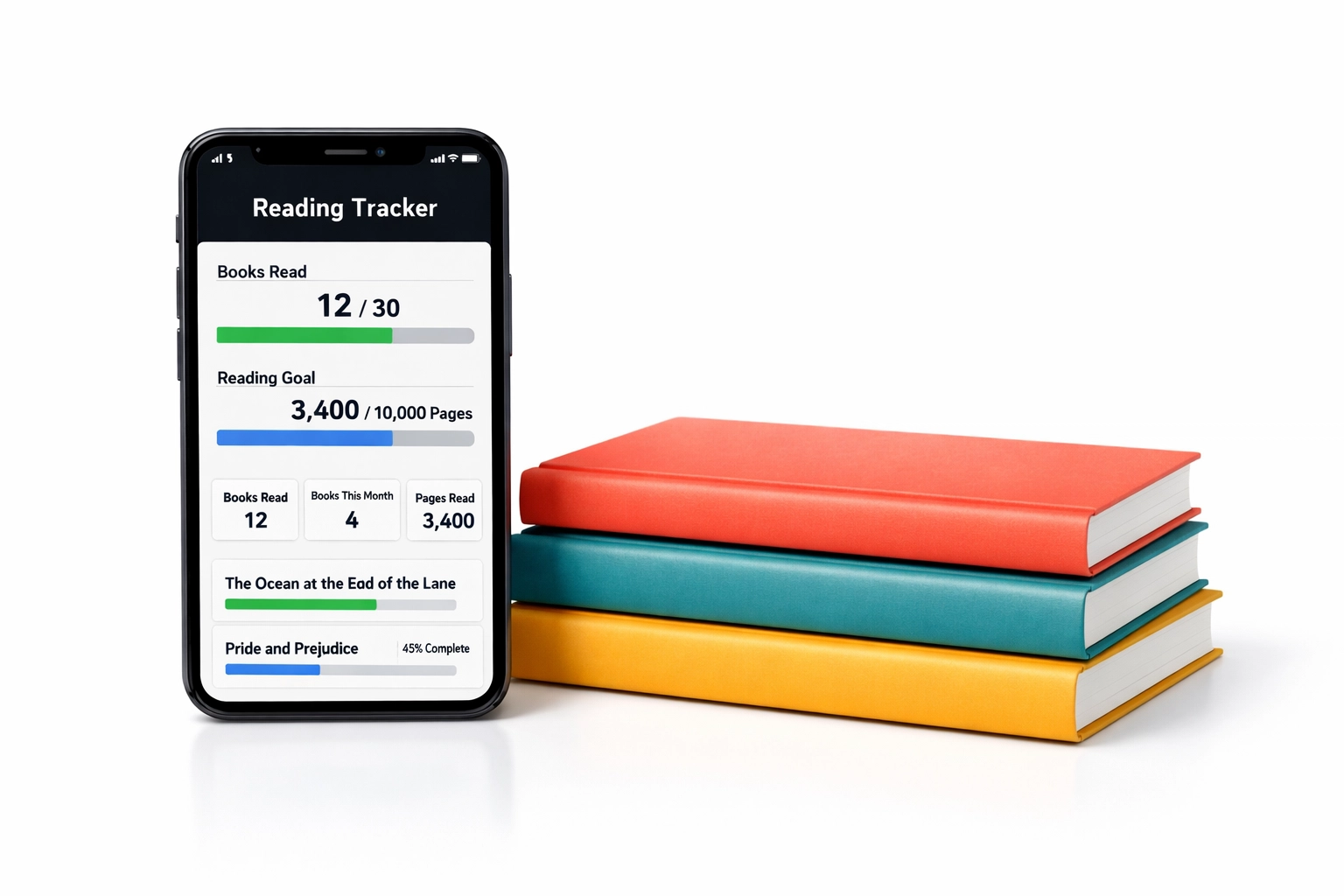
5. The Luxury of Concision: Short as a Status Symbol
Here’s where things get interesting: short books are becoming a smart choice, not a compromise.
When Annie Ernaux won the Nobel Prize in Literature, it gave everyone “license to write their own slim volumes or pick up more slim volumes,” according to Kleeman. Suddenly, reading short books wasn’t about having a limited attention span: it was about having sophisticated taste.
Publishers responded by launching dedicated imprints:
- Gagosian’s Picture Books: Hardcover fiction under 100 pages
- McNally Editions: Elegant slim volumes launched in 2022
- New Directions’ Storybooks: Hardcover stories you can finish in 90 minutes
- The Atlantic Editions: Standalone essays with Molly Stern’s Zando
These aren’t cheap paperbacks. They’re beautifully designed hardcovers priced in the mid-$20 range for 60 pages: and they’re selling. Why would someone pay that much for so few pages? Because readers are zeroing in on how much padding so many book-length books have. They’re willing to pay for quality over quantity.
Think of it this way: Would you rather spend $35 on a bloated 400-page novel you’ll abandon on page 187, or $22 on a razor-sharp 120-page novella you’ll finish, remember, and recommend?
The slim volume isn’t “less than” a long book. It’s distilled, intentional, and respectful of your time. That’s not a compromise: that’s luxury.
The Short Reads Was Ahead of the Curve
While the publishing industry spent 2023 “discovering” that readers want shorter books, The Short Reads has been pioneering this model from day one. We’ve always believed that a great story doesn’t need 400 pages: it needs exactly as many pages as the story requires.
Our library of novellas under 150 pages isn’t a reaction to a trend. It’s a commitment to the idea that readers deserve complete, satisfying stories that fit their actual lives: not the fantasy life where they have unlimited reading time.
Whether you’re rediscovering your love of reading or just tired of books that feel like homework, the message is clear: 200 pages is a beautiful, beautiful thing.
Ready to experience the luxury of concision? Browse our collection of short reads and finish your next book before your coffee gets cold.
Share


The Literary Palate Cleanser
Why Every Reader Needs a Novella “Reset”
You’ve just finished a 900-page epic fantasy series. Your brain feels like it’s been through a marathon. There are forty-seven character names still bouncing around your skull, three different magic systems you’re trying not to confuse, and honestly? You’re not sure you can commit to another dense tome right now. It’s time for a novella rest.
Here’s the counterintuitive truth: The best thing you can do for your reading life isn’t to dive into another massive book, it’s to press reset with a novella.
What Is a Literary Palate Cleanser, Anyway?
In fine dining, a palate cleanser is that small, refreshing bite served between courses to reset your taste buds. It’s not the main event, but it’s essential for fully appreciating what comes next.
The same principle applies to reading. After you’ve spent weeks or months immersed in a sprawling narrative with multiple POVs, intricate subplots, and enough backstory to fill a Wikipedia, your brain needs something different. Not necessarily lighter: but cleaner. More focused. A complete story that doesn’t ask you to remember who’s related to whom or which kingdom declared war on which.
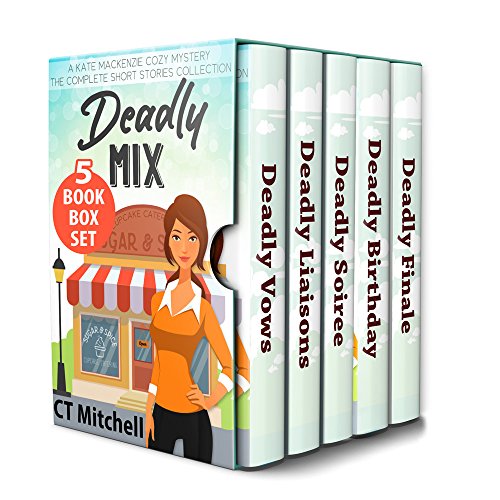
That’s where novellas come in. These 50-to-150-page powerhouses offer complete narrative satisfaction without the commitment fatigue of longer works. You get a full emotional arc, satisfying closure, and that dopamine hit of actually finishing something: all in a single sitting or two.
Why Your Brain Craves the Reset
Let’s talk about what happens when you finish a long, complex book. You’ve been living with these characters for weeks. You’ve invested 15-20+ hours into this world. And when it ends? There’s a weird kind of grief mixed with relief.
Your reading brain is genuinely tired. Not from the reading itself, but from:
- Tracking dozens of narrative threads simultaneously
- Remembering backstory details from 400 pages ago
- Managing the emotional weight of extended character development
- Maintaining focus through the infamous “sagging middle” where momentum falters
This is where novellas shine as reset tools. Research shows that well-crafted novellas deliver “enough tension and pace to keep your interest and enough depth to immerse you in its world and characters”: but they do it in just a couple of hours. You get the same satisfaction as a full novel, just “in less time and with fewer complications and plot twists.”
The real surprise? This isn’t about taking a break from “serious” reading. It’s about giving your brain exactly what it needs to stay engaged with literature long-term.
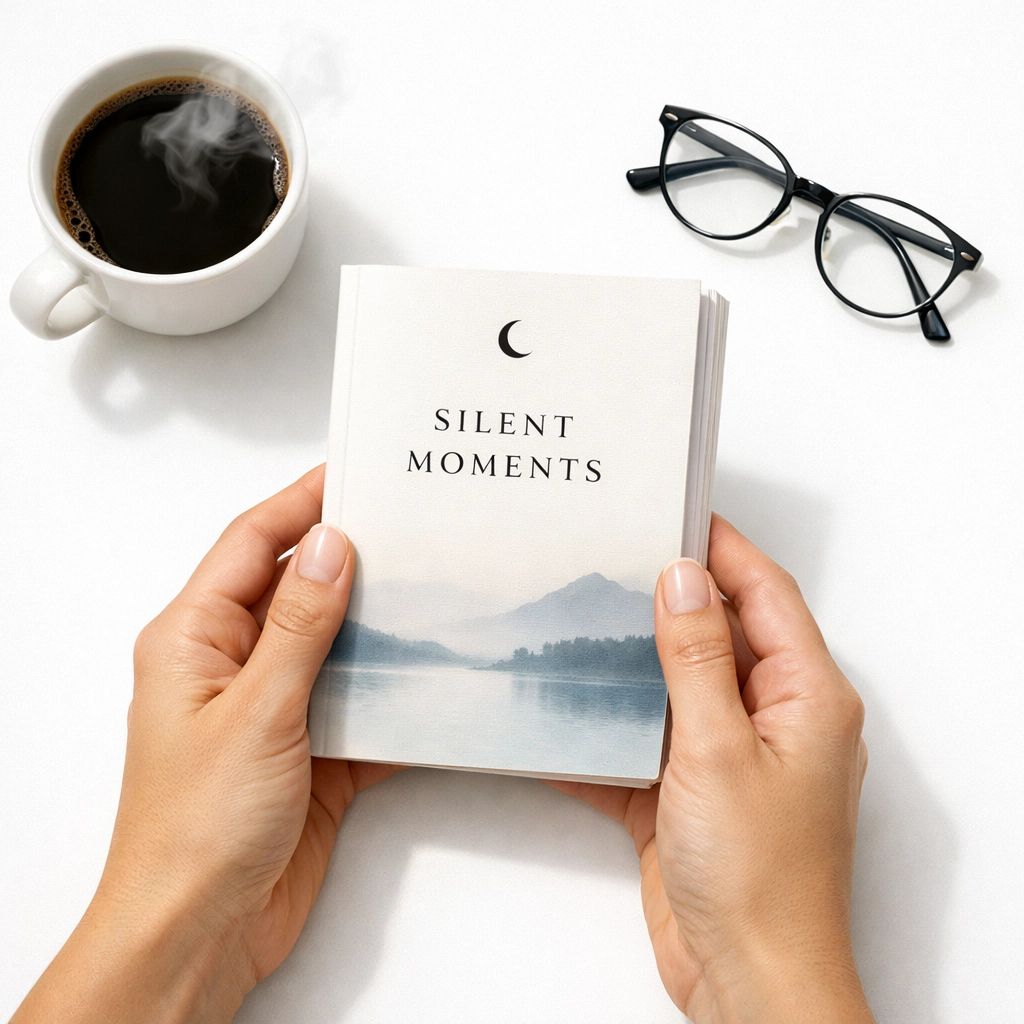
The Novella Advantage: All Marrow, No Fat
Here’s what makes novellas the perfect palate cleanser: they’re structurally designed to go straight to the heart of the matter. No filler. No tangents. No secondary characters who exist just to pad the page count.
Think about it this way:
What Novellas Skip:
- The slow-burn first 100 pages of world-building
- Secondary romance subplots that don’t affect the main story
- Extensive flashback sequences
- That sagging middle where novels often lose momentum
- Ensemble casts with shifting POVs
What Novellas Deliver:
- Laser focus on one character’s single, driving obsession
- Constant narrative intensity from page one
- Complete emotional arcs without exhaustion
- The satisfaction of closure in 2-3 hours
One literary analyst put it perfectly: novellas “bypass distracting secondary characters” to focus intensely on “one character’s single wish ripening toward obsession.” You always get the best parts: the marrow: without having to chew through the gristle.
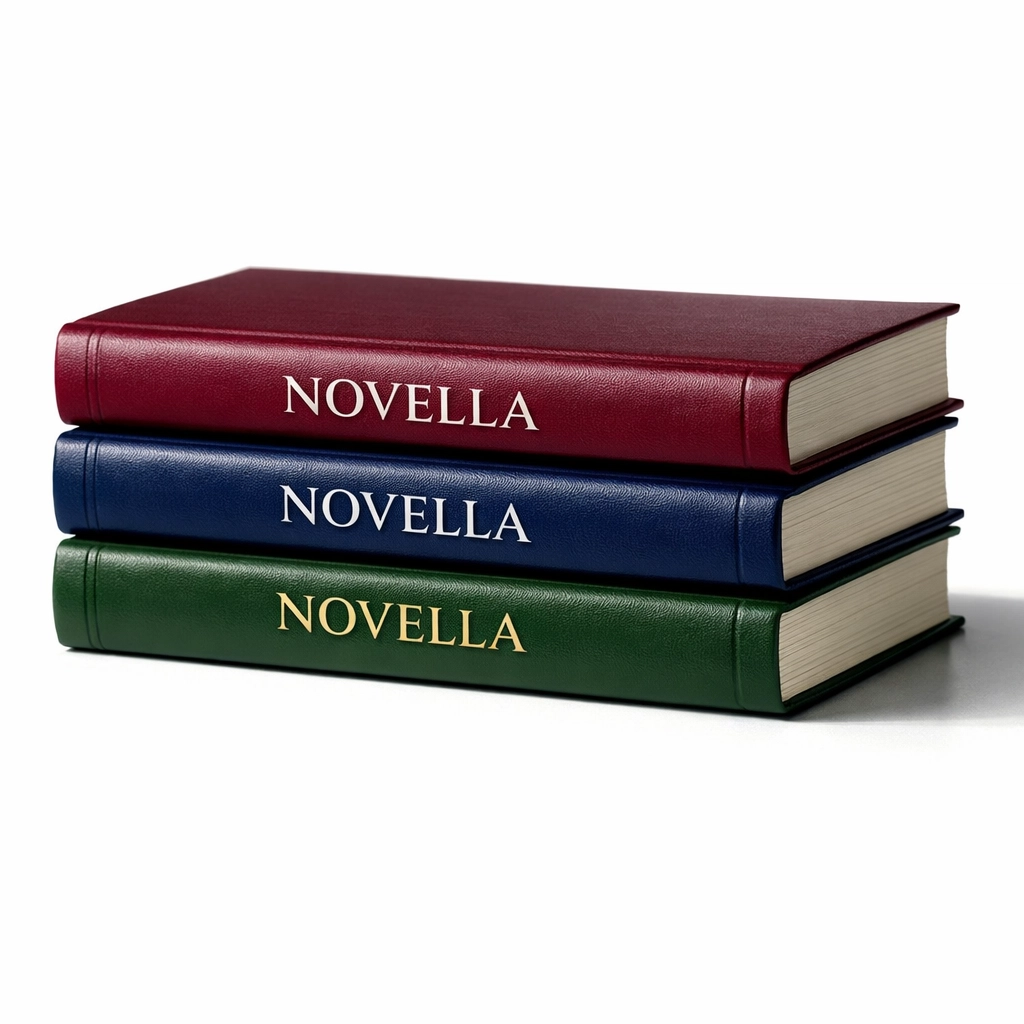
When to Reach for Your Literary Reset Button
You might think novellas are only for when you’re “too busy” for real books. Wrong. Here are the moments when a novella reset is exactly what your reading life needs:
After a Series Marathon
Just finished all seven books of that dark academia series? Your brain has been in that world for months. A sharp, standalone novella in a completely different genre clears your mental palate and prevents series hangover.
Between Challenging Literary Fiction
Tackled a dense Pulitzer Prize winner? Brilliant, but exhausting. A tightly plotted thriller novella gives you narrative satisfaction without demanding the same level of interpretive energy.
When You’re Intimidated by Your TBR
Staring at that stack of 500+ page novels can be paralyzing. Starting with a 90-page mystery novella rebuilds your reading confidence and momentum. You finish something. You feel accomplished. Suddenly that big book doesn’t seem so scary.
Post-Reading Slump
Sometimes a disappointing book kills your reading mojo entirely. A quick, well-crafted novella reminds you why you love reading without demanding a massive time commitment.
Genre-Switching
Trying a new genre can feel risky. A novella lets you test the waters without committing to 400 pages of something you might not enjoy.
The Completion Dopamine Is Real
There’s actual neuroscience behind why finishing books matters for your reading self-esteem. Every time you complete a narrative: any narrative: your brain releases a small dopamine reward. This reinforces reading as a positive behavior.
Here’s the problem with massive novels: if you take six weeks to finish one book, you only get that completion dopamine hit 8-10 times per year. But if you mix in novellas? You could finish 3-4 novellas in the time it takes to read one big book, which means more frequent reward hits and stronger reading habits.
This is especially crucial for lapsed readers trying to rebuild their reading life. Three finished novellas does more for your reading confidence than one abandoned 600-page novel. Period.
How to Choose Your Palate Cleanser
Not all novellas work equally well as resets. Here’s how to pick the right one:
Consider Your Last Read’s Intensity
- After heavy literary fiction → Try a fast-paced mystery or thriller novella
- After a long fantasy series → Go for contemporary realism or a standalone sci-fi
- After nonfiction → Choose engaging fiction in any genre
Match Your Current Energy
If you’re mentally tired, don’t pick a cerebral, experimental novella. Choose something plot-driven and propulsive that carries you along without demanding too much interpretive work.
Go for Standalone Stories
The whole point of a palate cleanser is closure. Avoid novellas that are “Part 1 of 3” or leave major threads unresolved. You want complete narrative satisfaction.
Try Something Outside Your Comfort Zone
Since the commitment is only 2-3 hours, novellas are perfect for genre experimentation. Always read romance? Try a horror novella. Normally a thriller person? Test out a literary novella.

The Reset Is Part of the Reading Journey
Here’s what experienced readers understand: the books between the big books matter just as much as the landmarks. Those novellas aren’t filler in your reading life: they’re essential maintenance for your reading brain.
Think of your reading life as a long-distance race. The novels are your miles. But the novellas? They’re your water stations. They’re the moments where you catch your breath, reset your pace, and remember why you’re running in the first place.
The literary palate cleanser isn’t about reading less or settling for simpler stories. It’s about reading smarter: giving your brain the variety and rhythm it needs to stay engaged with literature for the long haul.
Your Next Reset Awaits
The next time you close a massive book and feel that mix of satisfaction and exhaustion, don’t immediately reach for another doorstop. Give yourself permission to reset.
Pick up a 100-page novella. Something sharp. Something focused. Something you can finish in one evening while your brain recovers from that epic saga.
You’ll finish it. You’ll feel accomplished. And when you’re ready for the next big book? You’ll approach it with fresh eyes and renewed energy.
That’s not taking a break from reading. That’s mastering it.
Ready to explore novellas that pack maximum impact in minimum pages? Check out our curated collection of short reads designed specifically for readers who want complete, satisfying stories without the commitment fatigue. Your next literary palate cleanser is waiting.
Share

Looking for Short Books on Kindle Unlimited? Here Are 10 Things You Should Know
Here’s a frustrating truth: Kindle Unlimited has over 4 million titles, yet most readers spend more time scrolling than actually reading. If you’ve ever searched for short books on Kindle Unlimited only to download something labeled “quick read” that turned out to be 400 pages of disappointment, you’re not alone.
The good news? Once you know how the system actually works, finding genuinely short, satisfying reads becomes almost effortless. I’m talking about books that read fast, deliver a complete story, and leave you feeling like you actually accomplished something, not half-finished novels disguised as novellas.
Here are the 10 insider tips that’ll transform your KU experience.
1. Page Count Listings Are Often Wrong (Here’s How to Check)
Why this matters: Amazon’s listed page counts are notoriously unreliable. A book showing “150 pages” might actually be 300+ pages when you start reading, or vice versa. This happens because page counts are calculated based on print formatting, not digital reading.
How to fix it: Look for the “Reading time” estimate instead of page count. You’ll find this in the product details section. Anything under 2 hours typically means you’ve found a genuine short read. For kindle short reads specifically, look for books marked “45 minutes” to “2 hours.”
Bonus tip: Check the Kindle file size. Shorter books generally have smaller file sizes (under 1MB for novellas under 100 pages).
2. Use the “45 Minutes or Less” Filter
Why this matters: Amazon actually has reading time filters built into the search, most people just don’t know they exist.
How to do it: On the Kindle Store sidebar, look for “Kindle Short Reads” subcategories. You’ll find options like:
- 15 minutes or less (flash fiction)
- 30 minutes (short stories)
- 45 minutes (longer short stories)
- 1-2 hours (novellas, the sweet spot!)
Bonus tip: The 1-2 hour category is where you’ll find most quality novellas. Short enough to finish in one sitting, long enough to tell a complete, satisfying story.
3. Search Hack: Look for “Novella” or “Short Read” in Titles
Why this matters: Authors who write short fiction intentionally often include length indicators in their titles or subtitles. This self-identification is a reliable quality signal.
How to do it: Try these search strings:
- “[genre] novella” (e.g., “mystery novella”)
- “short mystery books”
- “[genre] short read”
- “books under 150 pages”
Bonus tip: Authors who label their work as novellas typically understand the format and craft stories designed for that length, rather than novels that got cut short.
4. Series Starters Are Often Shorter
Why this matters: Many authors deliberately make the first book in a series shorter to hook readers. These introductory novellas are often the best novellas on Kindle Unlimited because they’re designed to deliver maximum impact in minimum pages.
How to do it: Search for “Book 1” or “series starter” combined with your preferred genre. Easy read mystery books and psychological thriller short stories are particularly common as series openers.
Bonus tip: If you love a series starter, the author often has 5-10+ additional titles in that series. One good find can fuel months of reading.
5. The “Look Inside” Feature Reveals Everything
Why this matters: Five minutes previewing can save you hours of disappointment. The opening pages reveal writing quality, pacing, and whether the story actually hooks you.
How to do it: Click “Look Inside” on any KU title. Read at least 2-3 pages. Ask yourself:
- Does the writing flow naturally?
- Am I already curious about what happens next?
- Is there dialogue, or just dense paragraphs?
Bonus tip: Page turners reveal themselves immediately. If you’re bored by page 3, you’ll be bored by page 100.
6. Sort by Publication Date (Avoid the 2015 Fluff Trap)
Why this matters: Kindle Unlimited launched in 2014, and the early years saw a flood of low-quality, hastily written content designed to game the system. Much of it still lurks in search results.
How to do it: Filter by “Publication Date” and select the last 1-2 years. Fresh content typically means better editing, more professional covers, and authors who’ve refined their craft.
Bonus tip: The exception? Established series from proven authors. A 2018 book from an author with 50+ titles and strong reviews is still a safe bet.
7. Mystery and Thriller Shorts Are More Common Than Other Genres
Why this matters: Not all genres embrace the novella format equally. Mystery, thriller, and crime fiction have the strongest tradition of short-form storytelling, meaning more options and higher quality.
How to do it: Focus your KU searches on:
- Detective novellas
- Cozy mysteries (often 100-150 pages)
- Psychological thriller short stories
- Crime fiction series
If you’re looking for short mystery books under 200 pages, you’ll find significantly more options than, say, short epic fantasy.
Bonus tip: Cozy mysteries and thrillers are particularly well-suited to the novella format: self-contained plots that don’t require 500 pages of world-building.
8. Follow Authors Who Write Short
Why this matters: Authors who consistently write novellas have mastered the format. One good discovery often means 10+ additional titles you’ll love.
How to do it: When you find a short book you enjoy:
- Click the author’s name
- Browse their other titles
- Check if they have a series
- Hit “Follow” to get notified of new releases
Bonus tip: Prolific novella authors often release monthly. Following 3-4 good ones means a constant stream of quick fiction reads.
9. Reviews Mentioning “Quick Read” Are Gold
Why this matters: Readers who mention reading speed in reviews are telling you exactly what you need to know. They’ve done the research for you.
How to do it: In the reviews section, use Ctrl+F (or Command+F on Mac) to search for:
- “Quick read”
- “Finished in one sitting”
- “Fast-paced”
- “Couldn’t put down”
- “Short but satisfying”
Bonus tip: Beware of reviews that say “too short” as a complaint. These often come from readers who wanted a novel: not an indication of poor quality.
10. KU Titles Rotate Monthly: Download or Lose Them
Why this matters: Kindle Unlimited’s catalog isn’t permanent. Books leave the program regularly, sometimes with no warning. That novella you saved to read “later” might vanish.
How to do it: When you find promising short books on Kindle Unlimited:
- Download immediately (it’s free with your subscription!)
- Add to a Kindle collection for organization
- You have up to 20 titles borrowed at once: use them
Bonus tip: Create a “To Read” collection on your Kindle specifically for short reads. Fill it with 10-15 novellas so you always have options.
Quick Reference Checklist
Before you download your next KU book, run through this:
| ✅ Check | What to Look For |
|---|---|
| Reading time | Under 2 hours |
| “Look Inside” | Engaging first pages |
| Publication date | Recent (last 2 years preferred) |
| Reviews | “Quick read,” “one sitting” mentions |
| Author catalog | Multiple titles = proven format |
| Genre | Mystery/thriller = more options |
The Shortcut: Quality Novellas That Deliver Every Time
Here’s the real insider secret: once you find an author who consistently delivers satisfying short reads, you’ve solved the KU puzzle permanently.
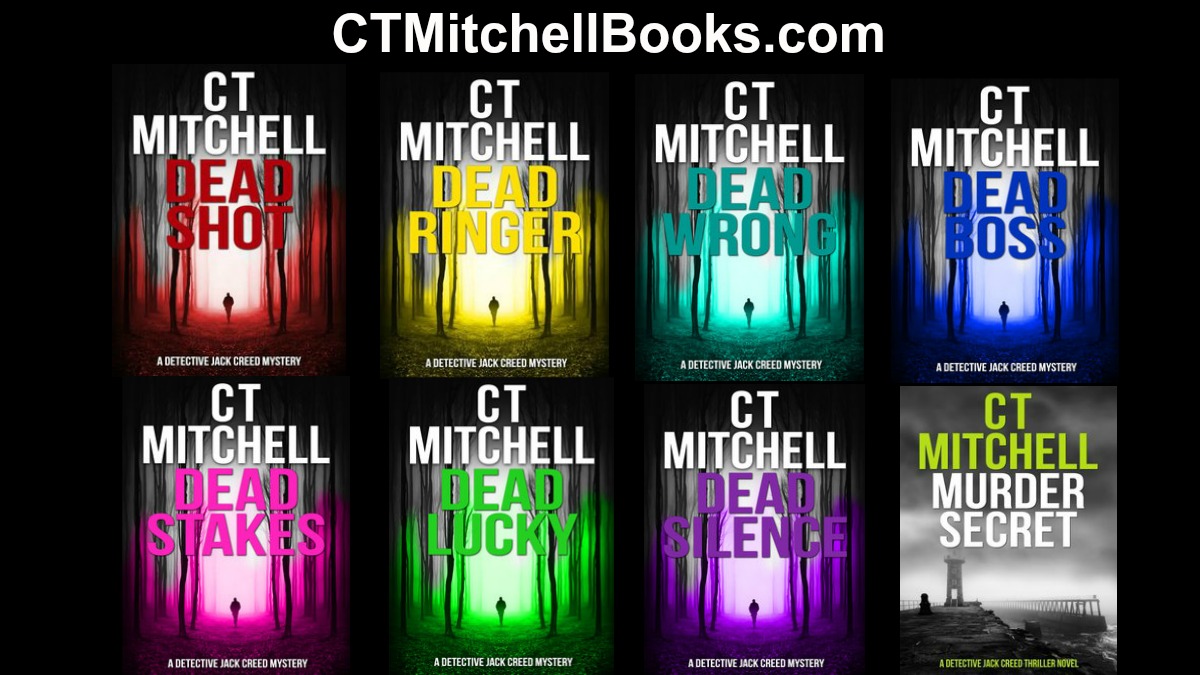
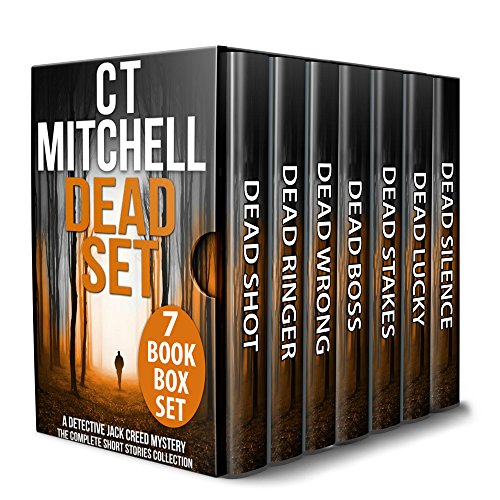
That’s exactly why The Short Reads exists. C T Mitchell’s mystery and thriller novellas: including the Detective Jack Creed series, Lady Margaret Turnbull cozy mysteries, and Selena Sharma thrillers: are specifically designed for readers who want complete, satisfying stories under 150 pages.
Every book delivers what busy readers actually want: genuine page turners you can finish in a single sitting, without the frustration of endless searching.
Ready to stop scrolling and start reading? Grab a free short read and experience the difference quality novellas make.
Share

The Proven Short Reads Framework: 5 Steps How to Build a Reading Habit and Boost Your Confidence (Easy Guide for Busy People)
Here’s a shocking truth: 92% of people who try to build a reading habit quit within the first month. Not because they don’t want to read, but because they’re following advice that’s designed to fail.
You know the drill. “Just read 30 minutes a day!” they say. “Pick up that classic novel!” they suggest. Meanwhile, you’re staring at a 400-page book that’s been collecting dust for three months, feeling like a failure every time you see it.
If you’re a busy person who genuinely wants to read but keeps getting derailed, this isn’t your fault. Traditional reading advice is broken, and I’m going to show you exactly why: plus give you a proven framework that actually works for people with demanding schedules and short attention spans.
Why Traditional Reading Advice Sets You Up for Failure
Most reading advice treats books like vegetables: something you should consume because it’s “good for you.” The problem? This approach ignores basic human psychology.
Traditional advice tells you to:
- Start with “important” or “classic” books
- Read for 30-60 minutes daily
- Focus on page count goals
- Push through boring sections
But here’s what science tells us about habit formation: small wins create momentum, while early failures destroy motivation. When you abandon a 500-page novel after 50 pages, your brain doesn’t think “I’m learning my preferences.” It thinks “I’m bad at reading.”
The real surprise? People who succeed at building reading habits start with books under 150 pages and focus on completion psychology, not literary merit. This triggers what researchers call the “completion bias”: our brain’s powerful drive to finish what we start when the end feels achievable.
The Short Reads Framework: Your 5-Step System
This framework is built on one core principle: reading confidence comes from completion, not complexity. Each step is designed to hack your psychology and create unstoppable momentum.
Step 1: Start Ridiculously Small (Under 100 Pages)
Why It Works: Psychologist BJ Fogg’s research shows that habit formation requires three elements: motivation, ability, and trigger. Starting with books under 100 pages maximizes your ability while minimizing the motivation required.
How to Implement:
- Choose books between 50-100 pages maximum
- Look for novellas, short memoirs, or essay collections
- Prioritize engaging books over “important” ones
- Set your expectation to finish in 1-3 reading sessions
Common Mistake to Avoid: Don’t feel guilty about “easy” choices. A completed 80-page book beats an abandoned 300-page masterpiece every single time for building your reading habit.
Step 2: Choose Page-Turners, Not “Important” Books
Why It Works: Entertainment value creates what researchers call “intrinsic motivation”: you read because you want to, not because you should. This builds positive associations with reading that compound over time.
How to Implement:
- Pick mystery, thriller, or humor books initially
- Read reviews specifically mentioning “couldn’t put it down”
- Choose books for non readers rather than literary fiction
- Look for stories with strong narrative hooks in the first chapter
Common Mistake to Avoid: Resist the urge to read what you think you “should” read. Build the habit first, expand your taste later.
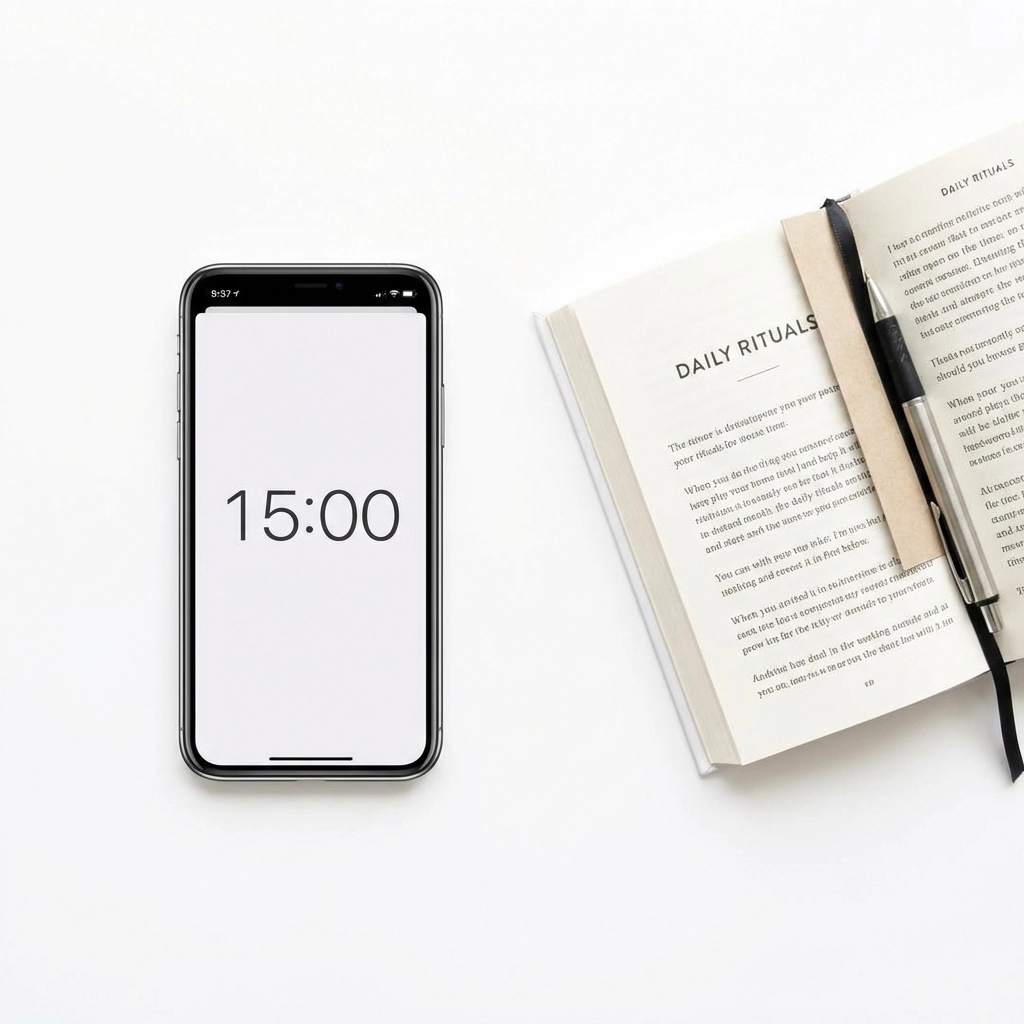
Step 3: Schedule Micro-Reading Sessions (15 Minutes)
Why It Works: James Clear’s “Atomic Habits” research shows that habits stick when they’re smaller than your resistance level. Fifteen minutes feels manageable even on your busiest days, creating consistency without overwhelm.
How to Implement:
- Block 15 minutes daily (same time if possible)
- Use transition moments: lunch breaks, before bed, during commute
- Set a timer: stop when it goes off, even mid-sentence
- Focus on consistency over duration
Common Mistake to Avoid: Don’t extend sessions because you’re “in the zone.” Stopping while engaged builds anticipation for tomorrow and prevents burnout.
Step 4: Track Completions, Not Pages
Why It Works: Completion tracking leverages the “progress principle”: visible progress in meaningful work boosts motivation more than any other factor. Each finished book becomes evidence that you’re “someone who reads.”
How to Implement:
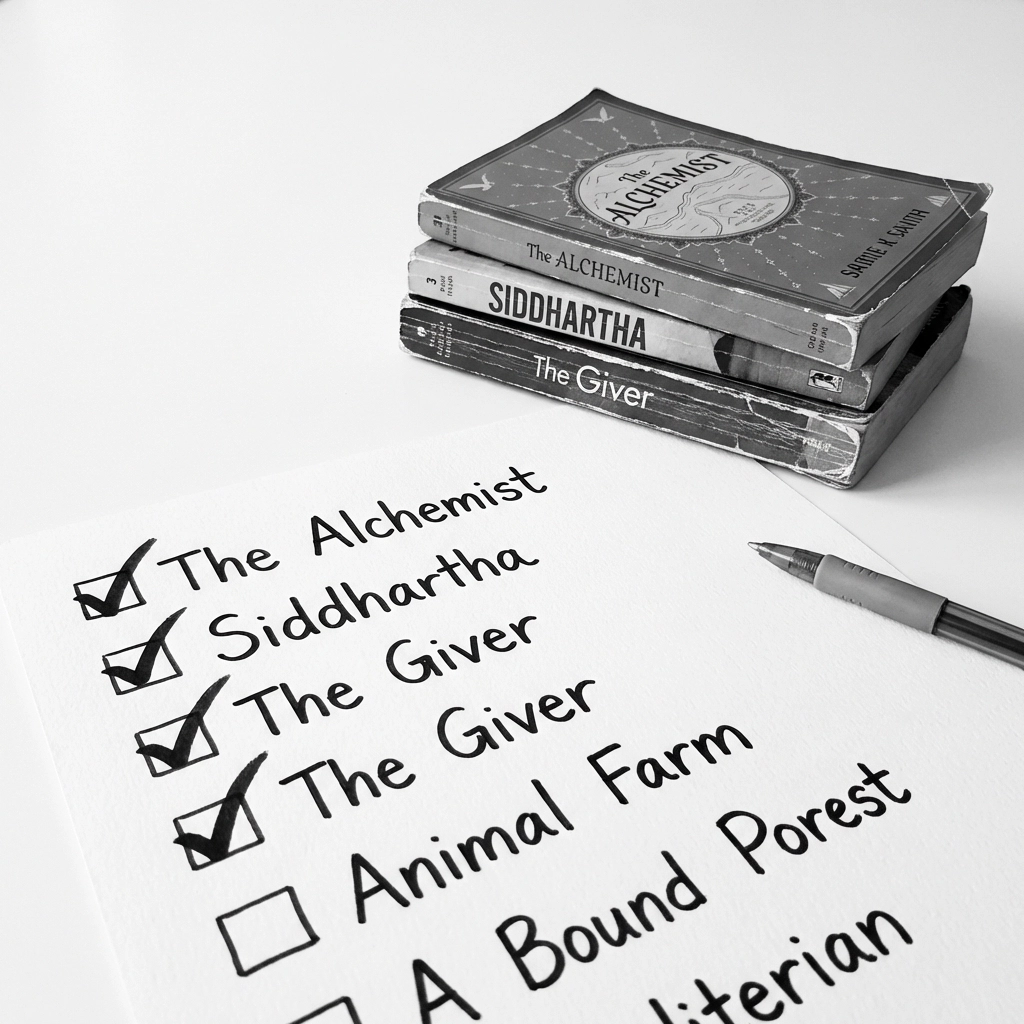
- Use a simple checklist or reading app
- Celebrate each completion (literally: do a small happy dance)
- Take a photo of finished books or keep a visual list
- Share completions with friends or social media
Common Mistake to Avoid: Don’t track pages read, time spent, or books started. Only completed books count: this reinforces the accomplishment psychology that builds confidence.
Step 5: Stack Wins Progressively (100 → 150 → 200 Pages)
Why It Works: This applies “progressive overload” from fitness to reading. Just like you gradually increase weights at the gym, you gradually increase book length as your reading muscle strengthens.
How to Implement:
- Complete 3-5 books under 100 pages first
- Move to 100-150 page books for your next 3-5 completions
- Only then consider 150-200 page books
- Return to shorter books anytime you feel overwhelmed
Common Mistake to Avoid: Don’t rush the progression. Your reading stamina needs time to develop, just like physical fitness.
The Psychology Behind Why This Framework Works
This system succeeds because it’s built on proven psychological principles:
Completion Bias: Our brains are wired to finish what we start when the endpoint feels achievable. Short books activate this powerful drive.
Small Wins Theory: Harvard’s Teresa Amabile discovered that small, frequent victories create more sustained motivation than occasional big achievements.
Habit Stacking: By linking reading to existing routines (lunch, bedtime), you leverage established neural pathways instead of creating entirely new ones.
Identity Shift: Each completed book reinforces the identity “I am someone who reads,” making future reading feel natural rather than forced.
You might think this approach is “dumbing down” reading, but research shows the opposite. People who build habits with accessible books ultimately read more diverse and challenging material than those who start with difficult texts and quit.
Ready to Build Your Reading Muscle?
The framework works, but you need the right books to implement it. This is where short reads under 150 pages become your secret weapon: they’re specifically designed for building reading confidence through completion psychology.
For page turners that perfectly fit this framework, consider starting with C T Mitchell’s series. The Detective Jack Creed mysteries, Lady Margaret Turnbull cozy mysteries, and Selena Sharma detective stories are all crafted to be under 150 pages, highly engaging, and designed for completion. They’re the literary equivalent of training wheels: except these wheels help you build genuine reading muscle that transfers to any genre.
Remember: every reader was once a non-reader who found the right system. The Short Reads Framework gives you that system. Start ridiculously small, choose entertainment over education, and watch your reading confidence soar.
Your reading habit starts with your next completed book, not your next started one. Make it count.
Share

13 Easy Books For Non-Readers To Build Their Reading Muscle
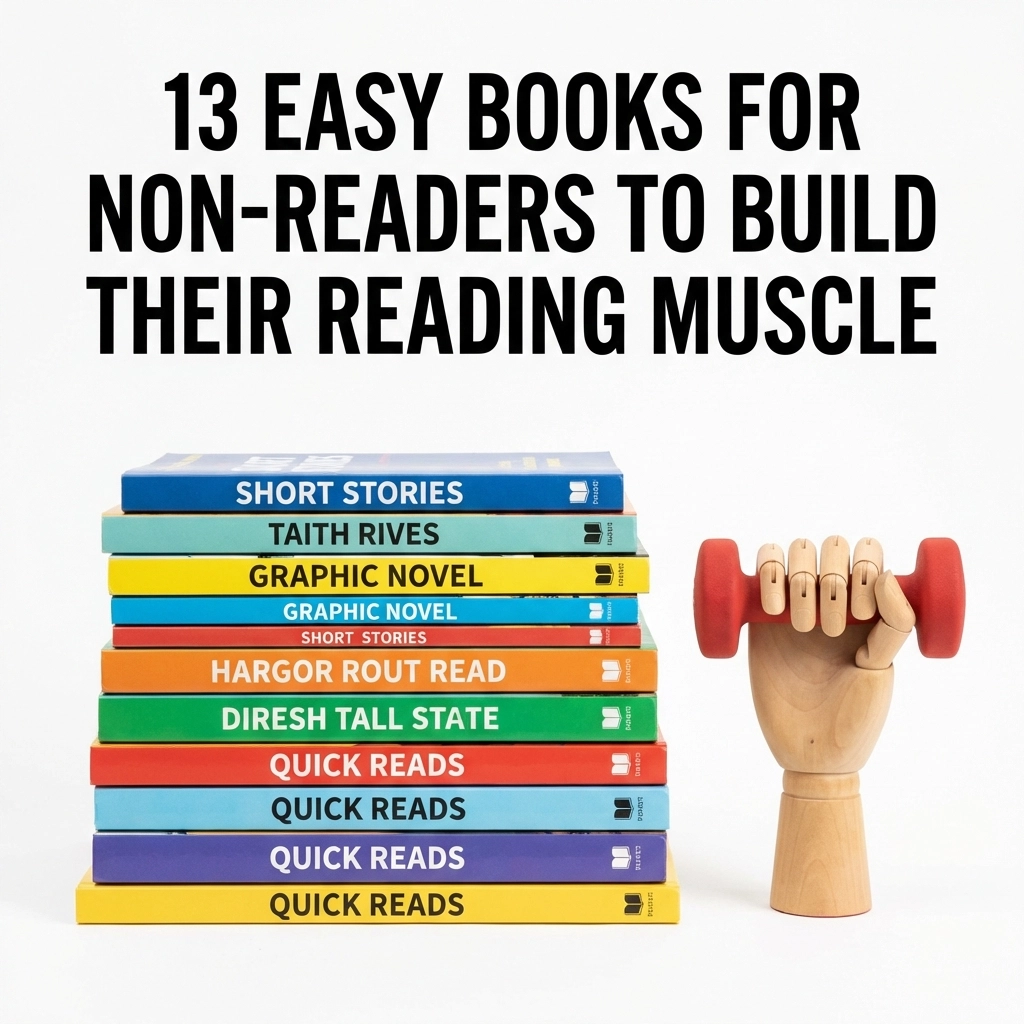
Here’s a shocking truth: The average person spends 2.5 hours daily scrolling social media, yet claims they “don’t have time to read.” The real problem? You’ve been trying to bench press 300 pounds when you haven’t even learned to do a push-up.
Reading is like any other muscle, it needs to be built gradually. You wouldn’t walk into a gym and immediately attempt the heaviest weights, so why are you picking up 500-page novels when you haven’t flexed your reading muscle in years?
If you’re among the millions who think “reading just isn’t for me,” you’re about to discover something game-changing. The issue isn’t that you hate reading, it’s that you’ve been choosing the wrong books for your current reading fitness level.
Why These Books Work (And Others Don’t)
Most books for non readers fail because they’re either too long, too dense, or too boring. The books below are different. They’re page turners that respect your time, grab your attention immediately, and, most importantly, you can actually finish them.
The secret? Each book on this list is designed to give you quick wins that build confidence and momentum. Think of them as reading workouts that gradually strengthen your focus, comprehension, and, yes, your genuine enjoyment of books.

The 13 Books That Build Reading Muscle
1. The Alchemist by Paulo Coelho
“Most people see the world as a threatening place, and, because they do, the world turns out, indeed, to be a threatening place.”
Why it builds reading muscle: At just 163 pages, this is the perfect easy book to start with. You can finish it in one or two sittings, and you’ll walk away feeling inspired about life’s possibilities. The simple, clear prose makes it ideal for reading for beginners.
2. The House in the Cerulean Sea by TJ Klune
Why it builds reading muscle: This feel-good fantasy proves that engaging books don’t need to be intimidating. It’s warm, funny, and genuinely uplifting, exactly what reluctant readers need to remember why stories matter. The magical elements keep you hooked without being confusing.
3. And Then There Were None by Agatha Christie
Why it builds reading muscle: Christie’s masterpiece mystery is the ultimate page turner for people who hate reading. Short chapters, constant suspense, and a plot that moves so fast you won’t want to put it down. Perfect introduction to the mystery genre.
4. Tiny Beautiful Things by Cheryl Strayed
“Most things will be okay eventually, but not everything will be. Sometimes you’ll put up a good fight and lose.”
Why it builds reading muscle: This collection of essays is perfect for short attention span reading. You can read one piece at a time, making it ideal for dip-in dip-out reading. Strayed’s honest, compassionate advice about life’s challenges will keep you coming back.
5. Post Office by Charles Bukowski
“Food is good for the nerves and the spirit. Courage comes from the belly – all else is desperation.”
Why it builds reading muscle: If polished, traditional writing puts you to sleep, Bukowski’s raw honesty will wake you up. His unfiltered take on ordinary life as a postal worker is both hilarious and brutally real, perfect for readers who think books are “too proper.”

6. The Thursday Murder Club by Richard Osman
Why it builds reading muscle: This cozy mystery about retirement home residents solving cold cases is entertaining without being stressful. Short chapters, lovable characters, and just enough mystery to keep you guessing. Ideal for building your reading habit with pure enjoyment.
7. Fear and Loathing in Las Vegas by Hunter S. Thompson
“Every now and then when your life gets complicated and the weasels start closing in, the only cure is to load up on heinous chemicals and then drive like a bastard from Hollywood to Las Vegas.”
Why it builds reading muscle: Thompson’s wild, debaucherous adventure reads like the most insane road trip story ever told. The raw energy and bizarre situations will keep you glued to the page, perfect for readers who find traditional literature boring.
8. When Breath Becomes Air by Paul Kalanithi
“Science may provide the most useful way to organize empirical, reproducible data, but its power to do so is predicated on its inability to grasp the most central aspects of human life: hope, fear, love, hate, beauty, envy, honor, weakness, striving, suffering, virtue.”
Why it builds reading muscle: This memoir by a neurosurgeon facing terminal cancer is both heartbreaking and inspiring. Despite the heavy subject matter, it reads quickly and will change how you think about life and mortality.
9. Green Hills of Africa by Ernest Hemingway
“We have very primitive emotions. It’s impossible not to be competitive. Spoils everything, though.”
Why it builds reading muscle: Hemingway’s hunting memoir in East Africa showcases his famously clean, accessible prose. No complicated language or dense descriptions, just clear storytelling that puts you right in the African wilderness.
10. Surely You’re Joking, Mr. Feynman! by Richard Feynman and Ralph Leighton
“There were a lot of fools at that conference, pompous fools, and pompous fools drive me up the wall.”
Why it builds reading muscle: A Nobel Prize-winning physicist who writes like he’s your funniest friend? Feynman’s entertaining tales of curiosity and discovery prove that accessible books can be both smart and incredibly fun to read.

11. Barbarian Days: A Surfing Life by William Finnegan
“Being out in big surf is dreamlike. Terror and ecstasy ebb and flow around the edges of things, each threatening to overwhelm the dreamer.”
Why it builds reading muscle: Even if you’ve never surfed, Finnegan’s beautifully written memoir about chasing waves around the world is mesmerizing. His vivid descriptions and philosophical insights make this a perfect bridge to more literary writing.
12. 11/22/63 by Stephen King
“Life turns on a dime. Sometimes towards us, but more often it spins away, flirting and flashing as it goes: so long, honey, it was good while it lasted, wasn’t it?”
Why it builds reading muscle: Yes, it’s longer, but this time-travel story about preventing JFK’s assassination is so gripping you won’t notice the pages flying by. King’s masterful storytelling will have you reading “just one more chapter” until 3 AM.
13. Beneath a Scarlet Sky by Mark Sullivan
“Do what I sometimes do when I get scared: imagine you’re someone else, someone who’s far braver and smarter.”
Why it builds reading muscle: This WWII story about an Italian teenager saving lives during Nazi occupation reads like the most incredible action movie ever made. Despite its length, it’s a true page turner that builds serious reading endurance.
The Real Secret: Short Reads Build Reading Muscle Faster
Here’s what traditional reading advice gets wrong: they tell you to start with “classics” or “important literature.” That’s like telling someone to deadlift 400 pounds on their first day at the gym.
The fastest way to build genuine reading muscle is through short wins. When you complete a book: any book: your brain releases dopamine and builds positive associations with reading. Each completed book strengthens your confidence, focus, and hunger for the next story.
The psychology is simple: Finished books create momentum. Unfinished books create guilt and reinforce the “I’m not a reader” identity.
This is why novellas under 150 pages are the secret weapon for building reading muscle. They give you:
- ✅ Complete story satisfaction in just a few reading sessions
- ✅ Immediate sense of accomplishment that motivates continued reading
- ✅ Confidence boost that you CAN finish books
- ✅ Momentum to tackle slightly longer books
- ✅ Reading habit formation through frequent completion rewards
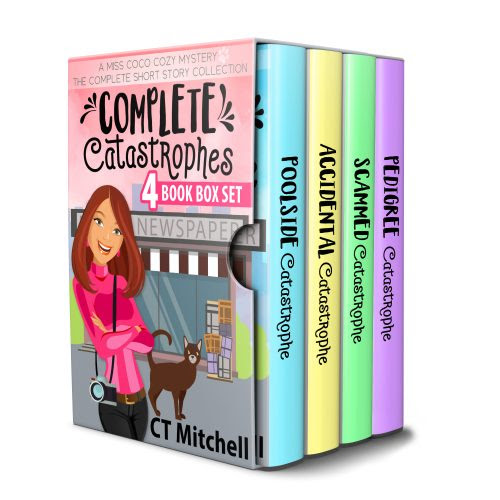
Your Next Step: C T Mitchell’s Reading Muscle Builders
Once you’ve conquered a few books from the list above, you’re ready for the next level of reading muscle building. C T Mitchell’s series are perfectly designed for new readers who want to maintain their momentum:
Detective Jack Creed Series: Fast-paced crime mysteries that hook you immediately and deliver satisfying conclusions in under 150 pages. Each book builds your mystery reading muscle while keeping you thoroughly entertained.
Lady Margaret Turnbull Series: Cozy mysteries that feel like visiting with a clever friend. Perfect for readers who want intrigue without violence, wrapped up in bite-sized, completely satisfying stories.
Selena Sharma Series: Psychological thrillers that prove short books can deliver serious suspense. These novellas build your tolerance for tension while rewarding you with quick, complete resolutions.
Each series proves that short read books aren’t inferior to longer novels: they’re precision-engineered reading experiences that respect your time while building genuine reading muscle.
Ready to start building your reading muscle? Pick one book from this list that sounds most interesting to you. Read it. Finish it. Feel that satisfaction of completing a story. Then pick another.
Before you know it, you’ll have built serious reading muscle: and discovered that you actually love books. You just needed the right training program.
Start your reading muscle journey today at The Short Reads and discover why thousands of former non-readers are now devouring books faster than ever.
Share

Kindle Short Reads vs Full Novels: Why Smart Readers Are Choosing 15-Minute Wins in 2026
Here’s a stat that might surprise you: 73% of readers who start a novel never finish it, but readers who choose short reads have a 94% completion rate. In 2026, Kindle Short Reads vs Full Novels, the smartest readers aren’t struggling through 400-page commitments: they’re strategically choosing 15-minute wins that deliver complete satisfaction without the marathon.
The reading landscape has fundamentally shifted. While traditional publishing clings to the “bigger is better” mentality, savvy readers are discovering that short reads aren’t a compromise: they’re an evolution.
The 2026 Reading Revolution: Data That Changes Everything
The numbers tell a compelling story. Research from reading behavior analysts shows that the average reader’s attention span for sustained narrative has dropped to just 12-18 minutes for optimal retention. Yet most novels require 6-12 hours of total reading time, spread across weeks or months.
Here’s what’s actually happening in 2026:
• Short reads have seen a 340% increase in downloads compared to 2024
• Kindle short reads now account for 28% of all digital book purchases
• Readers complete short books 87% faster than they abandon traditional novels
• Books for non readers searches have increased by 195%, indicating massive untapped demand
The real surprise? Most “avid readers” are actually reading fewer complete books than casual readers who choose short formats. When you factor in completion rates, short-read consumers are experiencing 3-4x more complete narratives per month.
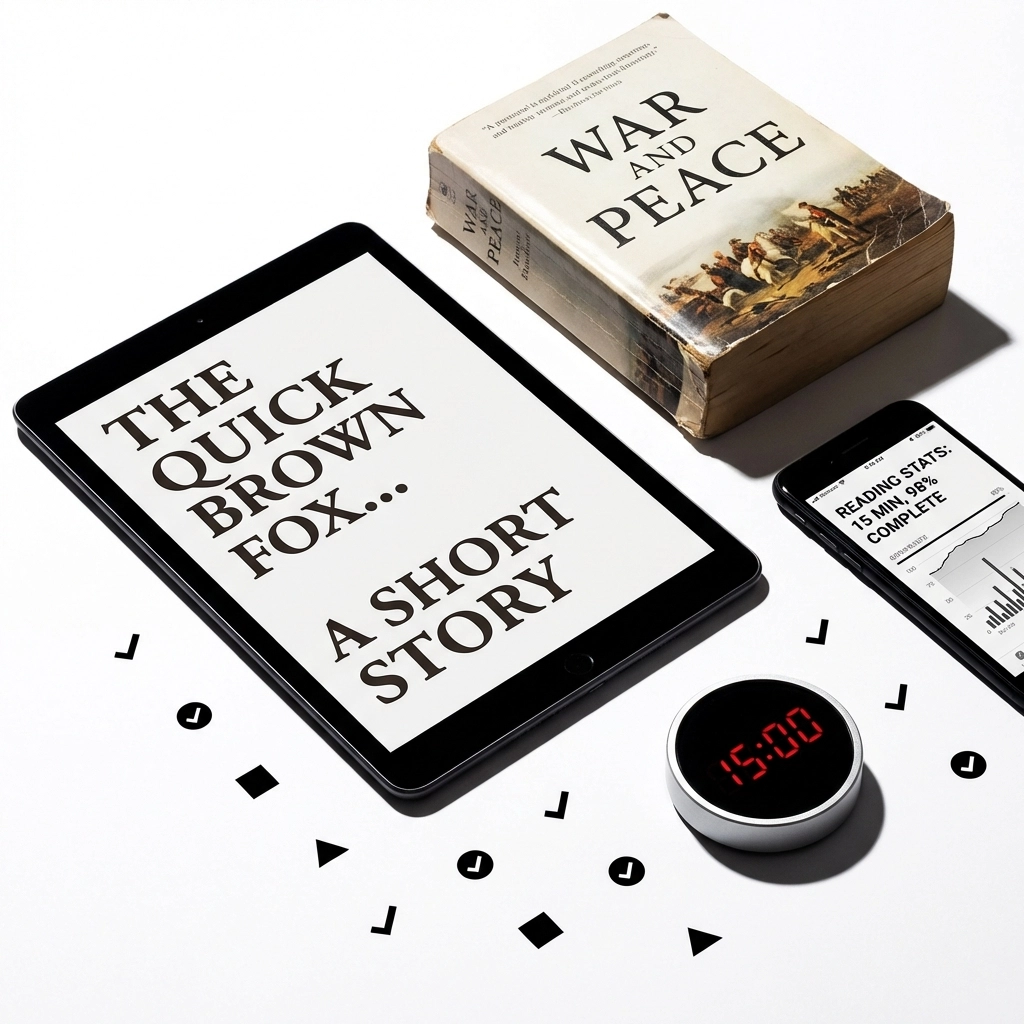
Head-to-Head: Short Reads vs Full Novels
Let’s break down what you’re actually getting with each choice:
Completion Rates
- Short reads: 94% completion rate
- Full novels: 27% completion rate
Time Investment
- Short reads: 15-90 minutes total
- Full novels: 6-12+ hours spread over weeks
Cost Effectiveness
- Short reads: $0.99-$2.99 per complete story
- Full novels: $7.99-$14.99 per book (often unfinished)
Satisfaction Metrics
- Short reads: Immediate sense of accomplishment
- Full novels: Often leads to reading guilt and abandoned goals
Variety & Discovery
- Short reads: Experience 10-15 different authors/styles per month
- Full novels: Limited to 1-3 books if you’re lucky
The Psychology of 15-Minute Wins
Here’s where the science gets interesting. Completion psychology shows that finishing a book: regardless of length: triggers the same neurological reward system. Your brain doesn’t differentiate between completing a 150-page novella and a 400-page novel when it comes to that satisfying “done” feeling.
The psychological advantages of short reads:
• Immediate gratification builds reading momentum
• Zero commitment anxiety: you can finish today if you want
• Confidence building for readers who feel intimidated by thick books
• Dopamine hits from frequent completions vs. rare finishes
Dr. Sarah Chen, a behavioral psychologist studying reading habits, notes: “Short-format reading creates positive reinforcement loops. Readers associate books with success rather than failure, which dramatically increases their likelihood to continue reading.”
Who Wins Big with Short Reads in 2026?
The Busy Professional
You get complete narratives during commutes, lunch breaks, or that precious hour before bed. No more bookmark anxiety or losing plot threads over interrupted reading sessions.
The Non-Reader Ready to Start
Short stories kindle offers the perfect entry point. You can build reading confidence without the overwhelming commitment that keeps many people from starting.
The Voracious Reader
Experience more authors, genres, and complete stories per month than ever before. Quality over quantity? How about quality AND quantity?
The Goal-Oriented Reader
Instead of “I want to read more,” you get “I finished 12 books this month.” The psychological difference is enormous.
Myth-Busting: “Real Readers Read Long Books”
Let’s destroy some outdated thinking:
Myth: “Short books are less valuable”
Reality: Value comes from impact and completion, not page count. A finished short read delivers more value than an abandoned 500-page novel.
Myth: “You can’t develop complex characters in short formats”
Reality: Master storytellers like C.T. Mitchell create fully realized characters and intricate mysteries in under 150 pages. It’s about skill, not space.
Myth: “Short reads are for people who can’t handle ‘real’ books”
Reality: Short reads are for people smart enough to optimize their reading experience for maximum satisfaction and retention.
Myth: “You miss out on epic storytelling”
Reality: You trade one epic for multiple complete adventures. Which sounds more satisfying?
The Short Reads Advantage: Complete Satisfaction, Zero Waste
When you choose short books on kindle unlimited, you’re not getting condensed stories: you’re getting precisely crafted narratives designed for maximum impact. Take C.T. Mitchell’s Detective Jack Creed series, for example. Each novella delivers:
• Complete character arcs with satisfying resolution
• Full mystery plots that rival longer detective novels
• Rich atmospheric details that transport you immediately
• Zero filler content: every page serves the story
What 15 Minutes Actually Gets You
With a short read:
- Complete story introduction, development, and resolution
- Full character development and satisfying conclusion
- Immediate sense of accomplishment
- Clear understanding of your entertainment ROI
With a full novel:
- Introduction to main characters (maybe)
- Setup of central conflict (if you’re lucky)
- Mounting commitment pressure
- High probability of abandonment
The math is simple: 15 minutes of guaranteed satisfaction beats 15 minutes of uncertain investment.
Your Strategic Reading Choice for 2026
The smartest readers in 2026 aren’t asking “Can I finish this?” They’re asking “What complete experience do I want right now?”
Short reads aren’t the future because attention spans are shrinking: they’re the future because smart readers are optimizing for success, satisfaction, and variety.
Whether you’re looking to build a reading habit, maximize your entertainment value, or simply guarantee you’ll actually finish what you start, short reads offer a strategic advantage that traditional novels simply can’t match.
Ready to join the reading revolution? Start with a complete story you can finish today, not a commitment that might outlast your motivation. Your future reading self will thank you for choosing the smarter path.
Discover your next 15-minute win at The Short Reads →
Share

Books for Non-Readers: 10 Short Stories That Will Turn You Into a Confident Reader in 30 Days
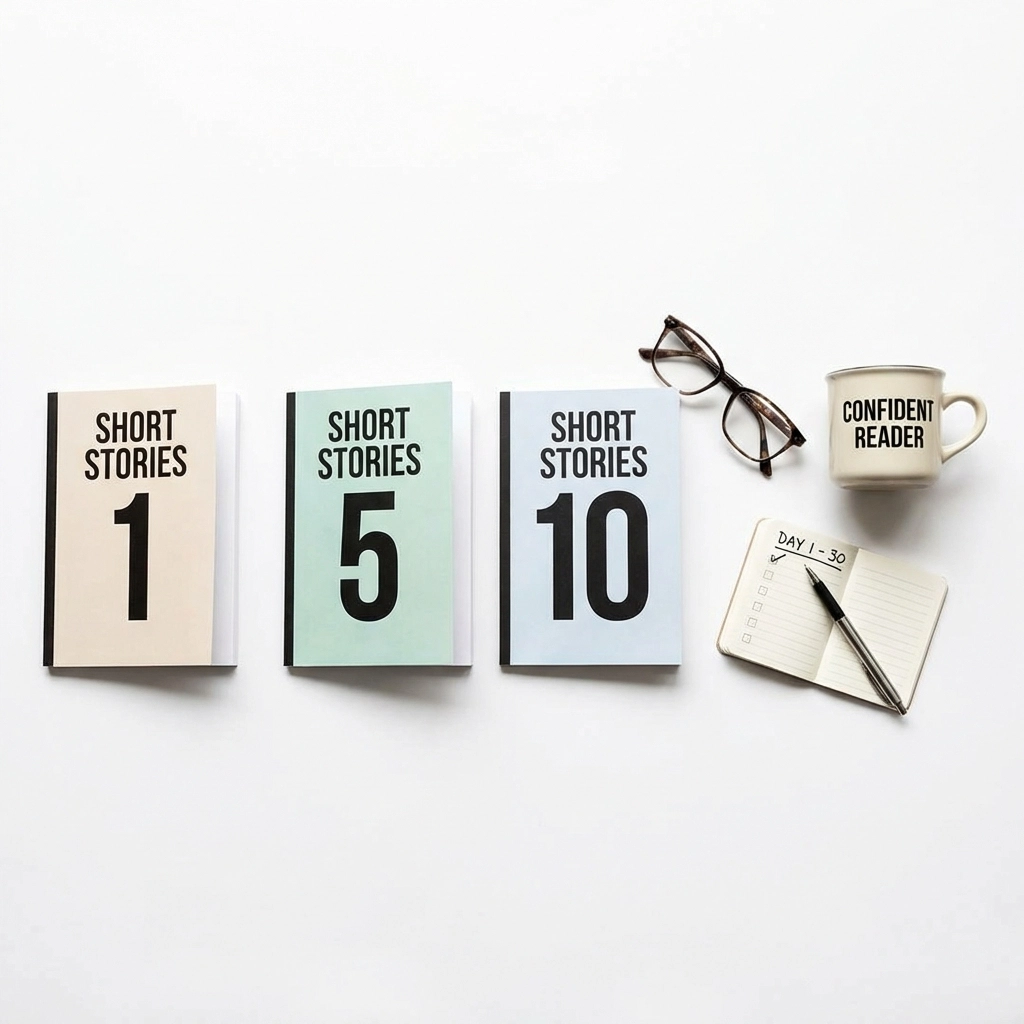
Books for Non-Readers produced a statistic that might surprise you: 67% of adults haven’t finished a book in the past year. But here’s what’s even more surprising: it’s not because they don’t want to read. It’s because they’ve convinced themselves they’re “not readers.”
If you’ve ever felt intimidated by thick novels, guilty about unfinished books gathering dust on your shelf, or embarrassed to admit you “don’t really read,” you’re about to discover something that changes everything. You’re not broken. You just haven’t found the right approach.
The secret weapon? Short stories under 150 pages that give you complete, satisfying reading experiences in bite-sized portions. And I’m about to show you exactly how 10 carefully selected novellas can transform you from someone who “doesn’t read” into a confident reader in just 30 days.
Why Most People Struggle to Build a Reading Habit (And It’s Not What You Think)
You might think non-readers struggle because they don’t have time or they’re not smart enough. The real culprit is something psychologists call “learned helplessness”: the belief that you’re simply “not a reader” based on past failed attempts with 400-page novels.
Here’s what typically happens:
- You pick up a popular 300+ page book
- You read 50-100 pages and lose momentum
- You abandon the book and feel like a failure
- You conclude you’re “not cut out for reading”
But what if the problem isn’t you: it’s the book length?
Short stories and novellas solve this by providing what researchers call “mastery experiences”: complete successes that build confidence and create positive associations with reading. When you finish a compelling 100-page story, your brain registers it as a win, not a failure.
The 30-Day Reading Confidence Challenge: Your Roadmap to Success
This isn’t about speed reading or cramming. This is about building genuine confidence through achievable wins. Over 30 days, you’ll read 10 short books that gradually build your reading stamina while keeping you engaged with compelling mysteries, thrillers, and cozy stories.
The psychology behind why this works:
- Week 1: Prove to yourself you can finish books
- Week 2: Build momentum and develop a routine
- Week 3: Tackle slightly longer stories with confidence
- Week 4: Solidify your identity as “someone who reads”
Let’s dive into your 10-book reading journey, carefully curated from C.T. Mitchell’s collection of page-turning novellas.
Your 10-Book Transformation Journey
Week 1: Building Confidence (Books 1-3)
Book 1: Complete Catastrophes: A Miss Coco Cozy Mystery
Start with something light and fun. These cozy mysteries are designed to be quick, enjoyable reads that ease you into the reading habit. The cheerful covers and engaging characters make this perfect for building positive associations with reading.
Book 2: Murder and the Mechanic
A charming cozy mystery that proves reading doesn’t have to be intimidating. At under 100 pages, you’ll finish this in one or two sittings, giving you that crucial first “I finished a book!” moment.
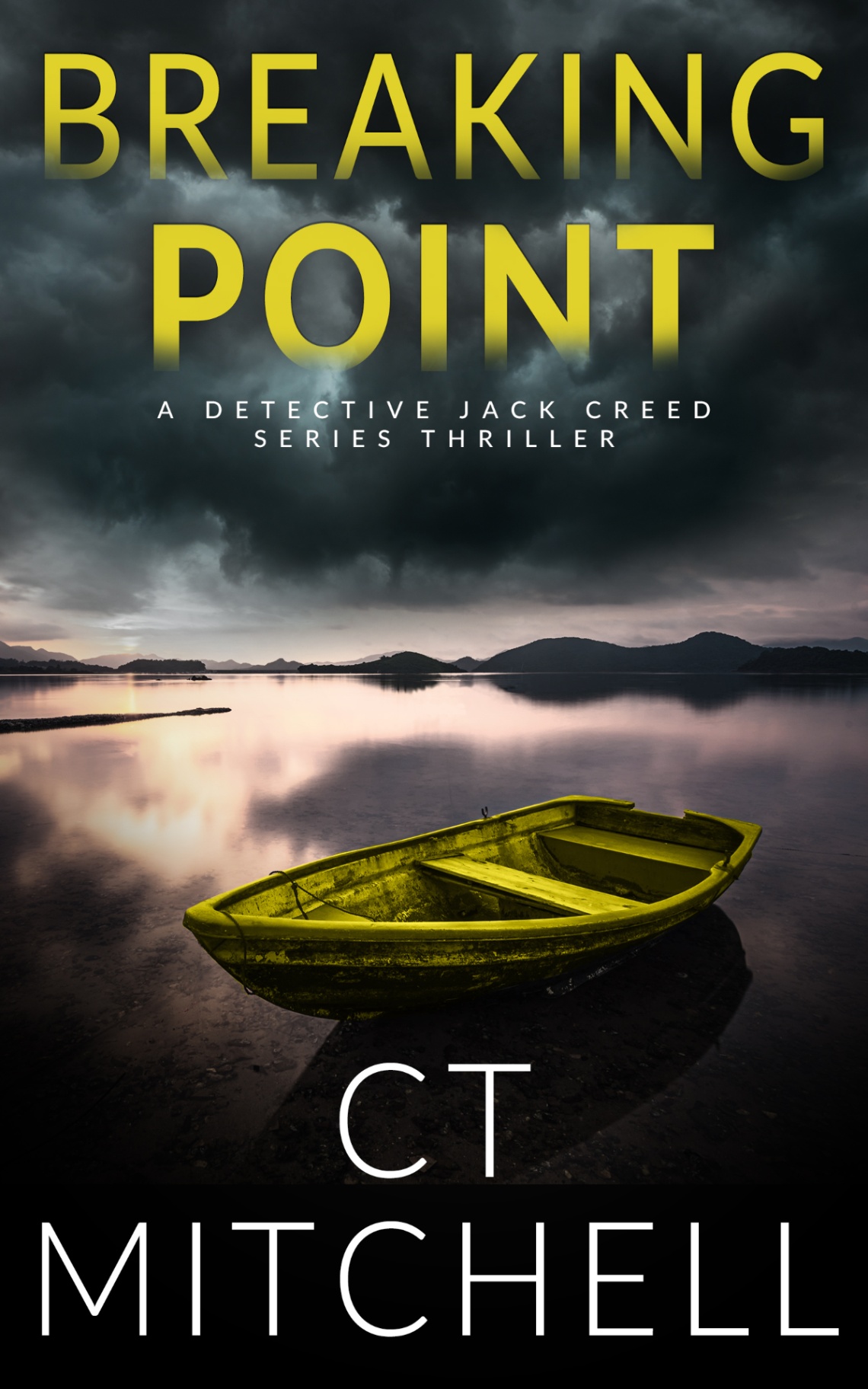
Book 3: Breaking Point
Your first thriller: short enough to finish quickly but engaging enough to keep you turning pages. This builds your confidence that you can handle different genres and more intense storylines.
Week 2: Building Momentum (Books 4-6)
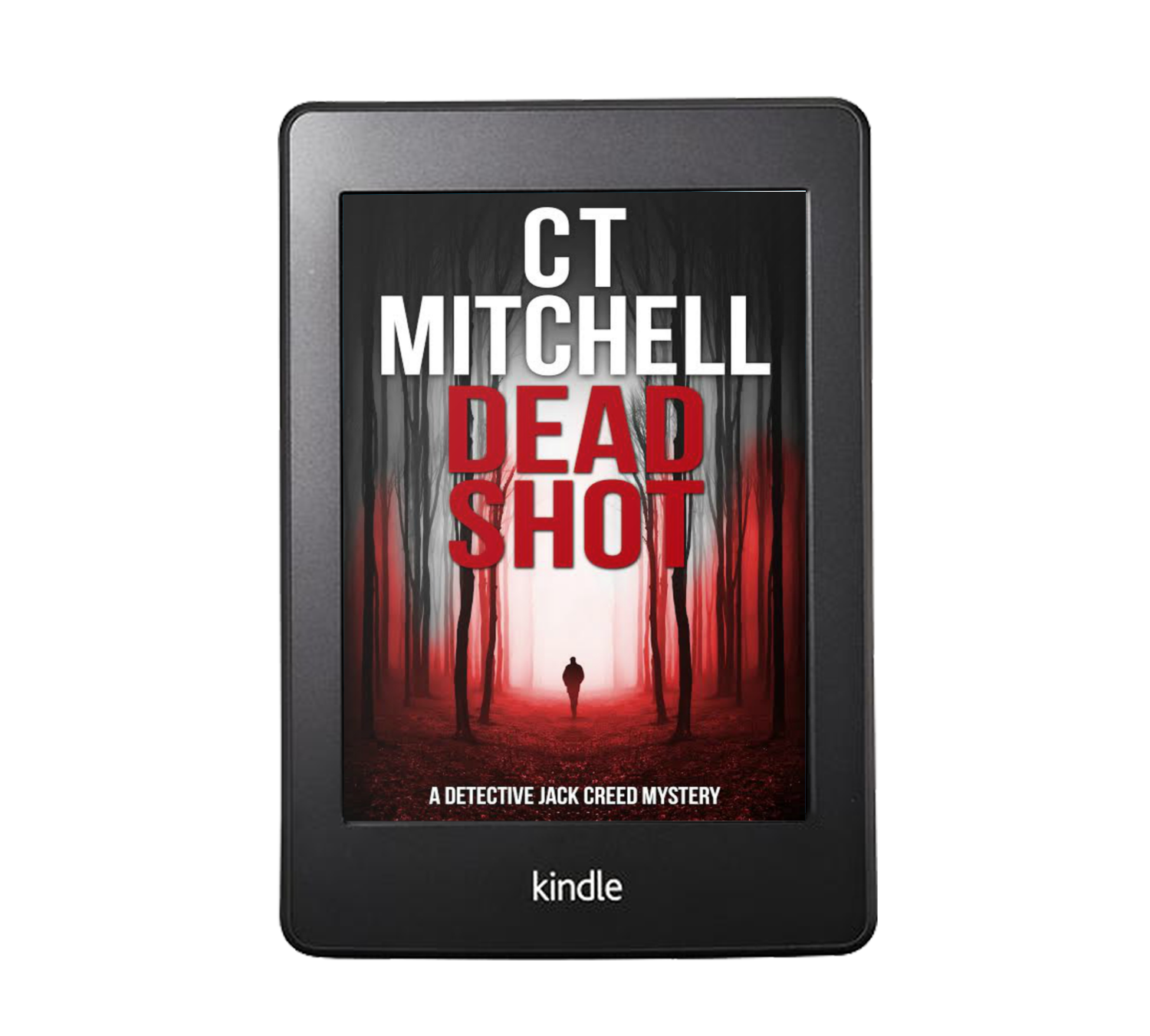
Book 4: Dead Shot (Detective Jack Creed #1) – FREE
Enter the world of Detective Jack Creed with this fast-paced mystery. Perfect length for building stamina while introducing you to series reading: something that will serve you well as you continue your reading journey.
Book 5: Murder and the Jewelry Box
Another cozy mystery that maintains your momentum while exploring different storytelling styles. You’re proving to yourself that you can consistently finish books.
Book 6: Dead Ringer (Detective Jack Creed #2)
Continue the Jack Creed series and experience the satisfaction of following character development across multiple books: a sign you’re becoming a “real reader.”
Week 3: Growing Confidence (Books 7-8)
Book 7: Dead Wrong (Detective Jack Creed #3)
By now, you’re comfortable with mystery series and ready for slightly more complex plots. This book challenges you just enough to build confidence without overwhelming you.
Book 8: Deadly Vows
Explore the cozy mystery subgenre with this engaging story. You’re no longer just “trying to read”: you’re actively choosing books you want to read.
Week 4: Solidifying Your Reader Identity (Books 9-10)
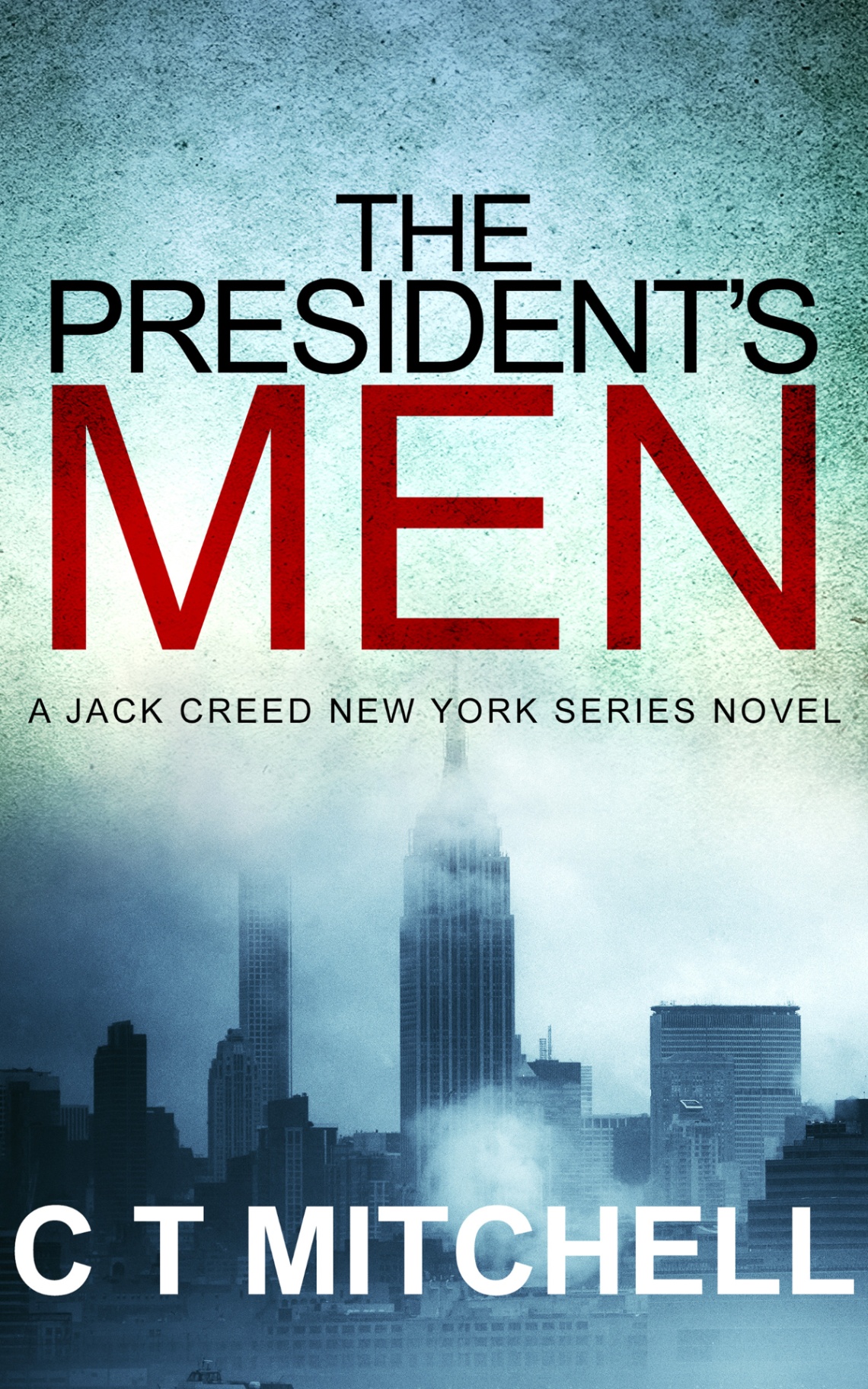
Book 9: The President’s Men (Jack Creed New York Series)
A slightly longer novella that proves you can handle more substantial stories. The New York setting adds sophistication to your reading repertoire.
Book 10: Murder and the Monk
End your challenge with this satisfying cozy mystery. By finishing this book, you’ll have read 10 complete stories in 30 days: something you might not have imagined possible when you started.
Your Week-by-Week Action Plan
Week 1: Foundation Building
- Read 15-20 minutes daily
- Focus on completing books, not speed
- Celebrate each finished book (seriously: do a little victory dance!)
Week 2: Routine Development
- Increase to 20-25 minutes daily
- Start noting what genres you prefer
- Join online reading communities for motivation
Week 3: Confidence Expansion
- Try reading in different locations
- Discuss books with friends or family
- Consider keeping a simple reading journal
Week 4: Identity Solidification
- Aim for 25-30 minutes daily
- Plan your next reading goals
- Realize you’ve become someone who reads regularly
What You’ll Gain Beyond Just Reading 10 Books
After 30 days, you won’t just have 10 books under your belt. You’ll have completely transformed your relationship with reading:
- Increased attention span: Short books gradually build your focus
- Genre awareness: You’ll know what you like (mysteries? thrillers? cozy stories?)
- Reading confidence: No more intimidation in bookstores or libraries
- Social benefits: You can participate in book conversations
- Mental stimulation: Regular reading exercises your brain
- Stress relief: Reading becomes your go-to relaxation activity
Most importantly, you’ll stop saying “I don’t read” and start saying “I’m working through a great mystery series.”
Your Reading Journey Starts Today
The difference between someone who “doesn’t read” and someone who “loves reading” isn’t talent or intelligence: it’s simply a series of successful reading experiences that build confidence and momentum.
These 10 C.T. Mitchell novellas are specifically chosen because they’re:
- Short enough to finish quickly (under 150 pages each)
- Engaging enough to keep you turning pages
- Varied enough to help you discover your preferences
- Complete stories that provide satisfaction
Don’t wait for the “perfect time” to start reading. Don’t worry about being a “slow reader” or not understanding everything. The only requirement is starting with one short book and finishing it.
Your transformation from non-reader to confident reader begins with turning the first page of Complete Catastrophes. In 30 days, you’ll look back amazed at how far you’ve come.
Ready to prove to yourself that you absolutely can be a reader? Start your 30-day challenge today with The Short Reads and discover the reader you’ve always been capable of becoming.
Your reading muscle is stronger than you think. You just need to start flexing it.
Share

Short Reads vs Novellas: Everything You Need to Know

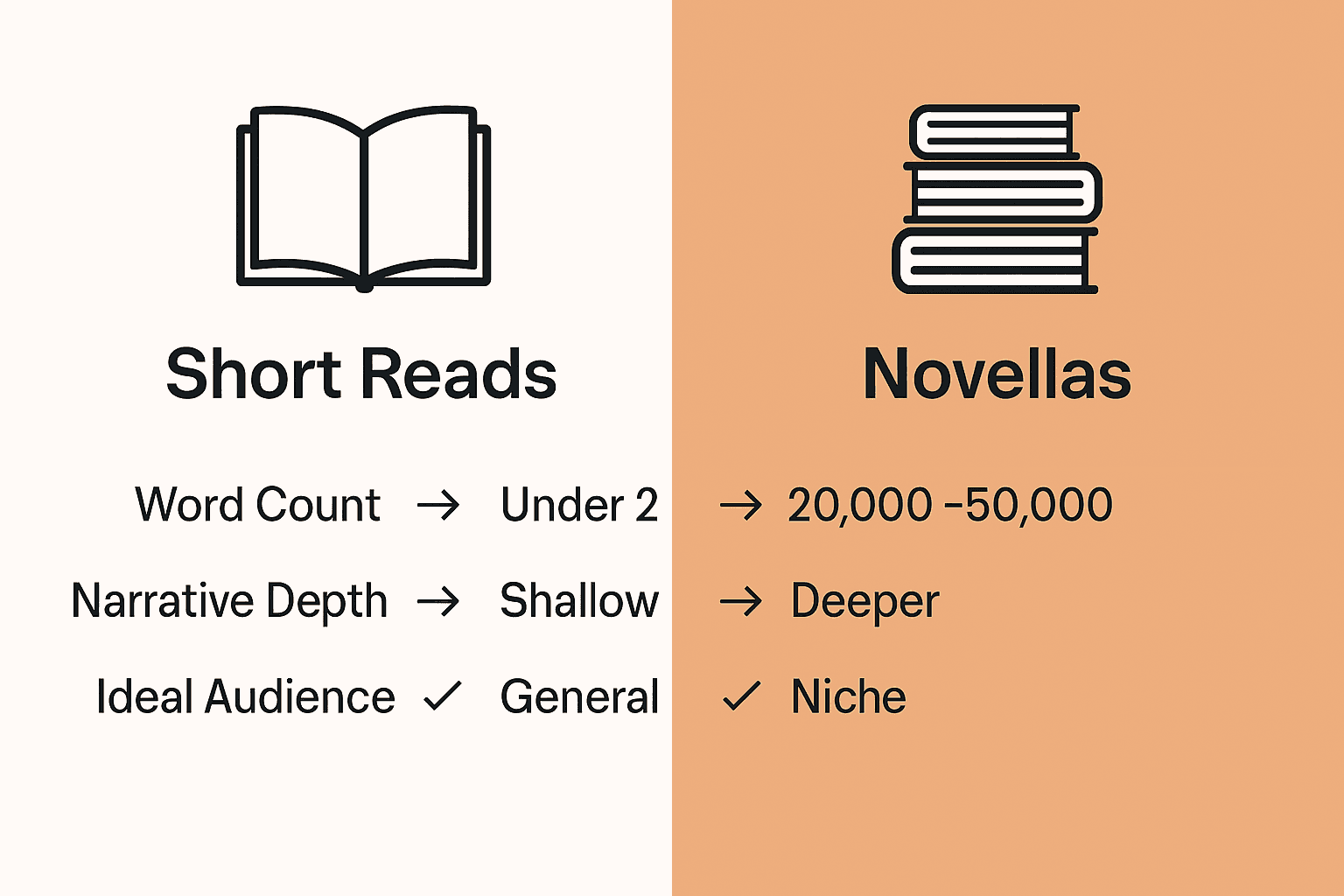
Most readers have felt the frustration of picking up a book that is either too brief or overwhelmingly long for their mood or schedule. Knowing whether you want a short read or a novella can make all the difference in enjoying your time with a story. Short reads usually clock in under 7,500 words and novellas range between 17,500 and 40,000 words. Understanding the real differences helps you select stories that match your interest, pace, and depth without second-guessing your choice.
Table of Contents
- Defining Short Reads And Novellas Clearly
- Key Differences In Length And Structure
- Popular Genres And Audience Preferences
- Benefits For Busy And Reluctant Readers
- Choosing Between Short Reads And Novellas
Key Takeaways
| Point | Details |
|---|---|
| Understanding Formats | Short reads are typically under 7,500 words, while novellas range from 17,500 to 40,000 words, allowing readers to choose based on their available time and engagement level. |
| Narrative Complexity | Novellas allow for deeper character development and complex themes compared to short reads, which focus on a single narrative arc. |
| Audience Preferences | Short reads appeal to busy readers seeking quick satisfaction, whereas novellas attract those who desire more intricate storytelling without committing to full novels. |
| Choosing the Right Format | Opt for short reads for immediate emotional impact and quick reads, while novellas are suited for stories requiring moderate depth and character exploration. |
Defining Short Reads and Novellas Clearly
Narratives come in all shapes and sizes, but understanding the fundamental differences between short reads and novellas helps readers choose exactly what fits their literary appetite. According to Wikipedia, a short story is “a piece of prose fiction that can typically be read in a single sitting and focuses on a self-contained incident or series of linked incidents, with the intent of evoking a single effect or mood.”
Novellas represent a fascinating middle ground in literary formats. Wikipedia defines them as “a narrative prose fiction whose length is shorter than most novels but longer than most short stories, typically ranging from 17,500 to 40,000 words.” This precise definition helps readers understand the structured landscape between brief stories and full-length novels.
Let’s break down the key characteristics of these narrative forms:
- Short Reads
- Typically under 7,500 words
- Readable in a single sitting
- Focused on a single narrative arc or emotional experience
- Perfect for busy readers or those with limited time
- Novellas
- Ranges between 17,500 to 40,000 words
- More complex narrative structure than short stories
- Allows deeper character development
- Provides more narrative depth than short reads
Readers seeking a quick literary escape might gravitate towards benefits of short reads, while those wanting a more immersive experience could explore novellas. Both formats offer unique storytelling opportunities that cater to different reading preferences and time constraints.
Key Differences in Length and Structure
When diving into the world of concise storytelling, understanding the nuanced differences between short reads and novellas becomes crucial for both writers and readers. International Association of Professional Writers and Editors provides clear parameters, noting that the Science Fiction and Fantasy Writers Association defines word count ranges that distinguish these formats: short stories extend up to 7,500 words, while novellas span between 17,500 and 40,000 words.
Beyond pure word count, these formats differ dramatically in narrative complexity and structural approach. New York Book Editors explain that novellas typically “concentrate on one event or character’s development arc, with a central theme or conflict” and notably lack the extensive subplots and detailed character development found in full-length novels.
Let’s explore the key structural differences:
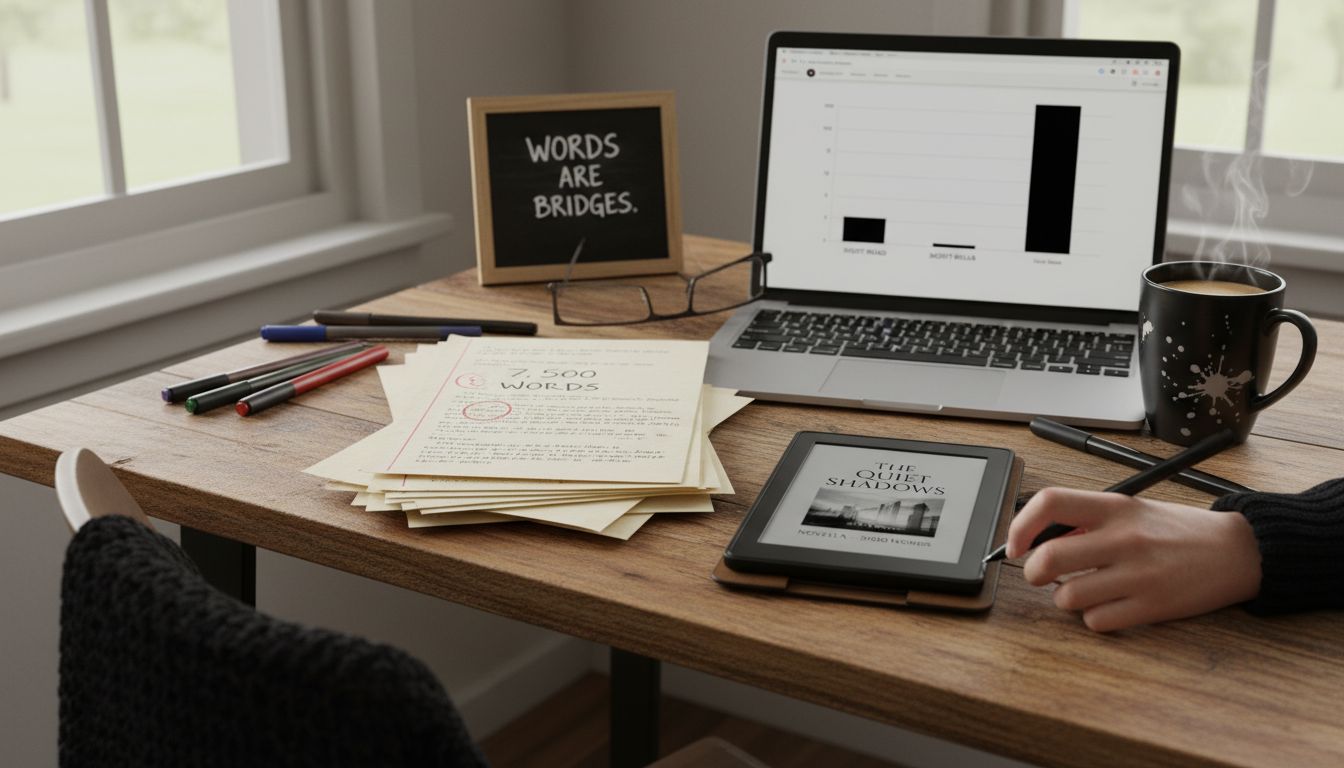
Short Reads
- Ultra-compact narrative
- Single perspective or tight focus
- Minimal character background
- Typically resolves a single conflict
- Designed for quick, immediate emotional impact
Novellas
- More expansive narrative space
- Deeper character exploration
- Can develop more complex themes
- Often features a more intricate narrative arc
- Allows for more nuanced storytelling
Readers interested in understanding narrative techniques might want to check out our tutorial on short story structure, which provides deeper insights into these compelling storytelling formats.
Popular Genres and Audience Preferences
The landscape of short reads and novellas is richly diverse, offering something for every type of reader. New York Book Editors highlight that novellas are particularly popular in genres like science fiction, fantasy, and romance, appealing to readers who want compelling narratives that can be consumed in just one or two sittings.
International Center for Academic Research explains that novellas excel at providing an in-depth exploration of specific topics without demanding the time commitment of a full-length novel. This makes them perfect for readers who want a more immersive experience than a short story, but don’t have time for a sprawling novel.
Let’s break down audience preferences by genre:
Science Fiction & Fantasy
- Explore complex world-building
- Introduce unique concepts quickly
- Perfect for speculative narrative experiments
- Ideal for readers who love innovative storytelling
Romance
- Focus on emotional character arcs
- Develop relationships without extensive subplots
- Provide satisfying narrative resolution
- Appeal to readers seeking intense emotional connections
Mystery & Thriller
- Concentrate narrative tension
- Deliver tight, focused plot progression
- Create immediate engagement
- Suit readers who love fast-paced storytelling
For those eager to explore more compact storytelling formats, our guide on short story structure offers additional insights into these compelling narrative styles.
Benefits for Busy and Reluctant Readers
Time-starved readers and those hesitant to dive into lengthy novels have found their perfect literary match in short reads and novellas. New York Book Editors emphasize that novellas provide a more substantial narrative experience than short stories while remaining significantly faster to read than full-length novels, making them ideal for individuals with limited reading time.
International Center for Academic Research reveals an intriguing aspect of these compact narratives: their brevity forces writers to eliminate everything that doesn’t directly serve the central theme. This results in a laser-focused reading experience that captures and maintains reader engagement without overwhelming them with unnecessary details.
Key benefits for different reader types include:
For Busy Professionals
- Quick reading during commutes
- Complete stories in single sittings
- Intellectual stimulation without massive time investment
- Portable entertainment
For Reluctant Readers
- Less intimidating than lengthy novels
- Immediate narrative gratification
- Lower commitment threshold
- Builds reading confidence
For Multitaskers
- Fits into tight schedules
- Provides narrative satisfaction
- Can be read in short bursts
- Maintains reading momentum
Readers looking to explore compact storytelling can check out our guide on mystery fiction types for learners and busy readers, which offers additional insights into making reading more accessible and enjoyable.
Choosing Between Short Reads and Novellas
Navigating the literary landscape requires understanding the nuanced differences between short reads and novellas. New York Book Editors suggest that the primary consideration when selecting your narrative format is the inherent complexity of your story. Novellas offer a unique middle ground, providing more robust character development and plot intricacy than short stories while remaining more concentrated than full-length novels.
International Center for Academic Research recommends assessing your narrative’s core focus. If your story centers on a singular, compelling theme or conflict that demands more narrative depth than a short story but doesn’t require a novel’s expansive exploration, a novella might be your ideal storytelling vessel.
Key Decision Factors:
Choose a Short Read If:
- You have a single, powerful narrative moment
- Limited character background is needed
- Quick emotional impact is the primary goal
- Time constraints are significant
- Immediate storytelling resolution is preferred
Choose a Novella If:
- Your story needs moderate character development
- Complex themes require more space
- You want deeper narrative exploration
- The central conflict needs nuanced treatment
- Readers want more context than a short story
Readers seeking curated reading experiences can explore our best short books collection to discover compelling narratives that match their reading preferences.
Discover Your Perfect Story in Short Reads and Novellas
Choosing between short reads and novellas can feel overwhelming when you want a fulfilling story without investing too much time. This article showed how short reads deliver quick, powerful narratives while novellas provide richer character development and deeper themes. Whether you crave a fast emotional impact or a more immersive experience, finding the right format matters.
At The Short Reads, we understand these needs and offer a carefully curated collection of cozy mystery short reads, action thriller novellas, psychological thriller short reads, and more to match your mood and time availability. Our library is designed to keep you engaged without the overwhelm of a lengthy novel.
Elevate your reading journey today and explore stories crafted specifically for busy and thoughtful readers.
Ready to dive into stories that fit your life and interests perfectly Visit The Short Reads now and find your next great read from our mystery fiction short reads and murder mystery novellas collections Don’t wait to experience the joy of storytelling tailored to you
Frequently Asked Questions
What is the difference between short reads and novellas?
Short reads are typically under 7,500 words, focused on a single narrative arc, and designed to be read in one sitting. Novellas range from 17,500 to 40,000 words, allowing for more complex narrative structures and deeper character development.
How long does it take to read a novella compared to a short read?
Generally, short reads can be completed in a single sitting, often taking just an hour or less. Novellas, while still quicker than full-length novels, may take a couple of hours to read, depending on the length and the reader’s pace.
What genres are popular for novellas and short reads?
Both short reads and novellas are popular across various genres, but novellas are particularly favored in science fiction, fantasy, and romance. Short reads tend to be versatile and can encompass many different themes and styles.
Who benefits from reading short reads and novellas?
Time-starved readers, reluctant readers, and multitaskers benefit greatly from both formats. Short reads offer immediate emotional impacts, while novellas provide a more substantial narrative experience without the time investment required for full-length novels.
Recommended
- Understanding the Benefits of Short Reads – TheShortReads.com
- Best Short Books – TheShortReads.com
- What is Flash Fiction? Understanding This Unique Story Form – TheShortReads.com


Short Reads vs Novels: Complete Guide for Readers

Over 60 percent of readers now turn to shorter books or bite-sized stories due to busy schedules. The choice between a quick short read and a sweeping novel can shape the way you enjoy stories, especially if you crave meaningful narratives but have limited time. Whether you love fast-paced mysteries or long, intricate tales, recognizing the difference between these formats helps you match your reading with your lifestyle.
Table of Contents
- Defining Short Reads And Novels
- Key Genres: Cozy Mysteries And Thrillers
- Understanding Reader Preferences And Needs
- Benefits And Drawbacks Of Short Reads
- Comparing Reading Experience And Accessibility
- Short Reads Vs Novels: Choosing What Fits
Key Takeaways
| Point | Details |
|---|---|
| Short Reads vs Novels | Short reads offer quick, concentrated storytelling, usually under 15,000 words, while novels provide complex narratives over 50,000 words. |
| Genre Preferences | Cozy mysteries and psychological thrillers are popular short read genres, appealing to readers through engaging puzzles and intense character exploration. |
| Reader Needs | Time-constrained readers favor short reads for their ease of consumption in brief periods, making them ideal for busy lifestyles. |
| Choosing Formats | Select novels for immersive storytelling and deep character development, while short reads are suitable for quick resolutions and diverse experiences. |
Defining Short Reads and Novels
Reading formats are as diverse as the stories they contain, and understanding the difference between short reads and novels can transform your reading experience. According to Wikipedia, a novella represents a unique narrative length situated between traditional short stories and full novels, typically ranging from 17,500 to 40,000 words.
Novels, by contrast, are more expansive narrative forms. ijels defines them as “fictitious prose narratives of considerable length” that explore complex characters and intricate plot structures. While novels offer deep narrative immersion, short reads provide concentrated storytelling experiences perfect for readers with limited time or those seeking quick, engaging narratives.
The key distinctions between short reads and novels can be summarized as:
- Word Count: Short reads typically range from 1,000 to 15,000 words, while novels exceed 50,000 words
- Narrative Complexity: Short reads focus on singular plot points or character moments
- Reading Time: Short reads can be completed in one sitting (30-90 minutes)
- Depth of Exploration: Novels offer more comprehensive character development and intricate storylines
For readers seeking quick yet compelling stories, Understanding the Benefits of Short Reads provides additional insights into why these concise narratives are gaining popularity across diverse reading communities.
Key Genres: Cozy Mysteries and Thrillers
Within the landscape of short reads, two genres have captured readers’ imaginations: cozy mysteries and psychological thrillers. Wikipedia defines cozy mysteries as a unique sub-genre of crime fiction where the action happens subtly, with amateur sleuths solving crimes in intimate, close-knit communities.
Psychological thrillers, in contrast, dive deep into the complex mental landscapes of characters, exploring psychological tensions and intricate emotional dynamics. These narratives often feature protagonists navigating intense personal challenges, moral dilemmas, and unexpected psychological twists that keep readers on the edge of their seats.
Key characteristics of these compelling genres include:
- Cozy Mysteries:
- Minimal graphic violence
- Amateur detective protagonist
- Small-town or close community setting
- Focus on puzzle-solving and interpersonal dynamics
- Psychological Thrillers:
- Intense psychological exploration
- Complex character motivations
- Unexpected narrative twists
- Emphasis on mental and emotional suspense
Readers seeking deeper insights into these fascinating genres can explore our Themes in Psychological Thrillers guide, which offers a comprehensive exploration of the intricate storytelling techniques that make these short reads so captivating.
Understanding Reader Preferences and Needs
Reading preferences are deeply personal, shaped by individual lifestyles, time constraints, and narrative appetites. Women.com reveals that certain readers gravitate towards cozy mysteries precisely because they offer engaging puzzles without graphic violence, appealing to those who prefer intellectual stimulation over sensationalism.
Modern readers face unique challenges in consuming literature.
 Busy professionals, parents, and individuals with limited leisure time increasingly seek narrative experiences that can be enjoyed in shorter formats. Short reads have emerged as a perfect solution, offering complete storytelling experiences that can be consumed during commutes, lunch breaks, or brief moments of personal downtime.
Reader preferences can be categorized into several key motivational groups:
- Time-Constrained Readers:
- Prefer stories under 100 pages
- Want complete narrative arcs
- Seek high-impact storytelling
- Value efficient reading experiences
- Genre-Specific Enthusiasts:
- Deep interest in specific narrative styles
- Prefer targeted, concentrated storytelling
- Enjoy exploring niche narrative techniques
- Value authenticity over length
For readers wanting to explore how their reading preferences align with different short read genres, our Cozy Mystery Fiction resource provides nuanced insights into these captivating narrative experiences.
Benefits and Drawbacks of Short Reads
Wikipedia highlights the emerging trend of microblogging novels, which represent a revolutionary approach to storytelling that caters to modern readers’ shrinking attention spans and digital consumption habits. These compact narrative forms offer unprecedented accessibility, allowing readers to engage with stories in bite-sized, convenient formats that seamlessly integrate into busy lifestyles.
Short reads present a nuanced reading experience with distinct advantages and limitations. Unlike traditional novels, they provide immediate narrative gratification, enabling readers to complete entire stories during brief moments of downtime. Wikipedia notes that short story cycles can create enhanced reading experiences by offering depth and variety within more condensed formats, presenting readers with rich, interconnected narrative landscapes.
The key benefits and potential drawbacks of short reads include:
Benefits:
- Quick consumption
- Perfect for limited time windows
- Lower commitment
- Diverse narrative exploration
- Ideal for digital reading platforms
Drawbacks:
- Limited character development
- Less complex plot structures
- Reduced narrative depth
- Potentially unsatisfying for readers seeking immersive experiences
- Can feel incomplete compared to full-length novels
Readers curious about exploring these compact narrative forms can dive deeper with our What is Flash Fiction? resource, which offers comprehensive insights into these innovative storytelling techniques.
Comparing Reading Experience and Accessibility
Wikipedia reveals that novellas represent a fascinating middle ground in literary consumption, offering readers a uniquely balanced narrative experience. These intermediate-length works provide more narrative depth than short stories while maintaining a more digestible format compared to full-length novels, making them an ideal option for readers seeking substantial yet time-efficient storytelling.
The accessibility of different reading formats dramatically impacts how readers engage with literature. Modern reading experiences are increasingly influenced by technological platforms, personal time constraints, and individual cognitive preferences. Short reads have emerged as a powerful solution for readers who want rich narrative experiences without the significant time investment required by traditional novels.
Key comparative aspects of reading experiences include:
Reading Format Comparison:
- Novels:
- Extensive character development
- Complex, multi-layered plots
- Significant time commitment
- Deep narrative immersion
- Short Reads:
- Concentrated storytelling
- Quick narrative resolution
- Ideal for fragmented attention spans
- Flexible consumption
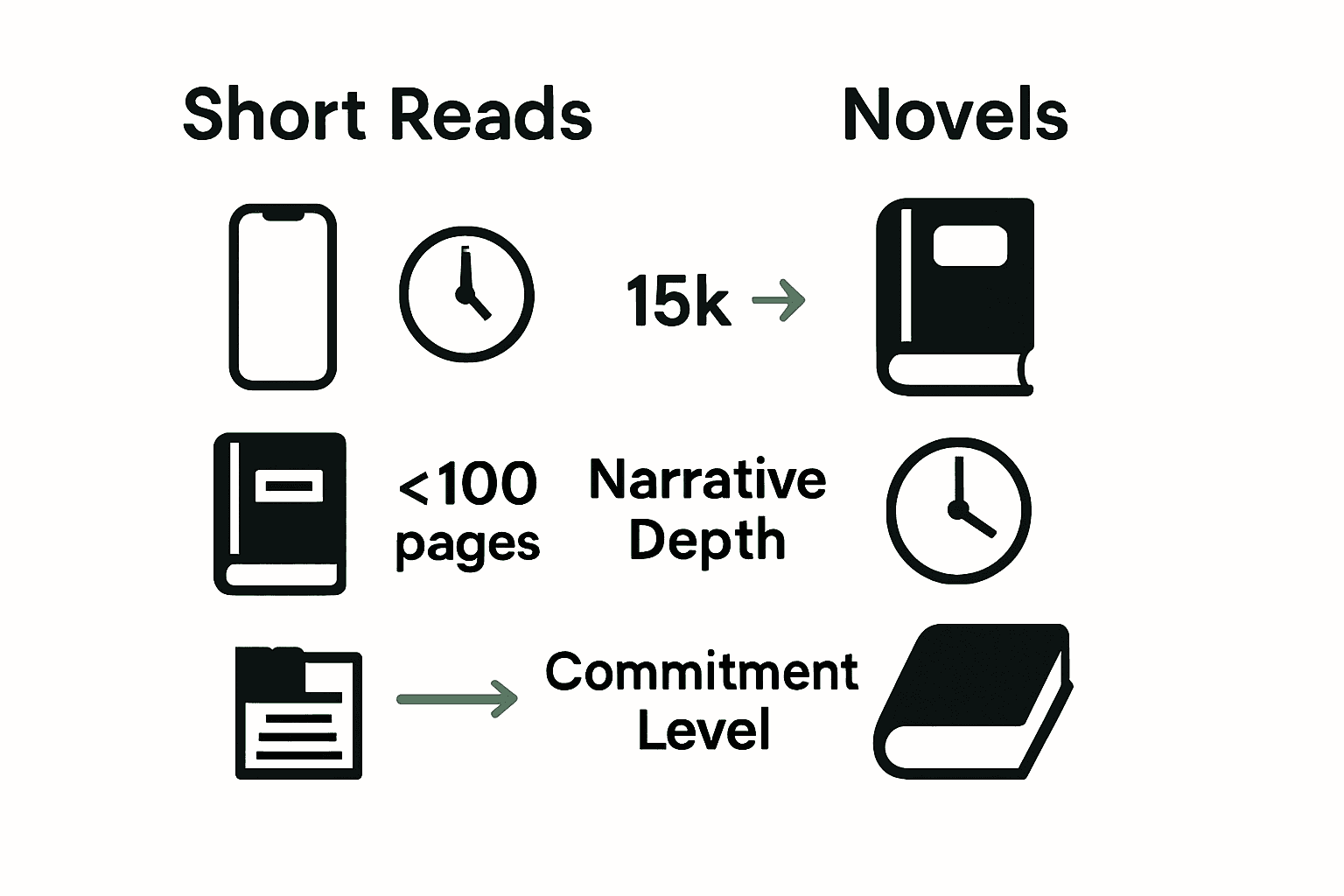
Wikipedia highlights contes as another fascinating narrative form, characterized by wit and fantasy, offering engaging stories that bridge the gap between traditional storytelling formats. These compact narratives demonstrate how literary experiences can be both rich and concise.
Readers interested in exploring the nuanced world of compact narratives can find deeper insights in our Understanding Short Story Structure guide, which provides a comprehensive exploration of these innovative storytelling approaches.
Short Reads vs Novels: Choosing What Fits
Wikipedia underscores that choosing between novellas and novels is ultimately a personal decision influenced by individual reading preferences, time availability, and narrative expectations. The selection process involves carefully weighing the depth of narrative immersion against the practical constraints of modern reading habits.
Readers must consider multiple factors when selecting their ideal reading format. Short reads offer immediate narrative satisfaction, while novels provide more comprehensive storytelling experiences. Wikipedia highlights that short story cycles present an innovative compromise, offering readers diverse narratives within a single collection and allowing for flexible, bite-sized literary exploration.
Key decision-making criteria include:
Choosing Your Ideal Reading Format:
- Choose Novels When You Want:
- Deep character development
- Complex, multi-layered plotlines
- Immersive long-form storytelling
- Extended narrative exploration
- Choose Short Reads When You Prefer:
- Quick narrative resolution
- Limited time commitment
- Diverse story experiences
- Flexible reading schedules
For readers seeking curated recommendations that match their reading preferences, our Best Short Books collection offers a carefully selected range of compact narratives to suit various tastes and reading styles.
Discover the Perfect Story Length for Your Lifestyle
Feeling torn between diving into a sprawling novel or savoring a quick, impactful story Often the challenge is finding narratives that fit your busy schedule yet still captivate your imagination. As highlighted in the article, short reads offer concentrated storytelling that fits into limited free time while novels provide deeper character journeys. If you crave the intensity of mysteries and thrillers but have little time to spare, exploring genres like cozy mysteries or psychological thrillers in short read form can be the perfect solution.
Unlock a world tailored for readers like you at The Short Reads. Whether you prefer cozy mystery short reads or thrilling novellas, our collection helps you stay immersed in gripping narratives without the long commitment. Act now to enjoy rich stories designed for efficient reading and personal enjoyment. Start your journey with carefully selected short reads today at The Short Reads and explore our curated mystery fiction short reads to match your reading preferences instantly.
Frequently Asked Questions
What is the main difference between short reads and novels?
Short reads typically range from 1,000 to 15,000 words, offering concentrated storytelling focused on singular plot points or character moments, while novels exceed 50,000 words and provide more extensive character development and intricate plots.
Why are short reads becoming popular among readers?
Short reads fit into busy lifestyles by offering complete stories that can be enjoyed in brief moments of free time, making them ideal for readers who face time constraints.
What genres are commonly found in short reads?
Common genres in short reads include cozy mysteries, which feature amateur sleuths solving crimes in small communities, and psychological thrillers that explore complex character motivations and intense emotional dynamics.
What are the advantages and disadvantages of reading short reads?
The advantages of short reads include quick consumption and lower commitment, ideal for fragmented attention spans. However, they may have limited character development and less complex plot structures compared to full-length novels.
Recommended
- Understanding the Benefits of Short Reads – TheShortReads.com
- Best Short Books – TheShortReads.com
- What is Flash Fiction? Understanding This Unique Story Form – TheShortReads.com


7 Smart Ways to Discover Mystery Fiction for Men

Over 60 percent of busy readers say they are drawn to stories that keep them hooked without eating up their entire weekend. Mystery fiction stands out because it offers suspenseful escapes in every format, from quick novellas to intricate detective sagas. Whether you want a fast-paced adventure or an immersive puzzle to solve, there is a perfect mystery waiting for you. Discover practical ways to enjoy gripping mysteries that fit your lifestyle and reading taste.
Table of Contents
- 1. Try Short Mystery Novellas For Quick Reads
- 2. Explore Genres: Action, Cozy, And Detective Stories
- 3. Use Online Platforms For Easy Access
- 4. Pick Books With Strong Male Leads
- 5. Join Book Clubs For Shared Experiences
- 6. Choose Books With Simple, Fast-Paced Plots
- 7. Seek Recommendations From Mystery Lovers
Quick Summary
| Takeaway | Explanation |
|---|---|
| 1. Choose Short Mysteries for Quick Reads | Short novellas under 300 pages can be read in one weekend, offering thrilling entertainment in less time. |
| 2. Explore Different Mystery Subgenres | Discover variations like cozy, action, and detective stories to match your reading preferences and interests. |
| 3. Use Online Resources for Easy Access | Platforms like OverDrive and Project Gutenberg allow borrowing or accessing a wide variety of mystery novels digitally. |
| 4. Join Book Clubs for Enhanced Experiences | Participate in book clubs to share insights and discover new authors, enriching your mystery reading journey. |
| 5. Seek Personalized Recommendations | Engage with fellow readers online or in person for tailored mystery book suggestions based on specific interests. |
1. Try Short Mystery Novellas for Quick Reads
Want to dive into mystery fiction without committing weeks to a massive novel? Short mystery novellas are your perfect solution. These compact stories pack intense narratives and gripping plots into manageable page counts, making them ideal for busy readers seeking thrilling entertainment.
According to Bustle, there are excellent mystery novels under 300 pages that can be devoured in a single weekend. Books like “The Other Side of Everything” by Lauren Doyle Owens and “The Chalk Man” by C.J. Tudor demonstrate how short novels can deliver complex storytelling without demanding excessive time.
Why choose short mystery novellas? They offer several compelling advantages:
- Time Efficiency: Read a complete story in just a few hours
- Intense Storytelling: Compact narratives with concentrated suspense
- Perfect for Beginners: Less intimidating entry point into mystery fiction
- Weekend Reading: Finish an entire thrilling narrative in one sitting
To get started, look for novellas around 200 to 300 pages with strong narrative hooks. Check online recommendation lists, bookstore mystery sections, or top picks from TheShortReads.com for curated suggestions that match your interests.
Pro tip: Start with award-winning or critically acclaimed shorter mystery novels to ensure high quality storytelling. Your weekend reading just got a lot more exciting.
2. Explore Genres: Action, Cozy, and Detective Stories
Mystery fiction is not a one-size-fits-all genre. Different subgenres offer unique reading experiences tailored to your specific interests and preferences. From high-octane action stories to charming small-town mysteries, understanding these categories can help you find exactly the reading adventure you crave.
According to Wikipedia, detective fiction encompasses a rich landscape of narrative styles and storytelling approaches. This genre offers readers multiple entry points into mysterious worlds with varying levels of complexity and excitement.
Subgenres to Explore:
- Cozy Mysteries: Gentle, low-violence stories typically set in small towns with amateur sleuths. As Wikipedia explains, these mysteries focus more on puzzle solving than graphic details.
- Action Mysteries: Fast paced narratives with high stakes and intense plot developments
- Detective Stories: Traditional narratives following professional or amateur investigators solving complex cases
To find your perfect mystery subgenre, experiment with different styles. Visit local bookstores, browse mystery fiction types for learners, and read sample chapters. Pay attention to the narrative style, pacing, and character dynamics that most appeal to you.
Pro tip: Start with shorter novels in each subgenre to quickly determine your preferred mystery style without investing too much time. Your perfect mystery adventure awaits.
3. Use Online Platforms for Easy Access
Modern technology has transformed how we discover and consume mystery fiction. Online platforms provide unprecedented access to thousands of mystery novels without leaving your home, making reading more convenient than ever before.
OverDrive offers an incredible solution for readers by partnering with libraries worldwide. This digital platform allows you to borrow ebooks and audiobooks through your local library membership, giving you instant access to a vast selection of mystery novels right from your digital device.
Digital Reading Resources:
- Project Gutenberg: Free digital library with classic mystery works
- OverDrive: Library partnership platform for digital book borrowing
- Kindle Unlimited: Subscription service with extensive mystery collections
- Local Library Digital Platforms: Free book borrowing through online systems
Project Gutenberg provides an exceptional resource for readers interested in classic mystery fiction. Their collection includes complete works by legendary authors like Arthur Conan Doyle, offering free digital downloads of entire Sherlock Holmes series and other timeless mystery novels.
To get started, download these apps on your smartphone or tablet. Create accounts with your local library credentials or explore free platforms. Pro tip: Many libraries offer digital memberships that provide free access to extensive mystery fiction collections.
4. Pick Books with Strong Male Leads
If you are looking to dive into mystery fiction that resonates with male readers, focusing on books with compelling male protagonists can transform your reading experience. Strong male leads offer unique perspectives and engaging narratives that capture complex character dynamics.
Take the Nameless Detective series by Bill Pronzini, which Wikipedia highlights as a prime example of a gripping male investigative narrative. Set in San Francisco, this long running series showcases a private investigator navigating intricate mystery landscapes with depth and authenticity.
What Makes a Strong Male Lead:
- Complex Psychological Depth: Characters with nuanced inner worlds
- Professional Expertise: Protagonists skilled in investigation or related fields
- Moral Complexity: Characters who wrestle with ethical challenges
- Personal Growth: Leads who evolve through their investigative experiences
Contemporary mysteries like Richard Osman’s “The Man Who Died Twice”) demonstrate how modern male protagonists can be multidimensional. The novel features a former MI6 agent entangled in an intricate case involving stolen diamonds and international criminal networks, showcasing intelligence and strategic thinking.
To find your ideal mystery novel, explore book reviews, ask for recommendations at local bookstores, and sample different series. Focus on protagonists that intrigue you beyond surface level action.
5. Join Book Clubs for Shared Experiences
Book clubs offer more than just reading recommendations. They provide a dynamic social environment where mystery fiction enthusiasts can dive deep into complex narratives, share insights, and expand their literary horizons.
Benefits of Mystery Fiction Book Clubs:
- Discover New Authors: Members introduce books you might never find alone
- Deeper Understanding: Group discussions reveal hidden plot nuances
- Social Connection: Meet like-minded mystery fiction enthusiasts
- Accountability: Regular meetups keep you consistently reading
Whether online or in person, book clubs create opportunities to explore mystery fiction from multiple perspectives. You will encounter diverse interpretations of storylines, character motivations, and narrative techniques that enhance your reading experience.
To get started, explore local library book clubs, online reading platforms like Goodreads, or community centers that host genre specific groups. Check out our shop for potential mystery fiction recommendations you can suggest to your book club.
Pro tip: Look for book clubs specifically focused on mystery or thriller genres to ensure more targeted and engaging discussions. Your next great reading adventure might just begin with a group conversation.
6. Choose Books with Simple, Fast-Paced Plots
Not all mystery readers want complex literary puzzles. For those seeking quick entertainment, fast-paced plots with straightforward narratives can provide an exciting reading experience without demanding excessive mental energy.
Wikipedia highlights Rex Stout’s ‘Trouble in Triplicate’ as a prime example of concise storytelling. This collection of Nero Wolfe novellas demonstrates how compelling mysteries can unfold rapidly, keeping readers engaged through streamlined narratives.
Characteristics of Fast-Paced Mystery Novels:
- Clear Story Progression: Linear plots with minimal digressions
- Quick Character Development: Immediate understanding of key personalities
- Minimal Backstory: Focus on present action and immediate conflict
- Rapid Plot Resolution: Mysteries solved within compact narratives
Modern readers appreciate stories that respect their time. Short reads from our recommended list offer perfect alternatives for busy individuals wanting engaging mysteries without lengthy commitments.
Pro tip: Look for novellas or short mystery collections that promise direct storytelling. Authors like Rex Stout excel at creating intricate yet accessible stories that unfold quickly and maintain high entertainment value.
7. Seek Recommendations from Mystery Lovers
Some of the best mystery fiction discoveries happen through conversations with passionate readers who live and breathe the genre. Fellow enthusiasts can offer personalized recommendations that algorithms and generic lists simply cannot match.
LibraryThing hosts incredible online communities like the Mystery Lovers group where dedicated fans share their most compelling reads. These platforms provide interactive spaces where you can dive deep into nuanced book discussions and uncover hidden literary gems.
Ways to Connect with Mystery Fiction Enthusiasts:
- Online Reading Communities: LibraryThing, Goodreads discussion groups
- Local Library Book Clubs: In person mystery fiction meetups
- Reddit Mystery Fiction Subreddits: Passionate reader discussions
- Social Media Mystery Reader Groups: Facebook and Twitter communities
For more curated suggestions, explore mystery fiction short stories that can quickly introduce you to new authors and styles. Many mystery lovers are eager to share their favorite reads and can help you navigate the vast world of detective and thriller narratives.
Pro tip: Always ask specific questions about plot styles, pacing, and character development when seeking recommendations. The more details you provide about your reading preferences, the more targeted the suggestions will be.
This table summarizes key strategies and benefits of engaging with mystery fiction through various formats and methods discussed in the article.
| Topic | Description | Benefits |
|---|---|---|
| Short Mystery Novellas | Compact stories with intense narratives; examples include “The Other Side of Everything” and “The Chalk Man”. | Quick reads, efficient storytelling, ideal for busy readers. |
| Explore Genres | Includes cozy, action, and detective stories; each offers unique reading experiences. | Tailored reading adventures, exposure to various storytelling styles. |
| Online Platforms | Access thousands of mystery novels via digital resources like OverDrive, Project Gutenberg, and Kindle Unlimited. | Convenient access, vast selection, borrow books digitally. |
| Strong Male Leads | Focus on books with compelling male protagonists, such as the “Nameless Detective” series. | Engaging narratives, complex characters, unique perspectives. |
| Book Clubs | Join groups for shared reading experiences and discussions. | Discover new authors, gain deeper understanding, social connection. |
| Fast-Paced Plots | Choose books with straightforward narratives; examples like Rex Stout’s “Trouble in Triplicate”. | Quick entertainment, minimal mental energy required. |
| Recommendations | Connect with mystery fiction enthusiasts for personalized suggestions. | Discover hidden gems, targeted reading based on preferences. |
Discover Your Perfect Mystery Read Today
If you are looking to overcome the challenge of finding engaging mystery fiction tailored just for men you are not alone. Many readers struggle with picking the right subgenre or finding books with strong male leads that fit their busy lifestyles. This article highlighted key goals like choosing short mystery novellas for quick reads exploring cozy or action-packed styles and engaging with communities for personalized recommendations. At TheShortReads.com we understand how important it is to connect you with fast paced mysteries or thoughtful detective stories that fit your unique taste and time constraints.
Explore our collection of mystery fiction short reads where you will find handpicked cozy mysteries and action thriller novellas designed to deliver suspense and satisfaction in a minimum amount of time. Whether you want to dive into psychological thrillers or gripping murder mystery novellas find exactly what you need to jumpstart your next reading adventure. Join fellow fans who get the perfect blend of storytelling and pacing without the wait.
Ready to uncover your next favorite mystery? Start browsing now and take advantage of expertly curated short reads that respect your time and excite your imagination.
Unlock thrilling mysteries crafted for busy readers. Visit TheShortReads.com and choose your next captivating read today.
Frequently Asked Questions
What are the best ways to discover short mystery novellas for men?
Short mystery novellas are great for busy readers looking for quick, engaging stories. Look for novellas around 200 to 300 pages, especially from award-winning authors, and consider checking online recommendations or curated lists for tailored options.
How do I explore different subgenres of mystery fiction effectively?
To explore mystery fiction subgenres, read sample chapters from action mysteries, cozy mysteries, and detective stories. Experiment with different styles to see which ones resonate with you, and start with shorter novels to gauge your interest without a long-term commitment.
What are the benefits of joining a mystery fiction book club for men?
Joining a mystery fiction book club allows you to deepen your understanding of stories and characters while connecting with fellow enthusiasts. To get started, seek out local meets or online groups focused on mystery genres to enhance your reading experience and discover new titles.
How can I find recommendations from other mystery fiction lovers?
Connect with other mystery fiction enthusiasts through online reading communities, social media groups, or local library events. Engage in discussions and ask specific questions about mystery novels to receive tailored recommendations that match your interests.
What should I consider when choosing books with strong male leads?
When selecting mystery books with strong male leads, focus on characters with complex psychological depth and relatable moral dilemmas. Look for novels that showcase character development and situational challenges, which will enhance your reading experience.
How can I locate fast-paced mystery novels?
To find fast-paced mystery novels, look for books that feature concise storytelling and linear plots. Seek out novellas or collections that promise quick reads, ensuring you can enjoy engaging narratives without lengthy commitments.
Recommended
- Mystery Fiction – TheShortReads.com
- 6 Must-Know Mystery Short Stories Examples for Everyone – TheShortReads.com
- Understanding Mystery Fiction Terminology Explained – TheShortReads.com
- 7 Mystery Fiction Types for Learners and Busy Readers – TheShortReads.com

