
Tag Archives for " crime fiction "
Mystery Genre Definition 101: A Beginner’s Guide to Mastering Crime Fiction

Here’s a surprising fact: crime fiction accounts for roughly one-third of all fiction sales worldwide, yet most new readers feel completely overwhelmed when they walk into a bookshop’s mystery section. Sound familiar?
You’ve heard people throw around terms like “cozy mysteries,” “noir,” and “psychological thrillers” like everyone should just know what they mean. Meanwhile, you’re staring at an entire wall of crime fiction wondering where on earth to start.
Good news: understanding the mystery genre is actually easier than solving an Agatha Christie plot. This guide breaks it all down so you can confidently find YOUR perfect mystery match: no detective skills required.
What Is the Mystery Genre? The Core Definition
Let’s start simple. The mystery genre definition centres on one core concept: stories focused on solving a crime or puzzle.
That’s it. Everything else builds from there.
Every mystery, regardless of subgenre, typically contains these essential elements:
- A crime or mysterious event (usually murder, but not always)
- A protagonist trying to solve it (detective, amateur sleuth, or even the victim)
- Clues planted throughout for readers to follow
- A revelation or solution at the end
The real magic? You’re solving alongside the characters. Your brain is actively hunting for clues, questioning suspects, and piecing together the puzzle. That’s why mysteries are so addictive: our brains are literally wired to love puzzles and the satisfaction of closure.
The genre took shape in the mid-19th century, with Edgar Allan Poe credited as a pioneer through “The Murders in the Rue Morgue.” Since then, iconic authors like Agatha Christie and Sir Arthur Conan Doyle have shaped crime fiction into the beloved genre it is today.
The Mystery Family Tree: Main Subgenres Explained
Here’s where beginners often get lost. Crime fiction isn’t one thing: it’s a whole family of reading experiences. Understanding these subgenres is your shortcut to finding books you’ll actually love.
Cozy Mysteries
What they are: Light-hearted, low-violence mysteries featuring amateur sleuths solving crimes through intellect rather than action.
The vibe: Think small towns, bookshops, bakeries, and tea rooms. Violence happens off-page. The focus is on puzzle-solving and charming characters.
Famous examples: Agatha Christie’s Miss Marple series
Perfect for: Beginners who want comfort and puzzle-solving without gore. If you enjoy gentle reads but love a good mystery, start here.
Try this: C.T. Mitchell’s Lady Margaret Turnbull series offers quick cozy mysteries you can finish in one sitting.
Classic Whodunits
What they are: Traditional puzzle mysteries laser-focused on the central question: “Who did it?”
The vibe: Often set in closed environments: country houses, trains, remote islands. Intellectual, methodical, and fair play (all clues are given to you).
Famous examples: Agatha Christie’s Hercule Poirot novels
Perfect for: Logic lovers and puzzle enthusiasts who want to outsmart the detective.
Police Procedurals & Crime Thrillers
What they are: Realistic crime fiction following law enforcement through authentic investigation methods.
The vibe: Urban, gritty, fast-paced. Focus on teamwork, forensics, and the procedural process of catching criminals.
Famous examples: Michael Connelly, Ian Rankin
Perfect for: Fans of Law & Order who appreciate gritty realism and action.
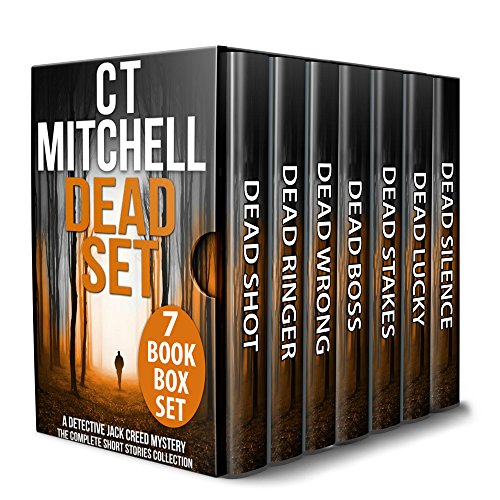
Try this: C.T. Mitchell’s Detective Jack Creed series delivers Australian crime procedurals in under 150 pages: perfect for testing if this subgenre clicks for you.
Psychological Mysteries & Thrillers
What they are: Character-driven mysteries focusing on minds, motivations, and unreliable narrators.
The vibe: Atmospheric, tense, twist-heavy. Often set in domestic or everyday settings that become unsettling.
Famous examples: Gone Girl, The Girl on the Train
Perfect for: Readers who crave shocking twists and psychological depth. For more on this subgenre, explore our guide to psychological thriller themes.
Try this: C.T. Mitchell’s Selena Sharma series offers psychological suspense in accessible, fast-paced novellas.
Historical Mysteries
What they are: Mysteries set in past eras, usually pre-1960s, where historical context shapes the investigation.
The vibe: Atmospheric, elegant, often educational. Period-accurate settings add richness to the mystery.
Famous examples: Ellis Peters’ Cadfael series, Anne Perry
Perfect for: History buffs and Downton Abbey fans who love immersive period settings.
Noir & Hard-Boiled
What they are: Dark, cynical detective stories featuring morally grey heroes navigating shadowy underworlds.
The vibe: Urban, seedy, nighttime. Pessimistic worldview, flawed detectives, moral ambiguity.
Famous examples: Raymond Chandler, Dashiell Hammett
Perfect for: Readers who appreciate dark, complex antiheroes and atmospheric tension.
Key Mystery Tropes You’ll Encounter
Once you understand these common elements, you’ll spot them everywhere: and that’s half the fun:
| Trope | What It Means |
|---|---|
| Locked Room Mystery | Crime occurs where escape seems impossible |
| Red Herrings | False clues designed to mislead you |
| Unreliable Narrator | The storyteller might be lying or confused |
| The Least Likely Suspect | Often the culprit hides in plain sight |
| Chekhov’s Gun | Every detail mentioned will matter later |
Understanding these tropes doesn’t spoil mysteries: it makes reading them more fun. You’ll start noticing the author’s craft while still enjoying the ride. For deeper exploration, check out our mystery fiction terminology guide.
How to Choose Your First Mystery
Still unsure where to start? Answer these quick questions:
Do you want violence on-page or off-page?
- Off-page → Cozy mysteries
- On-page → Crime thrillers, noir
Prefer cozy comfort or gritty realism?
- Comfort → Cozy mysteries, classic whodunits
- Realism → Police procedurals, noir
Love puzzles or character psychology?
- Puzzles → Classic whodunits, locked room mysteries
- Psychology → Psychological thrillers
Historical settings or modern day?
- Historical → Historical mysteries
- Modern → Most crime thrillers and procedurals

Pro tip: Start with SHORT mysteries under 150 pages. You’ll quickly discover what you love without committing to 600-page epics.
Common Mistakes Beginners Make
You might think jumping into crime fiction is straightforward. The real surprise? Most beginners sabotage their own enjoyment:
- Starting with 600-page epics (overwhelm kills the joy before you find your rhythm)
- Picking the wrong subgenre for their taste
- Expecting all mysteries to be the same
- Trying to outsmart the author instead of enjoying the ride
- Abandoning series after book one (often world-building heavy)
The fix: Start short, try different subgenres, and focus on finishing. Completion builds confidence and helps you identify what actually resonates.
Why Short Mysteries Are Perfect for Beginners
Here’s the strategic advantage most new readers miss: novellas let you sample the entire mystery genre quickly.
Under 150 pages means:
- You can try multiple subgenres in a single month
- Tight plotting delivers pure mystery with zero filler
- Every finished book builds your reading confidence
- Less commitment, more discovery
This is exactly why The Short Reads approach works so brilliantly for genre exploration.
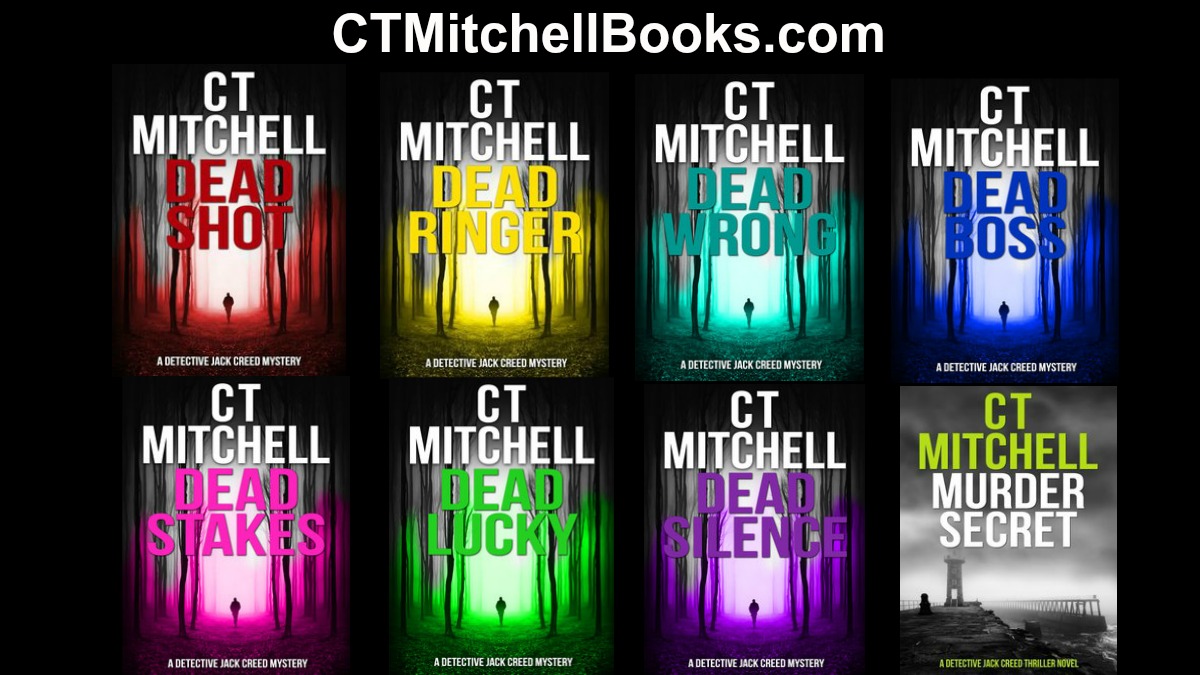
C.T. Mitchell’s three series offer the perfect beginner’s toolkit:
- Detective Jack Creed: Test crime procedurals (Australian setting, under 150 pages)
- Lady Margaret Turnbull: Try cozy historical mysteries (quick, satisfying reads)
- Selena Sharma: Explore psychological suspense (fast-paced, twist-driven)
Your Mystery Reading Roadmap
Ready to master crime fiction? Here’s your four-week experiment:
Week 1: Try a cozy mystery (low stakes, high comfort)
Week 2: Read a crime thriller (test your tolerance for grit)
Week 3: Explore psychological mystery (discover if you love twists)
Week 4: Pick your favourite subgenre and read two more
By month two, you’ll know exactly what you love. The Short Reads catalogue makes this experiment easy: every novella is under 150 pages, so you can move quickly through subgenres without getting stuck.
Your Mystery Journey Starts Now
The mystery genre isn’t intimidating once you understand the map. There’s genuinely a subgenre for everyone: whether you crave cozy comfort, gritty realism, or mind-bending psychological twists.
Starting short isn’t a shortcut: it’s the smart strategy for mastering crime fiction. You don’t need to read 500-page thrillers to be a “real” mystery fan.
Pick a subgenre that sounds appealing, download a Short Read, and start your mystery journey tonight. Your next favourite genre is waiting.
Share


13 Easy Books For Non-Readers To Build Their Reading Muscle
Here’s a shocking truth: The average person spends 2.5 hours daily scrolling social media, yet claims they “don’t have time to read.” The real problem? You’ve been trying to bench press 300 pounds when you haven’t even learned to do a push-up.
Reading is like any other muscle, it needs to be built gradually. You wouldn’t walk into a gym and immediately attempt the heaviest weights, so why are you picking up 500-page novels when you haven’t flexed your reading muscle in years?
If you’re among the millions who think “reading just isn’t for me,” you’re about to discover something game-changing. The issue isn’t that you hate reading, it’s that you’ve been choosing the wrong books for your current reading fitness level.
Why These Books Work (And Others Don’t)
Most books for non readers fail because they’re either too long, too dense, or too boring. The books below are different. They’re page turners that respect your time, grab your attention immediately, and, most importantly, you can actually finish them.
The secret? Each book on this list is designed to give you quick wins that build confidence and momentum. Think of them as reading workouts that gradually strengthen your focus, comprehension, and, yes, your genuine enjoyment of books.

The 13 Books That Build Reading Muscle
1. The Alchemist by Paulo Coelho
“Most people see the world as a threatening place, and, because they do, the world turns out, indeed, to be a threatening place.”
Why it builds reading muscle: At just 163 pages, this is the perfect easy book to start with. You can finish it in one or two sittings, and you’ll walk away feeling inspired about life’s possibilities. The simple, clear prose makes it ideal for reading for beginners.
2. The House in the Cerulean Sea by TJ Klune
Why it builds reading muscle: This feel-good fantasy proves that engaging books don’t need to be intimidating. It’s warm, funny, and genuinely uplifting, exactly what reluctant readers need to remember why stories matter. The magical elements keep you hooked without being confusing.
3. And Then There Were None by Agatha Christie
Why it builds reading muscle: Christie’s masterpiece mystery is the ultimate page turner for people who hate reading. Short chapters, constant suspense, and a plot that moves so fast you won’t want to put it down. Perfect introduction to the mystery genre.
4. Tiny Beautiful Things by Cheryl Strayed
“Most things will be okay eventually, but not everything will be. Sometimes you’ll put up a good fight and lose.”
Why it builds reading muscle: This collection of essays is perfect for short attention span reading. You can read one piece at a time, making it ideal for dip-in dip-out reading. Strayed’s honest, compassionate advice about life’s challenges will keep you coming back.
5. Post Office by Charles Bukowski
“Food is good for the nerves and the spirit. Courage comes from the belly – all else is desperation.”
Why it builds reading muscle: If polished, traditional writing puts you to sleep, Bukowski’s raw honesty will wake you up. His unfiltered take on ordinary life as a postal worker is both hilarious and brutally real, perfect for readers who think books are “too proper.”

6. The Thursday Murder Club by Richard Osman
Why it builds reading muscle: This cozy mystery about retirement home residents solving cold cases is entertaining without being stressful. Short chapters, lovable characters, and just enough mystery to keep you guessing. Ideal for building your reading habit with pure enjoyment.
7. Fear and Loathing in Las Vegas by Hunter S. Thompson
“Every now and then when your life gets complicated and the weasels start closing in, the only cure is to load up on heinous chemicals and then drive like a bastard from Hollywood to Las Vegas.”
Why it builds reading muscle: Thompson’s wild, debaucherous adventure reads like the most insane road trip story ever told. The raw energy and bizarre situations will keep you glued to the page, perfect for readers who find traditional literature boring.
8. When Breath Becomes Air by Paul Kalanithi
“Science may provide the most useful way to organize empirical, reproducible data, but its power to do so is predicated on its inability to grasp the most central aspects of human life: hope, fear, love, hate, beauty, envy, honor, weakness, striving, suffering, virtue.”
Why it builds reading muscle: This memoir by a neurosurgeon facing terminal cancer is both heartbreaking and inspiring. Despite the heavy subject matter, it reads quickly and will change how you think about life and mortality.
9. Green Hills of Africa by Ernest Hemingway
“We have very primitive emotions. It’s impossible not to be competitive. Spoils everything, though.”
Why it builds reading muscle: Hemingway’s hunting memoir in East Africa showcases his famously clean, accessible prose. No complicated language or dense descriptions, just clear storytelling that puts you right in the African wilderness.
10. Surely You’re Joking, Mr. Feynman! by Richard Feynman and Ralph Leighton
“There were a lot of fools at that conference, pompous fools, and pompous fools drive me up the wall.”
Why it builds reading muscle: A Nobel Prize-winning physicist who writes like he’s your funniest friend? Feynman’s entertaining tales of curiosity and discovery prove that accessible books can be both smart and incredibly fun to read.

11. Barbarian Days: A Surfing Life by William Finnegan
“Being out in big surf is dreamlike. Terror and ecstasy ebb and flow around the edges of things, each threatening to overwhelm the dreamer.”
Why it builds reading muscle: Even if you’ve never surfed, Finnegan’s beautifully written memoir about chasing waves around the world is mesmerizing. His vivid descriptions and philosophical insights make this a perfect bridge to more literary writing.
12. 11/22/63 by Stephen King
“Life turns on a dime. Sometimes towards us, but more often it spins away, flirting and flashing as it goes: so long, honey, it was good while it lasted, wasn’t it?”
Why it builds reading muscle: Yes, it’s longer, but this time-travel story about preventing JFK’s assassination is so gripping you won’t notice the pages flying by. King’s masterful storytelling will have you reading “just one more chapter” until 3 AM.
13. Beneath a Scarlet Sky by Mark Sullivan
“Do what I sometimes do when I get scared: imagine you’re someone else, someone who’s far braver and smarter.”
Why it builds reading muscle: This WWII story about an Italian teenager saving lives during Nazi occupation reads like the most incredible action movie ever made. Despite its length, it’s a true page turner that builds serious reading endurance.
The Real Secret: Short Reads Build Reading Muscle Faster
Here’s what traditional reading advice gets wrong: they tell you to start with “classics” or “important literature.” That’s like telling someone to deadlift 400 pounds on their first day at the gym.
The fastest way to build genuine reading muscle is through short wins. When you complete a book: any book: your brain releases dopamine and builds positive associations with reading. Each completed book strengthens your confidence, focus, and hunger for the next story.
The psychology is simple: Finished books create momentum. Unfinished books create guilt and reinforce the “I’m not a reader” identity.
This is why novellas under 150 pages are the secret weapon for building reading muscle. They give you:
- ✅ Complete story satisfaction in just a few reading sessions
- ✅ Immediate sense of accomplishment that motivates continued reading
- ✅ Confidence boost that you CAN finish books
- ✅ Momentum to tackle slightly longer books
- ✅ Reading habit formation through frequent completion rewards
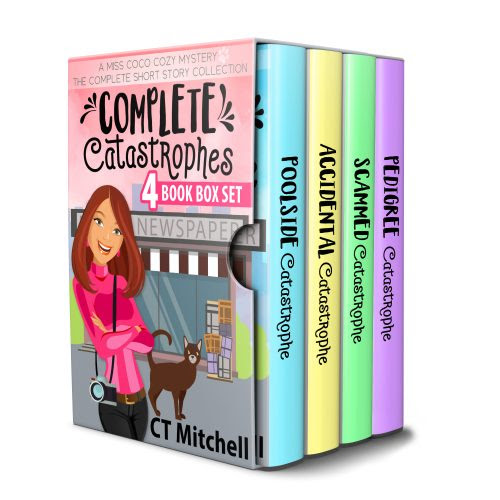
Your Next Step: C T Mitchell’s Reading Muscle Builders
Once you’ve conquered a few books from the list above, you’re ready for the next level of reading muscle building. C T Mitchell’s series are perfectly designed for new readers who want to maintain their momentum:
Detective Jack Creed Series: Fast-paced crime mysteries that hook you immediately and deliver satisfying conclusions in under 150 pages. Each book builds your mystery reading muscle while keeping you thoroughly entertained.
Lady Margaret Turnbull Series: Cozy mysteries that feel like visiting with a clever friend. Perfect for readers who want intrigue without violence, wrapped up in bite-sized, completely satisfying stories.
Selena Sharma Series: Psychological thrillers that prove short books can deliver serious suspense. These novellas build your tolerance for tension while rewarding you with quick, complete resolutions.
Each series proves that short read books aren’t inferior to longer novels: they’re precision-engineered reading experiences that respect your time while building genuine reading muscle.
Ready to start building your reading muscle? Pick one book from this list that sounds most interesting to you. Read it. Finish it. Feel that satisfaction of completing a story. Then pick another.
Before you know it, you’ll have built serious reading muscle: and discovered that you actually love books. You just needed the right training program.
Start your reading muscle journey today at The Short Reads and discover why thousands of former non-readers are now devouring books faster than ever.
Share

Mystery Fiction Terminology: Complete Guide for Readers

Over 80 percent of american readers find themselves puzzled by the unique language that fills mystery fiction stories. Understanding this specialized terminology matters because it shapes every twist, clue, and character you encounter in a detective novel. Whether you are a long-time fan or just starting to explore this genre, knowing these key terms brings every plot and clue into sharper focus. This guide unlocks the secrets behind the most important words in mystery fiction so every story becomes richer and more rewarding.
Table of Contents
- Mystery Fiction Terminology Defined Clearly
- Major Subgenres and Related Terminology
- Key Plot Devices and Character Archetypes
- Iconic Clues, Red Herrings, and Tropes
- Common Mistakes and Misused Terms
Key Takeaways
| Point | Details |
|---|---|
| Understanding Terminology | Mystery fiction has specific terminology such as detective, red herring, and MacGuffin that helps readers appreciate its complexity. |
| Subgenre Diversity | Major subgenres include detective fiction, cozy mystery, and true crime, each offering unique narrative styles and themes. |
| Character Archetypes | Common character types like the brilliant detective and the unreliable narrator enrich mystery storytelling by providing varied perspectives. |
| Common Misconceptions | Terminology in mystery fiction is often misused, making it essential for readers and scholars to understand the distinctions between subgenres. |
Mystery Fiction Terminology Defined Clearly
Mystery fiction is a captivating literary genre that transforms complex criminal puzzles into compelling narratives. According to Wikipedia, mystery fiction is characterized by an event, typically a crime, that remains enigmatic until the story’s conclusion, often involving a detective who unravels the mystery through logical reasoning.
Mystery fiction encompasses several distinctive terminology elements that help readers navigate and understand the intricate world of detective and crime narratives. These specialized terms provide insight into the genre’s narrative structures, character archetypes, and storytelling techniques.
Key terminology in mystery fiction includes several important categories:
- Detective: The primary investigator who systematically solves the central crime or puzzle
- Red Herring: A misleading clue intentionally designed to distract readers from the actual solution
- MacGuffin: An object or goal that drives the plot forward but may not have intrinsic significance
- Unreliable Narrator: A storyteller whose credibility is compromised, adding complexity to the narrative
For readers eager to explore more about the nuanced world of mystery storytelling, check out our guide on understanding mystery fiction terminology.
Major Subgenres and Related Terminology
Mystery fiction is a diverse literary landscape with multiple compelling subgenres. According to Wikipedia, major subgenres include detective fiction, true crime, cozy mystery, and locked-room mystery, each presenting unique narrative approaches and specialized terminology.
Detective Fiction represents the classic investigative narrative where a protagonist systematically uncovers criminal mysteries. This subgenre typically features a central investigator who uses logic, deduction, and keen observation to solve complex cases. Characters in detective fiction often follow specific archetypes: the brilliant lone detective, the methodical police investigator, or the amateur sleuth with extraordinary perception.
Other significant mystery subgenres include:
- Cozy Mystery: Gentle narratives set in small communities, featuring amateur detectives and minimal graphic violence
- Locked-Room Mystery: Intricate puzzles where a crime occurs in an apparently impossible scenario
- True Crime: Narratives based on actual criminal events, blending journalistic reporting with storytelling techniques
- Police Procedural: Stories focusing on systematic law enforcement investigation methods
As noted by LibGuides, mystery fiction subgenres are distinguished by unique themes and narrative styles, offering readers diverse approaches to exploring criminal intrigue.
IMAGE:descriptive_key_1] For readers interested in diving deeper into mystery storytelling, our [guide on understanding mystery fiction terminology provides comprehensive insights.
Key Plot Devices and Character Archetypes
Mystery fiction relies on intricate plot devices and memorable character archetypes to engage readers and create compelling narratives. According to Wikipedia, classic mystery novels like those by Ellery Queen exemplify the ‘fair play’ mystery approach, where readers receive all critical clues alongside the detective, transforming the reading experience into an intellectual challenge.
Character archetypes form the backbone of mystery storytelling, each bringing unique perspectives and investigative approaches. The primary investigative characters typically include:
- The Brilliant Lone Detective: Highly intelligent, often eccentric, who solves cases through exceptional deductive reasoning
- The Methodical Police Investigator: Systematic, procedural, following strict investigative protocols
- The Amateur Sleuth: Typically an outsider with keen observational skills who stumbles into solving mysteries
- The Flawed Protagonist: A complex character with personal challenges that both hinder and enhance their investigative abilities
In an innovative narrative twist, Wikipedia highlights the inverted detective story or ‘howcatchem’ approach, where the perpetrator is revealed at the story’s beginning. This technique shifts focus from ‘whodunit’ to ‘how will they be caught,’ creating a unique psychological exploration of crime and detection.
For readers intrigued by the psychological underpinnings of mystery narratives, our guide on character psychology offers deeper insights into the complex world of fictional investigators and their motivations.
Iconic Clues, Red Herrings, and Tropes
Mystery fiction thrives on the intricate dance of clues, misdirections, and narrative conventions that keep readers guessing. According to Wikipedia, the genre skillfully employs red herrings and complex clues to mislead readers, creating suspense and engaging them in the detective’s challenging journey to uncover the truth.
Red herrings represent one of the most compelling narrative devices in mystery storytelling. These deliberately misleading clues are strategically placed to:
- Distract readers from the actual solution
- Create additional narrative tension
- Challenge the protagonist’s investigative process
- Maintain reader engagement through uncertainty
Traditional mystery tropes have evolved dramatically over time. Wikipedia highlights an innovative approach with inverted detective stories, which subvert conventional narrative expectations by presenting the crime and perpetrator upfront. This technique transforms the narrative from a ‘whodunit’ to a fascinating exploration of investigative methodology and psychological motivation.
Readers fascinated by the nuanced world of narrative misdirection can explore more about these intricate storytelling techniques in our guide on red herrings, which delves deeper into the art of crafting compelling mystery narratives.
Common Mistakes and Misused Terms
Mystery fiction terminology is a nuanced landscape where precise definitions matter significantly. According to ALA Journals, certain subgenres like cozy mysteries are frequently undervalued or misclassified, creating challenges in literary scholarship and reader understanding.
Some of the most common terminology mistakes in mystery fiction include:
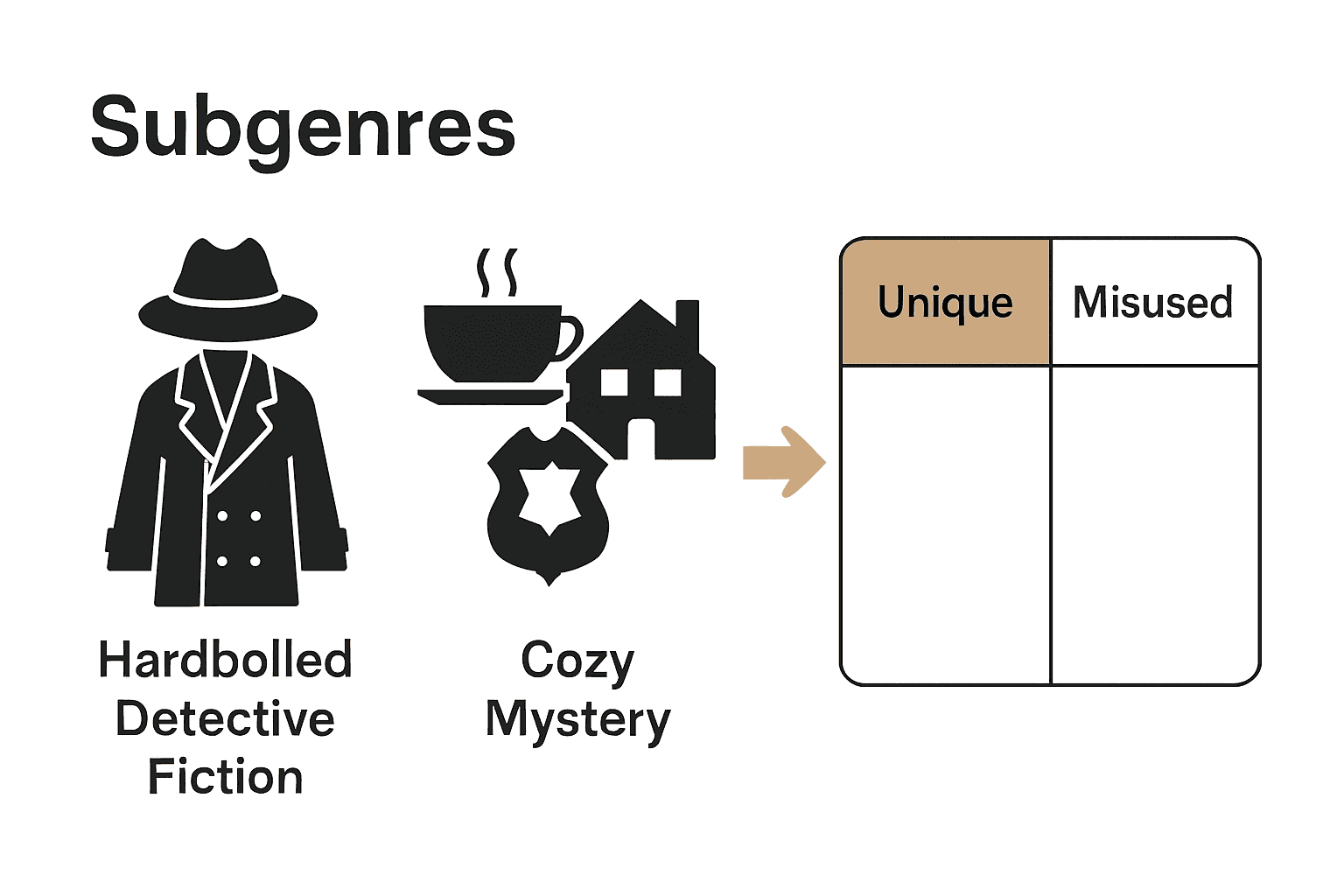
- Hardboiled vs. Detective Fiction: Often incorrectly used interchangeably
- Cozy Mystery vs. Traditional Mystery: Frequently confused despite distinct characteristics
- Thriller vs. Mystery: Misunderstood as synonymous genres
- Police Procedural vs. Detective Fiction: Subtle but important distinctions often overlooked
Bodhi Journals highlights the critical need for precise definitions, especially in academic and literary contexts. The conflation of hardboiled and detective fiction represents a prime example of how imprecise terminology can muddy our understanding of literary genres. Readers and scholars alike must pay careful attention to the nuanced differences between seemingly similar mystery subgenres.
For readers seeking to deepen their understanding of these complex distinctions, our guide on subtle literary classifications offers comprehensive insights into the intricate world of mystery fiction terminology.
Unlock the Mystery with Engaging Short Reads Tailored for You
Struggling to keep track of mystery fiction terminology like red herrings, cozy mysteries, and inverted detective stories can make enjoying the genre frustrating. If you love diving into complex puzzles or crave captivating stories featuring amateur sleuths and brilliant detectives but find traditional novels too time-consuming, our collection of mystery fiction short reads is designed just for you. Experience thrilling narratives that respect your busy schedule while immersing you in the exact subgenres and archetypes you enjoy.

Discover the perfect blend of intrigue and clarity with our Weekend Mystery Bundle. Featuring a carefully curated selection of cozy mystery short reads, murder mystery novellas, and detective short reads, you will embrace your passion for mystery fiction without getting lost in confusing terms or overwhelming plots. Don’t wait to transform your reading experience. Explore our collection now at theShortReads.com and decode mysteries effortlessly.
Frequently Asked Questions
What is mystery fiction?
Mystery fiction is a literary genre that revolves around an enigmatic event, typically a crime, that remains unsolved until the story’s conclusion. It often features a detective who uses logical reasoning to unravel the mystery.
What are common terminology used in mystery fiction?
Key terms in mystery fiction include ‘detective’ (the investigator), ‘red herring’ (misleading clues), ‘MacGuffin’ (a plot-driving object), and ‘unreliable narrator’ (a storyteller with questionable credibility).
What are the major subgenres of mystery fiction?
Major subgenres of mystery fiction include detective fiction, cozy mystery, locked-room mystery, true crime, and police procedural, each offering unique storytelling styles and themes.
How do red herrings function in mystery storytelling?
Red herrings are deliberately misleading clues designed to distract readers from the actual solution. They create tension and engage readers by maintaining uncertainty about the outcome.
Recommended
- Understanding Mystery Fiction Terminology Explained – TheShortReads.com
- Mystery Fiction – TheShortReads.com
- Short Mystery Writing Tips for Captivating Tales – TheShortReads.com
- 7 Smart Ways to Discover Mystery Fiction for Men – TheShortReads.com


Short Reads vs Novels: Complete Guide for Readers

Over 60 percent of readers now turn to shorter books or bite-sized stories due to busy schedules. The choice between a quick short read and a sweeping novel can shape the way you enjoy stories, especially if you crave meaningful narratives but have limited time. Whether you love fast-paced mysteries or long, intricate tales, recognizing the difference between these formats helps you match your reading with your lifestyle.
Table of Contents
- Defining Short Reads And Novels
- Key Genres: Cozy Mysteries And Thrillers
- Understanding Reader Preferences And Needs
- Benefits And Drawbacks Of Short Reads
- Comparing Reading Experience And Accessibility
- Short Reads Vs Novels: Choosing What Fits
Key Takeaways
| Point | Details |
|---|---|
| Short Reads vs Novels | Short reads offer quick, concentrated storytelling, usually under 15,000 words, while novels provide complex narratives over 50,000 words. |
| Genre Preferences | Cozy mysteries and psychological thrillers are popular short read genres, appealing to readers through engaging puzzles and intense character exploration. |
| Reader Needs | Time-constrained readers favor short reads for their ease of consumption in brief periods, making them ideal for busy lifestyles. |
| Choosing Formats | Select novels for immersive storytelling and deep character development, while short reads are suitable for quick resolutions and diverse experiences. |
Defining Short Reads and Novels
Reading formats are as diverse as the stories they contain, and understanding the difference between short reads and novels can transform your reading experience. According to Wikipedia, a novella represents a unique narrative length situated between traditional short stories and full novels, typically ranging from 17,500 to 40,000 words.
Novels, by contrast, are more expansive narrative forms. ijels defines them as “fictitious prose narratives of considerable length” that explore complex characters and intricate plot structures. While novels offer deep narrative immersion, short reads provide concentrated storytelling experiences perfect for readers with limited time or those seeking quick, engaging narratives.
The key distinctions between short reads and novels can be summarized as:
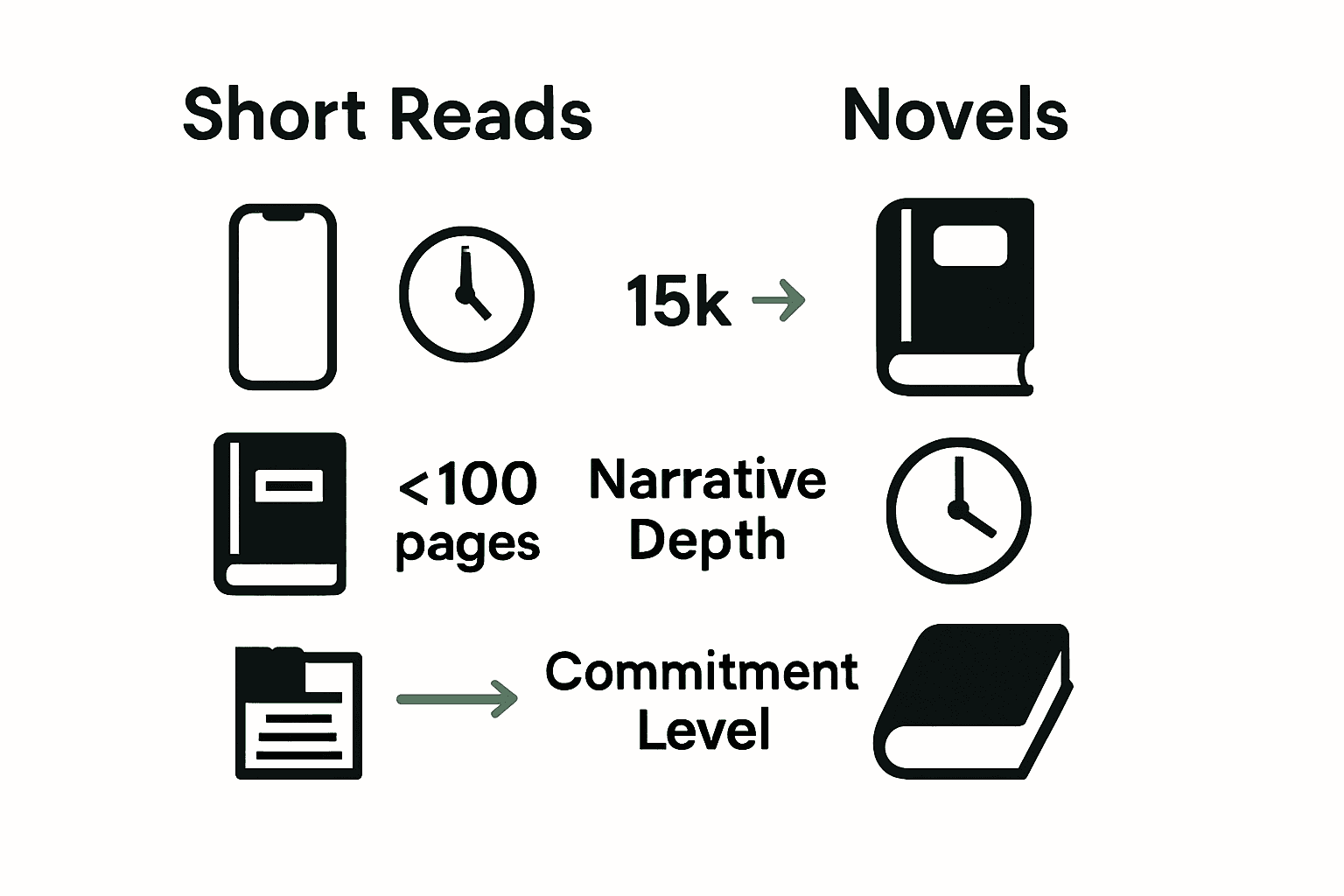
- Word Count: Short reads typically range from 1,000 to 15,000 words, while novels exceed 50,000 words
- Narrative Complexity: Short reads focus on singular plot points or character moments
- Reading Time: Short reads can be completed in one sitting (30-90 minutes)
- Depth of Exploration: Novels offer more comprehensive character development and intricate storylines
For readers seeking quick yet compelling stories, Understanding the Benefits of Short Reads provides additional insights into why these concise narratives are gaining popularity across diverse reading communities.
Key Genres: Cozy Mysteries and Thrillers
Within the landscape of short reads, two genres have captured readers’ imaginations: cozy mysteries and psychological thrillers. Wikipedia defines cozy mysteries as a unique sub-genre of crime fiction where the action happens subtly, with amateur sleuths solving crimes in intimate, close-knit communities.
Psychological thrillers, in contrast, dive deep into the complex mental landscapes of characters, exploring psychological tensions and intricate emotional dynamics. These narratives often feature protagonists navigating intense personal challenges, moral dilemmas, and unexpected psychological twists that keep readers on the edge of their seats.
Key characteristics of these compelling genres include:
- Cozy Mysteries:
- Minimal graphic violence
- Amateur detective protagonist
- Small-town or close community setting
- Focus on puzzle-solving and interpersonal dynamics
- Psychological Thrillers:
- Intense psychological exploration
- Complex character motivations
- Unexpected narrative twists
- Emphasis on mental and emotional suspense
Readers seeking deeper insights into these fascinating genres can explore our Themes in Psychological Thrillers guide, which offers a comprehensive exploration of the intricate storytelling techniques that make these short reads so captivating.
Understanding Reader Preferences and Needs
Reading preferences are deeply personal, shaped by individual lifestyles, time constraints, and narrative appetites. Women.com reveals that certain readers gravitate towards cozy mysteries precisely because they offer engaging puzzles without graphic violence, appealing to those who prefer intellectual stimulation over sensationalism.
Modern readers face unique challenges in consuming literature.
 Busy professionals, parents, and individuals with limited leisure time increasingly seek narrative experiences that can be enjoyed in shorter formats. Short reads have emerged as a perfect solution, offering complete storytelling experiences that can be consumed during commutes, lunch breaks, or brief moments of personal downtime.
Reader preferences can be categorized into several key motivational groups:
- Time-Constrained Readers:
- Prefer stories under 100 pages
- Want complete narrative arcs
- Seek high-impact storytelling
- Value efficient reading experiences
- Genre-Specific Enthusiasts:
- Deep interest in specific narrative styles
- Prefer targeted, concentrated storytelling
- Enjoy exploring niche narrative techniques
- Value authenticity over length
For readers wanting to explore how their reading preferences align with different short read genres, our Cozy Mystery Fiction resource provides nuanced insights into these captivating narrative experiences.
Benefits and Drawbacks of Short Reads
Wikipedia highlights the emerging trend of microblogging novels, which represent a revolutionary approach to storytelling that caters to modern readers’ shrinking attention spans and digital consumption habits. These compact narrative forms offer unprecedented accessibility, allowing readers to engage with stories in bite-sized, convenient formats that seamlessly integrate into busy lifestyles.
Short reads present a nuanced reading experience with distinct advantages and limitations. Unlike traditional novels, they provide immediate narrative gratification, enabling readers to complete entire stories during brief moments of downtime. Wikipedia notes that short story cycles can create enhanced reading experiences by offering depth and variety within more condensed formats, presenting readers with rich, interconnected narrative landscapes.
The key benefits and potential drawbacks of short reads include:
Benefits:
- Quick consumption
- Perfect for limited time windows
- Lower commitment
- Diverse narrative exploration
- Ideal for digital reading platforms
Drawbacks:
- Limited character development
- Less complex plot structures
- Reduced narrative depth
- Potentially unsatisfying for readers seeking immersive experiences
- Can feel incomplete compared to full-length novels
Readers curious about exploring these compact narrative forms can dive deeper with our What is Flash Fiction? resource, which offers comprehensive insights into these innovative storytelling techniques.
Comparing Reading Experience and Accessibility
Wikipedia reveals that novellas represent a fascinating middle ground in literary consumption, offering readers a uniquely balanced narrative experience. These intermediate-length works provide more narrative depth than short stories while maintaining a more digestible format compared to full-length novels, making them an ideal option for readers seeking substantial yet time-efficient storytelling.
The accessibility of different reading formats dramatically impacts how readers engage with literature. Modern reading experiences are increasingly influenced by technological platforms, personal time constraints, and individual cognitive preferences. Short reads have emerged as a powerful solution for readers who want rich narrative experiences without the significant time investment required by traditional novels.
Key comparative aspects of reading experiences include:
Reading Format Comparison:
- Novels:
- Extensive character development
- Complex, multi-layered plots
- Significant time commitment
- Deep narrative immersion
- Short Reads:
- Concentrated storytelling
- Quick narrative resolution
- Ideal for fragmented attention spans
- Flexible consumption
Wikipedia highlights contes as another fascinating narrative form, characterized by wit and fantasy, offering engaging stories that bridge the gap between traditional storytelling formats. These compact narratives demonstrate how literary experiences can be both rich and concise.
Readers interested in exploring the nuanced world of compact narratives can find deeper insights in our Understanding Short Story Structure guide, which provides a comprehensive exploration of these innovative storytelling approaches.
Short Reads vs Novels: Choosing What Fits
Wikipedia underscores that choosing between novellas and novels is ultimately a personal decision influenced by individual reading preferences, time availability, and narrative expectations. The selection process involves carefully weighing the depth of narrative immersion against the practical constraints of modern reading habits.
Readers must consider multiple factors when selecting their ideal reading format. Short reads offer immediate narrative satisfaction, while novels provide more comprehensive storytelling experiences. Wikipedia highlights that short story cycles present an innovative compromise, offering readers diverse narratives within a single collection and allowing for flexible, bite-sized literary exploration.
Key decision-making criteria include:
Choosing Your Ideal Reading Format:
- Choose Novels When You Want:
- Deep character development
- Complex, multi-layered plotlines
- Immersive long-form storytelling
- Extended narrative exploration
- Choose Short Reads When You Prefer:
- Quick narrative resolution
- Limited time commitment
- Diverse story experiences
- Flexible reading schedules
For readers seeking curated recommendations that match their reading preferences, our Best Short Books collection offers a carefully selected range of compact narratives to suit various tastes and reading styles.
Discover the Perfect Story Length for Your Lifestyle
Feeling torn between diving into a sprawling novel or savoring a quick, impactful story Often the challenge is finding narratives that fit your busy schedule yet still captivate your imagination. As highlighted in the article, short reads offer concentrated storytelling that fits into limited free time while novels provide deeper character journeys. If you crave the intensity of mysteries and thrillers but have little time to spare, exploring genres like cozy mysteries or psychological thrillers in short read form can be the perfect solution.
Unlock a world tailored for readers like you at The Short Reads. Whether you prefer cozy mystery short reads or thrilling novellas, our collection helps you stay immersed in gripping narratives without the long commitment. Act now to enjoy rich stories designed for efficient reading and personal enjoyment. Start your journey with carefully selected short reads today at The Short Reads and explore our curated mystery fiction short reads to match your reading preferences instantly.
Frequently Asked Questions
What is the main difference between short reads and novels?
Short reads typically range from 1,000 to 15,000 words, offering concentrated storytelling focused on singular plot points or character moments, while novels exceed 50,000 words and provide more extensive character development and intricate plots.
Why are short reads becoming popular among readers?
Short reads fit into busy lifestyles by offering complete stories that can be enjoyed in brief moments of free time, making them ideal for readers who face time constraints.
What genres are commonly found in short reads?
Common genres in short reads include cozy mysteries, which feature amateur sleuths solving crimes in small communities, and psychological thrillers that explore complex character motivations and intense emotional dynamics.
What are the advantages and disadvantages of reading short reads?
The advantages of short reads include quick consumption and lower commitment, ideal for fragmented attention spans. However, they may have limited character development and less complex plot structures compared to full-length novels.
Recommended
- Understanding the Benefits of Short Reads – TheShortReads.com
- Best Short Books – TheShortReads.com
- What is Flash Fiction? Understanding This Unique Story Form – TheShortReads.com


7 Smart Ways to Discover Mystery Fiction for Men

Over 60 percent of busy readers say they are drawn to stories that keep them hooked without eating up their entire weekend. Mystery fiction stands out because it offers suspenseful escapes in every format, from quick novellas to intricate detective sagas. Whether you want a fast-paced adventure or an immersive puzzle to solve, there is a perfect mystery waiting for you. Discover practical ways to enjoy gripping mysteries that fit your lifestyle and reading taste.
Table of Contents
- 1. Try Short Mystery Novellas For Quick Reads
- 2. Explore Genres: Action, Cozy, And Detective Stories
- 3. Use Online Platforms For Easy Access
- 4. Pick Books With Strong Male Leads
- 5. Join Book Clubs For Shared Experiences
- 6. Choose Books With Simple, Fast-Paced Plots
- 7. Seek Recommendations From Mystery Lovers
Quick Summary
| Takeaway | Explanation |
|---|---|
| 1. Choose Short Mysteries for Quick Reads | Short novellas under 300 pages can be read in one weekend, offering thrilling entertainment in less time. |
| 2. Explore Different Mystery Subgenres | Discover variations like cozy, action, and detective stories to match your reading preferences and interests. |
| 3. Use Online Resources for Easy Access | Platforms like OverDrive and Project Gutenberg allow borrowing or accessing a wide variety of mystery novels digitally. |
| 4. Join Book Clubs for Enhanced Experiences | Participate in book clubs to share insights and discover new authors, enriching your mystery reading journey. |
| 5. Seek Personalized Recommendations | Engage with fellow readers online or in person for tailored mystery book suggestions based on specific interests. |
1. Try Short Mystery Novellas for Quick Reads
Want to dive into mystery fiction without committing weeks to a massive novel? Short mystery novellas are your perfect solution. These compact stories pack intense narratives and gripping plots into manageable page counts, making them ideal for busy readers seeking thrilling entertainment.
According to Bustle, there are excellent mystery novels under 300 pages that can be devoured in a single weekend. Books like “The Other Side of Everything” by Lauren Doyle Owens and “The Chalk Man” by C.J. Tudor demonstrate how short novels can deliver complex storytelling without demanding excessive time.
Why choose short mystery novellas? They offer several compelling advantages:
- Time Efficiency: Read a complete story in just a few hours
- Intense Storytelling: Compact narratives with concentrated suspense
- Perfect for Beginners: Less intimidating entry point into mystery fiction
- Weekend Reading: Finish an entire thrilling narrative in one sitting
To get started, look for novellas around 200 to 300 pages with strong narrative hooks. Check online recommendation lists, bookstore mystery sections, or top picks from TheShortReads.com for curated suggestions that match your interests.
Pro tip: Start with award-winning or critically acclaimed shorter mystery novels to ensure high quality storytelling. Your weekend reading just got a lot more exciting.
2. Explore Genres: Action, Cozy, and Detective Stories
Mystery fiction is not a one-size-fits-all genre. Different subgenres offer unique reading experiences tailored to your specific interests and preferences. From high-octane action stories to charming small-town mysteries, understanding these categories can help you find exactly the reading adventure you crave.
According to Wikipedia, detective fiction encompasses a rich landscape of narrative styles and storytelling approaches. This genre offers readers multiple entry points into mysterious worlds with varying levels of complexity and excitement.
Subgenres to Explore:
- Cozy Mysteries: Gentle, low-violence stories typically set in small towns with amateur sleuths. As Wikipedia explains, these mysteries focus more on puzzle solving than graphic details.
- Action Mysteries: Fast paced narratives with high stakes and intense plot developments
- Detective Stories: Traditional narratives following professional or amateur investigators solving complex cases
To find your perfect mystery subgenre, experiment with different styles. Visit local bookstores, browse mystery fiction types for learners, and read sample chapters. Pay attention to the narrative style, pacing, and character dynamics that most appeal to you.
Pro tip: Start with shorter novels in each subgenre to quickly determine your preferred mystery style without investing too much time. Your perfect mystery adventure awaits.
3. Use Online Platforms for Easy Access
Modern technology has transformed how we discover and consume mystery fiction. Online platforms provide unprecedented access to thousands of mystery novels without leaving your home, making reading more convenient than ever before.
OverDrive offers an incredible solution for readers by partnering with libraries worldwide. This digital platform allows you to borrow ebooks and audiobooks through your local library membership, giving you instant access to a vast selection of mystery novels right from your digital device.
Digital Reading Resources:
- Project Gutenberg: Free digital library with classic mystery works
- OverDrive: Library partnership platform for digital book borrowing
- Kindle Unlimited: Subscription service with extensive mystery collections
- Local Library Digital Platforms: Free book borrowing through online systems
Project Gutenberg provides an exceptional resource for readers interested in classic mystery fiction. Their collection includes complete works by legendary authors like Arthur Conan Doyle, offering free digital downloads of entire Sherlock Holmes series and other timeless mystery novels.
To get started, download these apps on your smartphone or tablet. Create accounts with your local library credentials or explore free platforms. Pro tip: Many libraries offer digital memberships that provide free access to extensive mystery fiction collections.
4. Pick Books with Strong Male Leads
If you are looking to dive into mystery fiction that resonates with male readers, focusing on books with compelling male protagonists can transform your reading experience. Strong male leads offer unique perspectives and engaging narratives that capture complex character dynamics.
Take the Nameless Detective series by Bill Pronzini, which Wikipedia highlights as a prime example of a gripping male investigative narrative. Set in San Francisco, this long running series showcases a private investigator navigating intricate mystery landscapes with depth and authenticity.
What Makes a Strong Male Lead:
- Complex Psychological Depth: Characters with nuanced inner worlds
- Professional Expertise: Protagonists skilled in investigation or related fields
- Moral Complexity: Characters who wrestle with ethical challenges
- Personal Growth: Leads who evolve through their investigative experiences
Contemporary mysteries like Richard Osman’s “The Man Who Died Twice”) demonstrate how modern male protagonists can be multidimensional. The novel features a former MI6 agent entangled in an intricate case involving stolen diamonds and international criminal networks, showcasing intelligence and strategic thinking.
To find your ideal mystery novel, explore book reviews, ask for recommendations at local bookstores, and sample different series. Focus on protagonists that intrigue you beyond surface level action.
5. Join Book Clubs for Shared Experiences
Book clubs offer more than just reading recommendations. They provide a dynamic social environment where mystery fiction enthusiasts can dive deep into complex narratives, share insights, and expand their literary horizons.
Benefits of Mystery Fiction Book Clubs:
- Discover New Authors: Members introduce books you might never find alone
- Deeper Understanding: Group discussions reveal hidden plot nuances
- Social Connection: Meet like-minded mystery fiction enthusiasts
- Accountability: Regular meetups keep you consistently reading
Whether online or in person, book clubs create opportunities to explore mystery fiction from multiple perspectives. You will encounter diverse interpretations of storylines, character motivations, and narrative techniques that enhance your reading experience.
To get started, explore local library book clubs, online reading platforms like Goodreads, or community centers that host genre specific groups. Check out our shop for potential mystery fiction recommendations you can suggest to your book club.
Pro tip: Look for book clubs specifically focused on mystery or thriller genres to ensure more targeted and engaging discussions. Your next great reading adventure might just begin with a group conversation.
6. Choose Books with Simple, Fast-Paced Plots
Not all mystery readers want complex literary puzzles. For those seeking quick entertainment, fast-paced plots with straightforward narratives can provide an exciting reading experience without demanding excessive mental energy.
Wikipedia highlights Rex Stout’s ‘Trouble in Triplicate’ as a prime example of concise storytelling. This collection of Nero Wolfe novellas demonstrates how compelling mysteries can unfold rapidly, keeping readers engaged through streamlined narratives.
Characteristics of Fast-Paced Mystery Novels:
- Clear Story Progression: Linear plots with minimal digressions
- Quick Character Development: Immediate understanding of key personalities
- Minimal Backstory: Focus on present action and immediate conflict
- Rapid Plot Resolution: Mysteries solved within compact narratives
Modern readers appreciate stories that respect their time. Short reads from our recommended list offer perfect alternatives for busy individuals wanting engaging mysteries without lengthy commitments.
Pro tip: Look for novellas or short mystery collections that promise direct storytelling. Authors like Rex Stout excel at creating intricate yet accessible stories that unfold quickly and maintain high entertainment value.
7. Seek Recommendations from Mystery Lovers
Some of the best mystery fiction discoveries happen through conversations with passionate readers who live and breathe the genre. Fellow enthusiasts can offer personalized recommendations that algorithms and generic lists simply cannot match.
LibraryThing hosts incredible online communities like the Mystery Lovers group where dedicated fans share their most compelling reads. These platforms provide interactive spaces where you can dive deep into nuanced book discussions and uncover hidden literary gems.
Ways to Connect with Mystery Fiction Enthusiasts:
- Online Reading Communities: LibraryThing, Goodreads discussion groups
- Local Library Book Clubs: In person mystery fiction meetups
- Reddit Mystery Fiction Subreddits: Passionate reader discussions
- Social Media Mystery Reader Groups: Facebook and Twitter communities
For more curated suggestions, explore mystery fiction short stories that can quickly introduce you to new authors and styles. Many mystery lovers are eager to share their favorite reads and can help you navigate the vast world of detective and thriller narratives.
Pro tip: Always ask specific questions about plot styles, pacing, and character development when seeking recommendations. The more details you provide about your reading preferences, the more targeted the suggestions will be.
This table summarizes key strategies and benefits of engaging with mystery fiction through various formats and methods discussed in the article.
| Topic | Description | Benefits |
|---|---|---|
| Short Mystery Novellas | Compact stories with intense narratives; examples include “The Other Side of Everything” and “The Chalk Man”. | Quick reads, efficient storytelling, ideal for busy readers. |
| Explore Genres | Includes cozy, action, and detective stories; each offers unique reading experiences. | Tailored reading adventures, exposure to various storytelling styles. |
| Online Platforms | Access thousands of mystery novels via digital resources like OverDrive, Project Gutenberg, and Kindle Unlimited. | Convenient access, vast selection, borrow books digitally. |
| Strong Male Leads | Focus on books with compelling male protagonists, such as the “Nameless Detective” series. | Engaging narratives, complex characters, unique perspectives. |
| Book Clubs | Join groups for shared reading experiences and discussions. | Discover new authors, gain deeper understanding, social connection. |
| Fast-Paced Plots | Choose books with straightforward narratives; examples like Rex Stout’s “Trouble in Triplicate”. | Quick entertainment, minimal mental energy required. |
| Recommendations | Connect with mystery fiction enthusiasts for personalized suggestions. | Discover hidden gems, targeted reading based on preferences. |
Discover Your Perfect Mystery Read Today
If you are looking to overcome the challenge of finding engaging mystery fiction tailored just for men you are not alone. Many readers struggle with picking the right subgenre or finding books with strong male leads that fit their busy lifestyles. This article highlighted key goals like choosing short mystery novellas for quick reads exploring cozy or action-packed styles and engaging with communities for personalized recommendations. At TheShortReads.com we understand how important it is to connect you with fast paced mysteries or thoughtful detective stories that fit your unique taste and time constraints.
Explore our collection of mystery fiction short reads where you will find handpicked cozy mysteries and action thriller novellas designed to deliver suspense and satisfaction in a minimum amount of time. Whether you want to dive into psychological thrillers or gripping murder mystery novellas find exactly what you need to jumpstart your next reading adventure. Join fellow fans who get the perfect blend of storytelling and pacing without the wait.
Ready to uncover your next favorite mystery? Start browsing now and take advantage of expertly curated short reads that respect your time and excite your imagination.
Unlock thrilling mysteries crafted for busy readers. Visit TheShortReads.com and choose your next captivating read today.
Frequently Asked Questions
What are the best ways to discover short mystery novellas for men?
Short mystery novellas are great for busy readers looking for quick, engaging stories. Look for novellas around 200 to 300 pages, especially from award-winning authors, and consider checking online recommendations or curated lists for tailored options.
How do I explore different subgenres of mystery fiction effectively?
To explore mystery fiction subgenres, read sample chapters from action mysteries, cozy mysteries, and detective stories. Experiment with different styles to see which ones resonate with you, and start with shorter novels to gauge your interest without a long-term commitment.
What are the benefits of joining a mystery fiction book club for men?
Joining a mystery fiction book club allows you to deepen your understanding of stories and characters while connecting with fellow enthusiasts. To get started, seek out local meets or online groups focused on mystery genres to enhance your reading experience and discover new titles.
How can I find recommendations from other mystery fiction lovers?
Connect with other mystery fiction enthusiasts through online reading communities, social media groups, or local library events. Engage in discussions and ask specific questions about mystery novels to receive tailored recommendations that match your interests.
What should I consider when choosing books with strong male leads?
When selecting mystery books with strong male leads, focus on characters with complex psychological depth and relatable moral dilemmas. Look for novels that showcase character development and situational challenges, which will enhance your reading experience.
How can I locate fast-paced mystery novels?
To find fast-paced mystery novels, look for books that feature concise storytelling and linear plots. Seek out novellas or collections that promise quick reads, ensuring you can enjoy engaging narratives without lengthy commitments.
Recommended
- Mystery Fiction – TheShortReads.com
- 6 Must-Know Mystery Short Stories Examples for Everyone – TheShortReads.com
- Understanding Mystery Fiction Terminology Explained – TheShortReads.com
- 7 Mystery Fiction Types for Learners and Busy Readers – TheShortReads.com


7 Mystery Fiction Types for Learners and Busy Readers

Over 80 percent of modern readers struggle to find books that fit into their hectic lives. If you crave suspense and intrigue but do not have hours for lengthy novels, short mystery and thriller reads deliver the bite-sized excitement you need. This guide introduces a range of quick reads, from gentle cozy mysteries to gripping action thrillers, helping you discover stories that satisfy your curiosity and fit your schedule.
Table of Contents
- Explore Cozy Mystery Short Reads For Gentle Suspense
- Try Action Thriller Novellas For Fast-Paced Stories
- Dive Into Psychological Thriller Short Reads For Twists
- Learn With Political Thriller Novellas For Real-World Plots
- Choose Mystery Fiction Short Reads For Quick Enjoyment
- Unlock Murder Mystery Novellas For Classic Whodunits
- Start With Detective Short Reads For Puzzle Solving Skills
Quick Summary
| Takeaway | Explanation |
|---|---|
| 1. Choose cozy mysteries for gentle suspense. | Cozy mystery short reads offer engaging stories focusing on clever detective work without graphic violence, ideal for a relaxed reading experience. |
| 2. Opt for action thrillers for quick excitement. | Action thriller novellas provide fast-paced narratives that deliver intense excitement in a short format, perfect for limited reading time. |
| 3. Explore psychological thrillers for deep character insight. | Psychological thrillers present complex characters and unexpected twists that challenge readers’ perceptions within a concise narrative. |
| 4. Read political thrillers for condensed real-world insights. | Political thriller novellas allow readers to understand intricate political dynamics through engaging storytelling without lengthy commitments. |
| 5. Enjoy detective stories to enhance problem-solving skills. | Detective short reads are intellectually stimulating and encourage analytical thinking, making reading an active and enriching experience. |
1. Explore Cozy Mystery Short Reads for Gentle Suspense
Imagine solving a captivating crime without encountering graphic violence or intense psychological trauma. Welcome to the world of cozy mystery short reads. These delightful narratives offer readers a unique approach to crime fiction that prioritizes clever detective work and charming community settings over shocking brutality.
Cozy mysteries represent a softer side of detective storytelling. According to Wikipedia, these stories are characterized by amateur sleuths working in intimate, often small town environments to unravel intriguing criminal puzzles. The focus is less on violence and more on intellectual problem solving and community dynamics.
Why Cozy Mysteries Are Perfect for Busy Readers:
- Short length allows quick reading during breaks
- Minimal violence makes them emotionally comfortable
- Engaging plots that stimulate mental problem solving
- Warm community settings provide relaxing narrative experience
These gentle suspense stories typically feature intelligent protagonists who solve crimes through observation observation, local knowledge, and smart deduction rather than physical confrontation. Whether you are a senior reader seeking lighter entertainment or a busy professional wanting an engaging yet non stressful reading experience, cozy mystery short reads offer the perfect literary escape. Cozy Mystery Fiction provides an excellent gateway into this charming genre for those looking to explore a more nuanced approach to mystery storytelling.
2. Try Action Thriller Novellas for Fast-Paced Stories
If you are a busy reader craving high octane storytelling without the commitment of a full length novel, action thriller novellas are your perfect literary match. These compact narratives deliver heart racing excitement in a condensed format that fits seamlessly into your hectic schedule.
What Makes Action Thriller Novellas Unique:
- Intense storylines packed into fewer pages
- Quick reading experience
- Perfect for commutes and short breaks
- High energy narrative momentum
As Wikipedia highlights, authors like Ed Lynskey specialize in hardboiled crime and noir fiction characterized by fast paced action driven narratives. These stories provide readers with rapid plot progression and immediate engagement without sacrificing narrative depth.
Action thriller novellas excel at delivering concentrated storytelling. They capture the essence of suspense through crisp writing and dynamic character interactions. 7 Gripping Examples of Thriller Stories can help readers discover the rich world of compact thriller fiction.
For readers juggling multiple responsibilities or seeking a quick adrenaline boost, these novellas offer an ideal solution. They transform short reading windows into thrilling adventures that keep you on the edge of your seat while respecting your limited time.
3. Dive Into Psychological Thriller Short Reads for Twists
Psychological thriller short reads offer a mind bending journey into the complex inner worlds of characters where nothing is quite as it seems. These compact narratives deliver intense psychological exploration and unexpected plot twists that will keep you guessing until the final page.
What Makes Psychological Thriller Short Reads Compelling:
- Rapid psychological character development
- Intense narrative momentum
- Surprising plot revelations
- Compact storytelling format
According to Wikipedia), authors like Edith Maxwell demonstrate how mystery writers can craft stories with profound psychological depth and surprising narrative turns. These short reads excel at creating intricate mental landscapes where characters inner motivations become as suspenseful as external plot events.
Psychological thriller short reads are perfect for readers who want to explore complex human psychology without investing significant time. They transform brief reading windows into immersive experiences that challenge perceptions and reveal the intricate layers of human behavior. Psychological Thriller resources can help readers discover these captivating narrative experiences.
Whether you have a quick commute or limited reading time, these novellas provide a concentrated burst of psychological intrigue that will stimulate your mind and challenge your expectations about storytelling.
4. Learn With Political Thriller Novellas for Real-World Plots
Political thriller novellas offer a compact yet powerful window into complex global dynamics where intrigue meets reality. These condensed narratives provide busy readers an opportunity to explore intricate political landscapes without investing weeks of reading time.
Why Political Thriller Novellas Matter:
- Condensed global political insights
- Quick reading experience
- Real world plot inspirations
- Engaging storytelling format
According to Wikipedia, political thrillers focus on power struggles, espionage, and political intrigue that often mirror contemporary global tensions. These novellas transform complex geopolitical scenarios into accessible narratives that educate while entertaining.
The unique format of political thriller novellas allows readers to dive deep into nuanced political scenarios within a shorter reading window. Political Thrillers provide an exceptional platform for understanding global political dynamics through compelling storytelling.
For professionals, students, or curious readers wanting to understand international relations and political mechanisms without academic textbooks, these novellas offer an engaging alternative. They translate complex political concepts into human stories that reveal the emotional and strategic dimensions behind global events.
5. Choose Mystery Fiction Short Reads for Quick Enjoyment
Mystery fiction short reads are the ultimate solution for busy readers craving intellectual stimulation without extensive time commitment. These compact narratives deliver intricate puzzles and compelling storylines in bite sized formats perfect for modern lifestyles.
Benefits of Mystery Fiction Short Reads:
- Complete stories in minimal reading time
- Perfect for commutes and short breaks
- Diverse narrative experiences
- Low time investment high entertainment value
According to Wikipedia, short stories excel at delivering compelling narratives within a concise format. These literary gems transform limited reading windows into immersive mystery experiences that engage and entertain without overwhelming readers.
Anthologies provide an exceptional way to explore multiple mystery styles and authors quickly. 6 Must-Know Mystery Short Stories Examples can help readers discover the rich world of compact mystery fiction.
Whether you have a 15 minute coffee break or a quick commute, mystery fiction short reads offer a perfect escape. They provide intellectual challenge narrative excitement and complete storytelling experiences tailored for readers with dynamic lifestyles who refuse to compromise on quality entertainment.
6. Unlock Murder Mystery Novellas for Classic Whodunits
Murder mystery novellas represent the perfect sweet spot for readers who love intricate crime puzzles without the commitment of a lengthy novel. These compact narratives deliver the full excitement of classic detective stories in a streamlined format that fits perfectly into busy reading schedules.
Why Murder Mystery Novellas Shine:
- Condensed complex plot structures
- Quick resolution of criminal puzzles
- Perfect for analytical readers
- Minimal time investment maximum entertainment
According to Wikipedia, whodunits focus intensely on the central puzzle of identifying the criminal. Murder mystery novellas excel at presenting these intricate investigations within a more concentrated narrative framework that keeps readers guessing until the final reveal.
The compact nature of these novellas transforms reading into an intellectual game where every page brings you closer to solving the mystery. Detective Fiction offers readers a gateway into these engaging narrative experiences.
For puzzle lovers professionals and anyone who enjoys mental challenges murder mystery novellas provide the ultimate reading experience. They combine intellectual stimulation narrative complexity and quick resolution into one perfectly crafted storytelling package.
7. Start With Detective Short Reads for Puzzle Solving Skills
Detective short reads are the ultimate brain training ground for readers who want to sharpen their analytical thinking while enjoying compelling narratives. These compact stories transform reading into an intellectual exercise where every page becomes a puzzle waiting to be solved.
Detective Short Reads Supercharge Your Problem Solving:
- Quick mental challenges
- Develop critical thinking skills
- Improve pattern recognition
- Enhance logical reasoning abilities
According to Wikipedia, detective fiction centers on investigating crimes through methodical observation and deductive reasoning. Short detective stories compress these investigative journeys into bite sized narratives that challenge readers to think like detectives.
The concentrated format of these stories demands active reader participation. Understanding Mystery Fiction Terminology can help readers develop a deeper appreciation for the intricate mechanics of detective storytelling.
Whether you are a professional seeking mental stimulation or a student looking to enhance cognitive skills these detective short reads offer more than entertainment. They are cognitive workouts disguised as fascinating stories that transform passive reading into an active problem solving experience.
Below is a comprehensive table summarizing the different genres of short reads discussed throughout the article.
| Genre | Key Features | Best For |
|---|---|---|
| Cozy Mystery Short Reads | Clever detective work, minimal violence, charming settings | Busy readers seeking gentle suspense |
| Action Thriller Novellas | Intense and fast-paced, compact, high energy | Readers wanting quick adrenaline boosts |
| Psychological Thriller Short Reads | Rapid character development, plot twists, psychological depth | Those interested in complex psychology |
| Political Thriller Novellas | Real-world plots, political intrigue, global dynamics | Professionals or students of political science |
| Mystery Fiction Short Reads | Intricate puzzles, varied narratives, compact stories | Readers needing quick intellectual engagement |
| Murder Mystery Novellas | Classic whodunits, focused on plot puzzles | Analytical readers loving crime challenges |
| Detective Short Reads | Brain exercises, deductive reasoning, critical thinking | Individuals sharpening problem-solving skills |
Discover Your Perfect Mystery Fiction Companion for Busy Lives
Struggling to find engaging mystery fiction that fits your busy schedule and sharpens your mind at the same time You are not alone. The article highlights how busy readers and learners juggle limited reading time but crave captivating stories like cozy mysteries, psychological thrillers, and detective short reads each offering unique intellectual challenges without overwhelming commitment. If the challenge is finding quality, bite sized stories that deliver suspense, mystery, and mental stimulation then exploring curated collections of cozy mystery short reads and psychological thriller short reads can be a game changer.
Unlock the world of mystery fiction that respects your time and enriches your mind. Visit TheShortReads.com today to browse expertly chosen novellas and short stories crafted for learners and busy readers alike. Dive into genres like murder mystery novellas or action thriller novellas and transform short reading sessions into rewarding adventures. Don’t wait—engage your detective instincts and unravel mysteries one short story at a time.
Frequently Asked Questions
What are cozy mystery short reads, and how can they benefit busy readers?
Cozy mystery short reads are charming detective stories that focus on intellectual problem-solving without graphic violence. These stories are ideal for busy readers as they can be enjoyed in short time slots, such as during breaks or commutes.
How do action thriller novellas differ from longer novels?
Action thriller novellas are concise narratives that deliver high-energy storytelling in a compact format. Readers can complete these novellas quickly, making them suitable for those with tight schedules who still desire an adrenaline-filled reading experience.
What elements make psychological thriller short reads engaging?
Psychological thriller short reads include intense character development and surprising plot twists that keep readers on their toes. By reading these short pieces, you can enjoy a deep psychological exploration without a significant time commitment.
How can political thriller novellas provide insight into real-world scenarios?
Political thriller novellas offer condensed narratives that explore complex political dynamics and global issues. Reading these stories can enhance your understanding of current geopolitical themes, allowing you to grasp significant concepts in just a few hours.
Why are detective short reads effective for improving problem-solving skills?
Detective short reads challenge readers to engage in analytical thinking and deduction as they piece together clues. By dedicating a few moments each day to these narratives, you can sharpen your critical thinking skills and enjoy a rewarding intellectual exercise.
Recommended
- Understanding Mystery Fiction Terminology Explained – TheShortReads.com
- 6 Must-Know Mystery Short Stories Examples for Everyone – TheShortReads.com
- Blog
- Mystery Fiction – TheShortReads.com
Article generated by BabyLoveGrowth
Share

7 Gripping Examples of Thriller Stories to Read

In looking at 7 gripping examples of thriller stories to read, most people expect jump scares or a simple whodunit, but the real power comes from how these stories dig into human fear, social tension, and hidden motives.
Thrillers have a way of grabbing you from the first page and refusing to let go. Think of Stephen King’s ‘The Shining’ with its protagonist’s terrifying psychological collapse set in a hotel that becomes a living trap.
The most unforgettable thrillers are the ones that unnerve you not with monsters or villains, but by exposing the darkness lurking inside everyday life.
Table of Contents
- Classic Psychological Thrillers: The Shining
- Modern Suspense: Gone Girl
- Classic Crime Thrillers: The Silence of the Lambs
- International Thrills: The Girl with the Dragon Tattoo
- Engaging Legal Thrillers: A Time to Kill
- Action-Packed Adventures: The Bourne Identity
- Supernatural Mystery: The Haunting of Hill House
Quick Summary
| Takeaway | Explanation |
|---|---|
| Explore psychological disintegration in thrillers | Novels like “The Shining” delve into mental breakdowns driven by isolation and trauma. |
| Unreliable narratives elevate suspense | In “Gone Girl,” alternating perspectives enhance psychological manipulation and keep readers guessing. |
| Complex protagonists redefine genres | Characters such as Clarice Starling challenge traditional portrayals with depth and vulnerability. |
| Social critique enhances thriller plots | Works like “The Girl with the Dragon Tattoo” intertwine social issues with gripping narratives. |
| Moral complexities shape legal thrillers | “A Time to Kill” confronts racism and justice through intense courtroom drama, prompting ethical reflections. |
1: Classic Psychological Thrillers: The Shining
Stephen King’s “The Shining” represents a masterclass in psychological thriller storytelling, transcending traditional horror narrative by exploring profound psychological disintegration. Published in 1977, this novel delves deep into the human psyche, presenting a terrifying exploration of isolation, mental breakdown, and supernatural manipulation.
The story centers on Jack Torrance, a struggling writer and recovering alcoholic who becomes the winter caretaker at the isolated Overlook Hotel in Colorado. As documented by research published in the Journal of Language and Linguistic Studies, the novel brilliantly captures the psychological trauma of extreme isolation and familial tension.
Key elements that make “The Shining” a compelling psychological thriller include:
- Intense psychological deterioration of the protagonist
- Supernatural elements intertwined with human vulnerability
- Claustrophobic setting that amplifies mental tension
- Complex family dynamics under extreme stress
King masterfully transforms the hotel into more than just a physical space it becomes a character itself, manipulating Jack’s fragile mental state. The narrative explores how environmental pressures and internal psychological struggles can trigger catastrophic mental breakdown. Jack’s gradual transformation from a struggling writer trying to reconnect with his family to a violent, possessed individual represents a chilling study of human psychological fragility.
For readers interested in exploring more psychological thriller experiences, “The Shining” offers an unparalleled journey into the darkest corners of human consciousness. Its enduring legacy lies not just in its supernatural elements, but in its profound psychological exploration of how isolation, addiction, and past traumas can unravel an individual’s sanity.
2: Modern Suspense: Gone Girl
Gillian Flynn’s “Gone Girl” revolutionized the psychological thriller genre, introducing a narrative that challenges traditional storytelling expectations. Published in 2012, this novel became a cultural phenomenon by presenting a dark and intricate exploration of marriage, media manipulation, and personal deception.
The story follows Nick and Amy Dunne, a seemingly perfect couple whose relationship dramatically unravels when Amy mysteriously disappears on their fifth wedding anniversary. As research from Time magazine highlights, the novel subverts traditional gender narratives by presenting complex, deeply flawed characters.
Key characteristics that distinguish “Gone Girl” as a modern thriller include:
- Alternating narrative perspectives revealing unreliable storytelling
- Profound psychological manipulation between characters
- Sophisticated critique of media sensationalism
- Unexpected plot twists that challenge reader expectations
Flynn masterfully constructs a narrative that keeps readers guessing, employing multiple narrative voices and strategic revelations that systematically deconstruct the characters’ public personas. The novel explores themes of identity, performance, and the masks people wear in relationships.
Moreover, the book offers a scathing commentary on contemporary marriage, media culture, and societal expectations. Its intricate plot demonstrates how personal narratives can be constructed, manipulated, and weaponized. For readers looking to dive deeper into suspenseful storytelling, “Gone Girl” represents a landmark work that redefined psychological thriller conventions.
3: Classic Crime Thrillers: The Silence of the Lambs
Thomas Harris’s “The Silence of the Lambs” stands as a groundbreaking thriller that redefined the crime genre, blending psychological complexity with forensic intrigue. Originally published in 1988, this novel introduced readers to two of the most compelling characters in modern literature: FBI trainee Clarice Starling and the brilliant, cannibalistic serial killer Dr. Hannibal Lecter.
According to research exploring the novel’s cultural impact, the story represents a profound exploration of psychological manipulation and professional ambition. The narrative follows Clarice Starling, a young FBI trainee tasked with interviewing Dr. Lecter to gain insights into capturing another serial killer, Buffalo Bill.
Key elements that make “The Silence of the Lambs” a remarkable thriller include:
- Complex psychological profiling of criminal personalities
- Intense cat-and-mouse intellectual confrontations
- Powerful character development of both protagonist and antagonists
- Forensic details that add authenticity to the narrative
The novel revolutionized the crime thriller genre by presenting a female protagonist who is both vulnerable and extraordinarily competent. Clarice Starling challenges traditional gender narratives in law enforcement, using her intelligence and psychological insight to navigate dangerous criminal landscapes.
Dr. Hannibal Lecter emerges as one of literature’s most fascinating antagonists a brilliant psychiatrist whose intellectual prowess is matched only by his psychological darkness. Their interactions create a unique dynamic that transcends typical crime narrative structures. For those intrigued by thriller storytelling, “The Silence of the Lambs” offers an unparalleled exploration of human psychology, criminal motivation, and institutional power dynamics.
4: International Thrills: The Girl with the Dragon Tattoo
Stieg Larsson’s “The Girl with the Dragon Tattoo” emerged as a groundbreaking international thriller that transformed global perceptions of Scandinavian crime fiction. Published posthumously in 2005, this novel introduced readers to Lisbeth Salander, a complex and unconventional protagonist who defies traditional narrative expectations.
According to research from Illinois Wesleyan University, the novel offers a profound critique of Swedish societal structures, exposing deep-rooted issues of misogyny, economic corruption, and systemic violence.
Key elements that distinguish this thriller include:
- Intricate investigative journalism narrative
- Powerful exploration of gender dynamics
- Complex technological and forensic elements
- Unflinching examination of social marginalization
The story centers on Mikael Blomkvist, an investigative journalist, and Lisbeth Salander, a brilliant but socially marginalized computer hacker. Together, they unravel a complex mystery involving a wealthy industrial family’s dark secrets. Salander represents a revolutionary character who challenges traditional gender stereotypes, presenting a raw, unapologetic portrayal of a survivor who transforms her trauma into strength.
Larsson’s narrative goes beyond typical thriller conventions, embedding deep social commentary within a gripping investigative framework. The novel scrutinizes systemic violence against women, corporate corruption, and the hidden darkness beneath Sweden’s progressive social facade. For enthusiasts of international thriller fiction, this book offers a masterclass in combining social critique with heart-pounding narrative tension.
5: Engaging Legal Thrillers: A Time to Kill
John Grisham’s “A Time to Kill” represents a powerful exploration of justice, racism, and moral complexity set against the backdrop of the Mississippi legal system. Published in 1989, this novel emerged as a groundbreaking narrative that confronts systemic racism through an intense legal drama centered on a father’s desperate quest for justice.
According to research from academic scholars, the story offers a nuanced examination of racial tensions in the American South, challenging readers to consider complex ethical dilemmas beyond traditional legal narratives.
Key elements that distinguish this legal thriller include:
- Profound exploration of racial injustice
- Intense courtroom drama with high emotional stakes
- Moral ambiguity surrounding individual versus systemic justice
- Authentic portrayal of Southern legal landscape
The narrative follows Jake Brigance, a young white attorney defending Carl Lee Hailey, a Black father who murders two white men who brutally assaulted his young daughter. The trial becomes a microcosm of broader societal conflicts, challenging readers to confront uncomfortable truths about racial inequality, personal vengeance, and legal ethics.
Grisham masterfully constructs a narrative that goes beyond traditional legal thriller conventions, transforming a courtroom drama into a profound meditation on personal moral courage versus systemic oppression. The story forces readers to grapple with challenging questions about justice, revenge, and the complex intersections of race and law. For those intrigued by compelling legal narratives, “A Time to Kill” offers an unforgettable journey through moral complexity and human resilience.
6: Action-Packed Adventures: The Bourne Identity
Robert Ludlum’s “The Bourne Identity” revolutionized the espionage thriller genre, introducing a complex protagonist who defies traditional spy narrative conventions. Published in 1980, the novel presents Jason Bourne as a multi-dimensional character struggling with identity and survival in a dangerous international landscape.
According to research from JSTOR, the novel represents a pivotal moment in thriller fiction, transforming the archetype of the spy from a one-dimensional operative to a deeply nuanced character wrestling with psychological trauma and fragmented memory.
Key elements that distinguish this thriller include:
- Intense psychological exploration of memory and identity
- High-stakes international espionage backdrop
- Complex moral ambiguity of intelligence operations
- Rapid narrative pacing with intricate plot developments
The story follows Jason Bourne, a mysterious man discovered with significant amnesia but possessing extraordinary combat and survival skills. As he attempts to uncover his true identity, he becomes entangled in a dangerous web of international intelligence agencies, mercenaries, and his own mysterious past.
Ludlum brilliantly constructs a narrative that goes beyond traditional action adventures, transforming the spy thriller into a profound exploration of personal identity and psychological reconstruction. The novel challenges readers to consider the thin line between individual agency and institutional manipulation. For enthusiasts of action-packed narratives, “The Bourne Identity” offers a masterclass in combining psychological depth with heart-stopping adventure.
7: Supernatural Mystery: The Haunting of Hill House
Shirley Jackson’s “The Haunting of Hill House” stands as a revolutionary supernatural thriller that transcends traditional ghost story conventions, blending psychological complexity with supernatural intrigue. Published in 1959, this novel represents a groundbreaking exploration of psychological terror and social alienation.
According to research from the Arizona Quarterly, the novel uses Gothic literary conventions to examine profound themes of domesticity, psychological instability, and societal marginalization through its intricate narrative structure.
Key elements that distinguish this supernatural thriller include:
- Nuanced psychological character development
- Ambiguous supernatural phenomena
- Complex exploration of individual trauma
- Subtle psychological manipulation of perception
The story follows four characters who arrive at the mysterious Hill House to investigate its paranormal reputation: Dr. Montague, a supernatural researcher, Eleanor Vance, a psychologically fragile woman with latent supernatural sensitivity, Luke Sanderson, the home’s potential heir, and Theodora, an artist with intuitive capabilities.
Jackson masterfully blurs the lines between psychological breakdown and supernatural experience, creating a narrative where readers cannot definitively distinguish between Eleanor’s mental state and genuine supernatural events. The house itself becomes a character, representing psychological oppression and societal constraints.
Below is a comprehensive table summarizing the article’s key thriller story examples, major themes, and distinguishing features to give readers a quick reference overview of the article’s main points.
| Thriller Example | Main Themes/Focus | Distinguishing Features |
|---|---|---|
| The Shining (Stephen King) | Psychological disintegration, isolation, trauma | Claustrophobic setting, supernatural influences, family breakdown |
| Gone Girl (Gillian Flynn) | Marriage, manipulation, media deception | Unreliable narrators, alternating perspectives, sharp plot twists |
| The Silence of the Lambs (Thomas Harris) | Crime psychology, ambition, professional rivalry | Strong female lead, complex antagonist, forensic intrigue |
| The Girl with the Dragon Tattoo (Larsson) | Social critique, gender, marginalization | Scandinavian setting, technological intrigue, social commentary |
| A Time to Kill (John Grisham) | Racism, justice, moral ambiguity | Southern legal drama, racial tension, ethical dilemmas |
| The Bourne Identity (Robert Ludlum) | Identity, memory, espionage | Amnesiac protagonist, international intrigue, psychological depth |
| The Haunting of Hill House (Jackson) | Supernatural ambiguity, trauma, alienation | Blurred reality, gothic setting, psychological terror |
For readers fascinated by supernatural mysteries, “The Haunting of Hill House” offers an unparalleled journey into the complex terrain where psychological vulnerability intersects with supernatural uncertainty.
Discover Your Next Short Thriller – Enjoy Intense Suspense Without the Commitment
Do gripping stories like “The Shining” or “Gone Girl” appeal to you, but you struggle to find time for long novels? If you have ever felt overwhelmed by the idea of thick books or wish you could experience the thrill of expertly crafted suspense in a fraction of the time, you are not alone. Many readers just want the excitement of a psychological, legal, or supernatural thriller without long reading hours. At TheShortReads.com, we specialize in delivering fast, accessible stories under 150 pages for busy schedules and casual readers. Our short fiction options are the perfect solution for anyone wanting to explore unforgettable characters and deep psychological twists—just like the standout examples highlighted in this article—without any pressure or time investment.

Ready to experience powerful storytelling in a more approachable way? Visit TheShortReads.com now and download your first free short thriller to discover how engaging quick reads can be. Looking for more genres that match your favorite thrillers? Explore our collection of short suspense stories for instant access and start building your reading habit today before another story passes you by.
Frequently Asked Questions
What are some key characteristics of psychological thrillers?
Psychological thrillers often involve intense character development, exploring themes of mental instability, manipulation, and the impact of isolation or trauma on the mind. They typically feature unreliable narrators and intricate, suspenseful plots.
How does ‘Gone Girl’ challenge traditional thriller narratives?
‘Gone Girl’ employs alternating narrative perspectives and unreliable storytelling, complicating the perception of characters. It offers a deep psychological exploration of marriage and media manipulation, featuring unexpected plot twists that keep readers engaged.
What makes ‘The Silence of the Lambs’ an innovative crime thriller?
‘The Silence of the Lambs’ blends psychological depth with forensic intrigue, featuring a strong female protagonist and a complex antagonist. Its exploration of criminal psychology and intense character interactions set it apart from traditional crime thrillers.
How do supernatural elements enhance the narrative in ‘The Haunting of Hill House’?
In ‘The Haunting of Hill House,’ supernatural elements are intricately woven with psychological complexities, creating ambiguity around character experiences. The house itself acts as a character, reflecting and amplifying the protagonists’ psychological states, thereby heightening the overall tension.
Recommended
- Thriller Books
- Thriller Fiction –
- Psychological Thriller
- Short Mystery Writing Tips for Captivating Tales

