
Sci-fi
Best Short Sci-Fi Books to Read in One Sitting (2026)
![[HERO] Best Short Sci-Fi Books to Read in One Sitting (2026)](https://cdn.marblism.com/mgSbplJ4xYC.webp)
Science fiction has a significant bloat problem. You might think that a grand, universe-spanning idea requires a thousand-page tome to be taken seriously, but the data suggests otherwise. The average length of a Hugo Award winning novel has increased by over 110 percent since the 1960s. The genre that once produced lean, idea-driven novels in 150 pages now routinely delivers 800-page doorstoppers with 200 pages of worldbuilding before a single plot point even lands.
The real surprise? The history of science fiction is actually a history of short fiction. The genre was built in the trenches of magazines and novellas. Giants like Asimov, Le Guin, Bradbury, and Dick were masters of the short form. Their short work is frequently their sharpest because a single idea, fully explored, needs exactly as many pages as the idea requires: and not a single one more.
Every book on this page is under 250 pages, with many falling well under 200. We have organised these by subgenre because the specific flavor of science fiction you want matters. Hard sci-fi rewards intellectual rigor, speculative literary fiction focuses on the human condition, and dystopia serves as a social mirror. Here is how to find your next great read without committing to a month-long saga.
Hard Science Fiction
Hard science fiction takes its speculative premise seriously as science. The ideas are extrapolated from real physics, biology, or technology, and the internal logic is rigorous. The pleasure here is purely intellectual: you are thinking alongside the author about what a premise actually implies for the future of our species.
The Hitchhiker’s Guide to the Galaxy by Douglas Adams | 193 pages | COMIC HARD SCI-FI
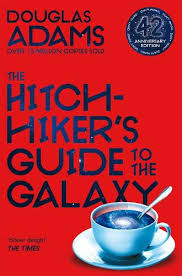
Earth is demolished to make way for a hyperspace bypass. Arthur Dent, still in his dressing gown, is the only human to escape. Adams takes real cosmological ideas: the scale of the universe, the randomness of existence, the improbability of life: and applies comic logic to them with precision. The humour is not decoration; it is the argument.
This is a book about how absurd it is to be a human in a universe this large, written by someone who found that genuinely funny rather than distressing. At 193 pages, it contains more ideas per page than most 600-page science fiction novels. It is a perfect example of how short reads vs novels can often favor the shorter format for high-concept comedy.
Slaughterhouse-Five by Kurt Vonnegut | 215 pages | HARD SCI-FI / ANTI-WAR
Billy Pilgrim has come unstuck in time. A veteran of the Dresden firebombing: which Vonnegut witnessed as a prisoner of war: Billy now experiences all moments of his life simultaneously, including his abduction by aliens from the planet Tralfamadore. Vonnegut uses the sci-fi frame to do something no conventional war novel could: render the randomness and moral incoherence of mass killing from inside a fractured timeline.
The most important anti-war novel of the twentieth century and a masterpiece of short-form science fiction. At 215 pages, it is a book you can finish in an afternoon but will sit with for the rest of your life. The phrase “So it goes” becomes a rhythmic meditation on the nature of time and loss.
Fahrenheit 451 by Ray Bradbury | 158 pages | HARD SCI-FI / DYSTOPIAN
In a future America, firemen do not put out fires: they start them, burning the books that have been outlawed. Guy Montag is a fireman who begins to question his work. Bradbury wrote this in nine days on a rented typewriter in a library basement, paying ten cents per half hour. The premise is science fiction; the execution is closer to poetry. Bradbury’s prose is dense with imagery, built around sensation rather than plot mechanics. 158 pages that have influenced every dystopian novel written since.
Quick Summary: Hard Sci-Fi Classics
Speculative Fiction
Speculative fiction uses a single departure from reality: a “what-if”: to examine something true about human nature, society, or experience. These books are often shelved in literary fiction because the technology is a lens rather than a destination. If you are interested in the role of novellas in fiction, these titles represent the gold standard.
The Metamorphosis by Franz Kafka | 55 pages | SPECULATIVE LITERARY FICTION
Gregor Samsa wakes one morning to find he has been transformed into a giant insect. Kafka never explains the transformation and never treats it as anything other than a logistical problem to be managed. The family adjusts, then they don’t. Written in 1915, this is the founding text of speculative literary fiction. At 55 pages, this is readable in a single sitting and carries the kind of afterthought that stays for days. The insect is not the point: Gregor’s invisibility and his transformation into his family’s burden is the point.
Never Let Me Go by Kazuo Ishiguro | 288 pages | SPECULATIVE LITERARY FICTION
Kathy H. grows up at Hailsham, an English boarding school that is not quite what it appears to be. Ishiguro withholds the central revelation for long enough that when it arrives it lands not as plot information but as grief. Never Let Me Go is a novel about mortality: about what it means to live knowing how and when you will die. While it sits at 288 pages, slightly over our usual threshold, it reads significantly faster because the voice is so compulsive and the benefits of short reads are evident in its tight emotional focus.
This Is How You Lose the Time War by Amal El-Mohtar and Max Gladstone | 198 pages | SPECULATIVE LITERARY FICTION
Two agents on opposite sides of a temporal war begin leaving letters for each other hidden in moments across history: in the rings of a tree, in the gut of a fish, or in the dying words of a soldier. What begins as taunting becomes correspondence. The prose is genuinely beautiful and dense with image and invention. At 198 pages, it is one of the most formally original love stories in science fiction and a strong argument for the short form as the natural home for speculative fiction.
The Left Hand of Darkness by Ursula K. Le Guin | 286 pages | SPECULATIVE LITERARY FICTION
A human envoy travels to the planet Gethen, whose inhabitants have no fixed gender. They are sexually dormant for most of the month and can become either male or female during their fertile period. Le Guin uses this single speculative premise to examine everything that gender shapes in human society: politics, kinship, war, and identity. Published in 1969, it remains the benchmark for speculative fiction that takes its “what-if” seriously as philosophy.

Dystopian Fiction
Dystopian fiction imagines a society organised around the wrong values. The best dystopian fiction is not prediction but diagnosis: it is a look at what we are already doing, taken to a logical, terrifying extreme. Short dystopian novels work because the world is wrong, we understand it quickly, and what matters is how the characters survive inside it.
Animal Farm by George Orwell | 112 pages | DYSTOPIAN CLASSIC
The animals of Manor Farm overthrow their human farmer and establish a society of equals. The pigs, being the most intelligent, take charge of the administration. Orwell wrote this as a direct allegory of the Soviet revolution, but it reads as a universal study of how power corrupts idealism. 112 pages. It remains the most efficient explanation of how “equal” societies can still produce elites.
Brave New World by Aldous Huxley | 311 pages | DYSTOPIAN CLASSIC
In the World State, human beings are manufactured in hatcheries and kept compliant through a happiness drug called soma. There is no poverty, disease, or war: and no freedom, meaning, or art. Huxley’s dystopia has aged more uncomfortably than Orwell’s 1984 because it suggests that we might be controlled by pleasure rather than pain. At 311 pages, it is the longest on our list, but its influence on the genre makes it essential.
Convenience Store Woman by Sayaka Murata | 163 pages | SPECULATIVE / DYSTOPIAN ADJACENT
Keiko Furukura has worked in the same convenience store for eighteen years. She is thirty-six, unmarried, and perfectly content: a fact that everyone around her treats as a malfunction requiring correction. Murata does not write this as science fiction, but the logic is dystopian: a society so rigidly programmed around convention that the woman who finds meaning outside those conventions becomes the deviant. 163 pages of dry, sharp precision.
Where to Start if You’re New to Sci-Fi
The genre often has an intimidating reputation involving complex technology and long series. None of that applies here. Here is your quick entry guide:
- Start with Hitchhiker’s Guide if: you want to laugh and think at the same time. It is the perfect gateway for those who think sci-fi is too “serious.”
- Start with Slaughterhouse-Five if: you want literary ambition and a deep meditation on history alongside your aliens.
- Start with The Metamorphosis if: you want the shortest possible entry point and enjoy psychological depth over space travel.
- Start with Convenience Store Woman if: you are uncertain about the genre but want a precise look at social conformity.
What to Read Next
If you enjoyed these shorter formats, you might want to explore:
| Best Short Books to Read in One Sitting | the full hub across all genres
| Best Novellas of All Time | for the literary end of the sci-fi spectrum
| Short Books to Break a Reading Slump | works like Convenience Store Woman are perfect for this
| Short Reads vs Full Novels | a guide on why brevity often beats length
| Understanding Mystery Fiction Terminology | if you want to branch out into other genres
Science fiction at its best is not about spaceships or aliens. It is about what it means to be human, examined from an angle that realism cannot reach. The short form forces that angle to be precise. You get one premise, followed honestly to its conclusion, without the padding that long series use to fill the space between ideas. That is science fiction working exactly as it was intended.
Ready to find your next favorite story? Browse our full collection of high-impact novellas and experience the power of the short read today.