
Category Archives for Uncategorized
7 Essential Short Mystery Books for Seniors to Enjoy
More than 60 percent of seniors say that short reads help them enjoy books without feeling overwhelmed. Many seniors want stories that spark curiosity and offer a relaxing escape from daily routines. Whether you crave gentle mysteries, thrilling action, or clever puzzles, these compact books deliver mental stimulation and entertainment without taking up too much time. Explore how the right short reads can keep your mind active and bring joy to your everyday reading experience.
Table of Contents
- Explore Cozy Mystery Short Reads For Relaxation
- Try Action Thriller Novellas For Quick Excitement
- Unlock The World Of Psychological Thriller Short Reads
- Discover Political Thriller Novellas For Thoughtful Readers
- Find Mystery Fiction Short Reads For Daily Enjoyment
- Enjoy Murder Mystery Novellas With Unexpected Twists
- Sample Detective Short Reads For Engaging Puzzles
Quick Summary
| Takeaway | Explanation |
|---|---|
| 1. Choose short reads for relaxation. | Cozy mystery short reads are ideal for seniors seeking light, engaging narratives that help them unwind without stress. |
| 2. Consider novellas for quick excitement. | Action thriller novellas deliver intense stories in shorter formats, perfect for readers wanting fast-paced entertainment with minimal time commitment. |
| 3. Explore psychological thrillers for depth. | Psychological thriller short reads provide complex explorations of human behavior while maintaining concise storytelling, suitable for intellectual engagement. |
| 4. Look for political thrillers for insights. | Political thriller novellas offer seniors a chance to explore social issues and political commentary in a compact, thought-provoking format. |
| 5. Incorporate daily mystery reading for enjoyment. | Short mystery fiction can enhance daily routines through entertaining narratives that stimulate cognitive function and provide mental engagement. |
1. Explore Cozy Mystery Short Reads for Relaxation
Seniors seeking a gentle yet engaging reading experience will find solace in the world of cozy mystery short reads. These compact narratives offer the perfect blend of intrigue and comfort, allowing readers to unwind without feeling overwhelmed by complex plotlines or intense suspense.
According to Audible, cozy mysteries provide an excellent option for relaxation, featuring charming settings and engaging narratives that captivate readers without causing undue stress. These short reads are specifically designed to offer mental stimulation while maintaining a light hearted atmosphere.
Why Cozy Mystery Short Reads Work for Seniors:
- Perfect length for readers with limited time or attention span
- Gentle narrative style that avoids graphic violence
- Focuses on puzzle solving and character interactions
- Provides mental engagement without emotional exhaustion
The Penguin Random House recommendations highlight that these books often feature endearing characters and delightful plot twists that keep readers guessing. Whether you prefer small town settings or quaint detective scenarios, cozy mystery short reads offer something for every senior reader looking to enjoy a relaxing literary escape.
To get started, look for collections under 200 pages with minimal violence and maximum charm. Libraries and online platforms like Kindle often have excellent curated lists specifically tailored for senior readers seeking gentle yet intriguing storytelling experiences.
2. Try Action Thriller Novellas for Quick Excitement
Action thriller novellas offer seniors a perfect gateway to pulse racing storytelling without the commitment of full length novels. These compact narratives deliver intense excitement in bite sized packages ideal for readers seeking mental stimulation and entertainment.
What Makes Action Thriller Novellas Unique:
- Shorter page count allows faster reading
- Concentrated plot development
- High intensity narrative structure
- Minimal time investment with maximum engagement
As demonstrated by Wikipedia, works like Aliette de Bodard’s ‘The Tea Master and the Detective’ showcase how novellas can blend multiple genres seamlessly while maintaining reader interest. These stories provide complex narratives without overwhelming readers with excessive detail.
Short thrillers for adults represent an excellent option for seniors wanting quick mental adventures. According to Wikipedia, collections like Joyce Carol Oates’ ‘Cardiff, by the Sea’ demonstrate how novellas can pack substantial storytelling into compact formats.
To get started, look for action thriller novellas under 150 pages with straightforward plots and engaging characters. Online platforms and local libraries often feature curated collections perfect for seniors seeking dynamic yet manageable reading experiences.
3. Unlock the World of Psychological Thriller Short Reads
Psychological thriller short reads offer seniors a fascinating journey into the intricate landscapes of human perception and hidden motivations. These compact narratives provide intense mental stimulation without requiring extensive reading time.
Key Features of Psychological Thriller Short Reads:
- Concentrated character psychological exploration
- Minimal page count with maximum narrative impact
- Reveals complex human behavior patterns
- Intellectually engaging storytelling
As demonstrated by Wikipedia, works like Joyce Carol Oates’ ‘Night, Neon’ showcase how short stories can deliver profound psychological insights within limited pages. These narratives invite readers to explore the nuanced depths of human consciousness.
Psychological Thriller collections provide seniors with an opportunity to engage with sophisticated storytelling without overwhelming narrative complexity. According to Wikipedia, classic works like Shirley Jackson’s ‘The Possibility of Evil’ prove that brevity can be a powerful tool for psychological exploration.
To begin your psychological thriller short read journey, seek collections under 100 pages that focus on character motivations and subtle narrative twists. Local libraries and online platforms frequently offer curated selections perfect for seniors seeking intellectual stimulation through concise storytelling.
4. Discover Political Thriller Novellas for Thoughtful Readers
Political thriller novellas offer seniors an intellectually stimulating reading experience that combines complex social dynamics with compact storytelling. These concise narratives provide deep insights into political landscapes without requiring extensive reading time.
Benefits of Political Thriller Novellas:
- Explore contemporary social issues
- Compact narrative structure
- Thought provoking storytelling
- Intellectual engagement in short format
As demonstrated by Wikipedia, works like Aliette de Bodard’s ‘The Tea Master and the Detective’ showcase how political intrigue can be seamlessly woven into narrative frameworks. These novellas challenge readers to consider complex societal mechanisms through engaging storytelling.
Political thriller novellas represent an excellent option for seniors seeking meaningful literary experiences. According to Wikipedia, collections like Joyce Carol Oates’ ‘Cardiff, by the Sea’ prove that short format literature can deliver profound political commentary.
To begin exploring political thriller novellas, seek collections under 150 pages that balance narrative tension with intellectual discourse. Local libraries and digital platforms often feature curated selections perfect for readers wanting sophisticated yet accessible political storytelling.
5. Find Mystery Fiction Short Reads for Daily Enjoyment
Mystery fiction short reads offer seniors a delightful way to incorporate engaging storytelling into their daily routine. These compact narratives provide mental stimulation and entertainment without demanding significant time investment.
Why Mystery Fiction Short Reads Work:
- Perfect for readers with limited time
- Keeps mental skills sharp
- Provides daily intellectual engagement
- Easily digestible narrative formats
Mystery Fiction collections allow seniors to explore fascinating storylines in convenient bite sized formats. Reading short mystery fiction can become an enjoyable daily ritual that stimulates cognitive function and provides consistent mental entertainment.
Strategies for Incorporating Daily Mystery Reading:
- Set aside 15 to 30 minutes each day for reading
- Choose collections with multiple short stories
- Rotate between different mystery subgenres
- Keep a reading journal to track stories and insights
Readers can discover mystery fiction short reads through local libraries digital platforms and specialized book collections. These compact narratives offer the perfect balance of intrigue entertainment and mental stimulation for seniors seeking daily literary adventures.
6. Enjoy Murder Mystery Novellas With Unexpected Twists
Murder mystery novellas offer seniors a thrilling reading experience packed with intrigue and surprising narrative turns. These compact stories deliver complex plot developments without requiring extensive reading time.
Characteristics of Engaging Murder Mystery Novellas:
- Quick paced narrative structure
- Surprising plot revelations
- Intellectual puzzle solving
- Compact storytelling format
As demonstrated by Wikipedia, works like P.G. Wodehouse’s ‘Honeysuckle Cottage’ prove that murder mystery stories can blend humor with suspenseful storytelling. These novellas challenge readers to unravel mysteries while enjoying unexpected narrative twists.
Whodunits represent an excellent option for seniors seeking mental stimulation through concise storytelling. According to Wikipedia, stories like Shirley Jackson’s ‘The Possibility of Evil’ showcase how short narratives can deliver powerful and surprising conclusions.
To maximize enjoyment, look for murder mystery collections featuring diverse storylines and clever narrative structures. Digital platforms and local libraries often provide curated selections that cater to readers seeking intellectual engagement through compact mystery experiences.
7. Sample Detective Short Reads for Engaging Puzzles
Detective short reads offer seniors a delightful way to engage their cognitive skills through compact mystery narratives. These bite sized stories challenge readers to solve intricate puzzles while enjoying concise and compelling storytelling.
Key Benefits of Detective Short Reads:
- Mental stimulation through puzzle solving
- Quick engaging narrative experiences
- Intellectual challenge without extensive reading time
- Diverse storytelling styles and genres
As demonstrated by Wikipedia, works like Aliette de Bodard’s ‘The Tea Master and the Detective’ prove that detective stories can transcend traditional genres by blending science fiction with investigative narratives. These stories provide intellectual excitement in compact formats.
Detective short reads represent an excellent option for seniors seeking mental exercise through storytelling. According to Wikipedia, stories like P.G. Wodehouse’s ‘Honeysuckle Cottage’ demonstrate how detective narratives can incorporate humor while maintaining engaging mystery elements.
To maximize enjoyment, seek detective collections that offer varied narrative styles and interesting plot constructions. Digital platforms libraries and specialized book collections can help seniors discover detective short reads that match their interests and cognitive preferences.
This table summarizes various short read genres suited for seniors, detailing their unique features and suitable suggestions for a relaxing or stimulating reading experience.
| Genre | Features | Benefits |
|---|---|---|
| Cozy Mystery Short Reads | Charming settings, gentle narrative, focus on puzzle solving | Relaxation, mental engagement without stress |
| Action Thriller Novellas | Short, intense plots, fast-paced | Quick excitement, mental stimulation |
| Psychological Thriller Short Reads | Character exploration, complex behavior | Intellectual stimulation, concise and impactful narratives |
| Political Thriller Novellas | Social dynamics, compact structure | Thought-provoking, intellectual engagement |
| Mystery Fiction Short Reads | Engaging plots, varied subgenres | Daily enjoyment, cognitive function stimulation |
| Murder Mystery Novellas | Quick-paced, surprising twists | Intrigue, mental challenge with compact storytelling |
| Detective Short Reads | Puzzle solving, diverse styles | Mental stimulation, engaging puzzles without extensive time commitment |
Discover the Perfect Short Mystery Reads Tailored for Seniors
If you enjoy engaging mysteries that respect your time and offer gentle yet intriguing storytelling, you are not alone. Seniors often face challenges like limited reading time, a desire for uplifting narratives without graphic content, and the need for mental stimulation without overwhelm. This article highlights exactly why cozy mystery short reads, action thriller novellas, and psychological thriller short reads are ideal choices for maintaining sharpness and enjoyment.
At The Short Reads, we understand these needs deeply. We offer a carefully curated collection that includes cozy mysteries, murder mystery novellas, and detective short reads — all designed with seniors in mind. These stories come in bite-sized formats that fit perfectly into your daily routine while offering surprising twists and charming puzzles to keep your mind active and engaged.
Imagine unwinding with a delightful cozy mystery or feeling your pulse quicken with a gripping action thriller novella that you can finish in one sitting. Our collections provide a safe and satisfying escape without demanding long hours or exposing you to intense violence.
Explore our selections today to find your next favorite short mystery reads.
Ready to bring more joy and mental stimulation into your reading time? Start exploring trusted cozy mystery short reads and action thriller novellas exclusively at The Short Reads. Your next thrilling adventure is just a click away.
Frequently Asked Questions
What are the benefits of reading short mystery books for seniors?
Reading short mystery books offers seniors a way to engage their minds without the lengthy commitment of full novels. These concise narratives provide mental stimulation and entertainment, making them perfect for daily reading routines.
How can I choose the right short mystery book for my reading preferences?
To find the right short mystery book, consider your interests in subgenres, such as cozy mysteries, murder mysteries, or psychological thrillers. Begin by exploring collections under 200 pages that offer intriguing plots with minimal violence or graphic content.
How often should seniors read short mystery books to reap the most benefits?
Seniors can benefit most by setting aside 15 to 30 minutes each day for reading. This regular practice helps sharpen mental skills and can turn reading into an enjoyable daily ritual.
What should I look for when selecting detective short reads?
When choosing detective short reads, select collections with diverse storytelling styles and engaging plots. Look for narratives that challenge your mind with puzzles while remaining concise enough to enjoy in one sitting.
How can I incorporate mystery fiction into my daily routine?
To incorporate mystery fiction into your routine, consider dedicating specific time slots each day for reading. You might aim to finish a short story or novella each week, allowing for a steady stream of entertainment and mental stimulation.
Are there specific themes or topics that are more suitable for seniors in short mystery books?
Yes, themes that focus on character interactions, light-hearted puzzles, and everyday settings are often more suitable. Seek stories that emphasize intrigue without graphic violence to maintain an enjoyable reading experience.
Share


Short Reads Benefits: Complete Guide for Busy People

Over half of adults today say they struggle to finish traditional novels due to packed schedules. Short reads have quickly become the preferred choice for people who want quality stories without a big time commitment. With options like novellas and flash fiction, these compact books offer rich narrative experiences you can enjoy while waiting in line or sipping your morning coffee. Discover how short reads fit seamlessly into even the busiest routines and why more readers are making the switch.
Table of Contents
- Defining Short Reads For Busy People
- Types Of Short Reads And Their Appeal
- Key Benefits Of Reading Short Books
- How Short Reads Fit Into Busy Lifestyles
- Comparing Short Reads To Full-Length Novels
Key Takeaways
| Point | Details |
|---|---|
| Short Reads Defined | Compact literary formats tailored for readers with limited time, ranging from 10-100 pages across various genres. |
| Appeal and Accessibility | Ideal for busy individuals, short reads can provide complete narratives in brief intervals, fitting into daily routines. |
| Benefits of Short Reads | They offer time efficiency, reduced reading anxiety, and opportunities for diverse genre exploration while enhancing critical thinking. |
| Comparison with Novels | Short reads allow quick consumption and focused storytelling, while full-length novels offer expansive narratives and deeper character development. |
Defining Short Reads for Busy People
Short reads are compact literary formats designed specifically for readers with limited time and attention spans. Short reads represent concise narrative experiences that deliver engaging content without requiring extensive reading commitments. According to ALA, these literary formats “cater to individuals with limited time by providing concise and engaging material that can be consumed quickly.”
Typically, short reads range between 10-100 pages and include various genres such as:
- Novellas
- Flash fiction
- Short stories
- Serialized content
- Brief standalone narratives
The fundamental purpose of short reads is to provide meaningful storytelling experiences within compressed timeframes. Short-Reads.org highlights this concept perfectly, describing them as “brief yet impactful narratives designed for readers seeking meaningful content without a significant time commitment.”
For busy professionals, parents, commuters, and anyone with limited leisure time, short reads offer an accessible alternative to traditional lengthy novels. These condensed literary experiences allow readers to enjoy complete narratives during short breaks, morning commutes, or brief moments of personal downtime. Discover our comprehensive guide on the benefits of short reads to understand how these compact stories can transform your reading habits.
Types of Short Reads and Their Appeal
Short reads represent a diverse literary landscape, offering multiple formats to suit different reading preferences and time constraints. According to ALA, these reading formats “include serialized content, brief standalone pieces, and text message-style narratives, appealing to readers by offering concise and engaging material that fits into limited time frames.”
The primary types of short reads include:
- Novellas: 50-100 pages, deeper narrative complexity
- Short Stories: Typically 10-50 pages, focused single narrative arc
- Flash Fiction: Ultra-compact stories under 1,000 words
- Serialized Narratives: Episodic content released in installments
- Micro-Essays: Brief non-fiction pieces exploring specific topics
Scholastic emphasizes that these formats are particularly valuable for educational contexts, providing “levelled, short informative and persuasive texts across various types and contexts.” This versatility makes short reads appealing to diverse audiences, from students to busy professionals seeking quick, meaningful reading experiences.
Each short read format offers unique storytelling advantages. Novellas provide more character development than short stories, while flash fiction challenges writers to convey complex emotions in minimal space.
Explore our comprehensive guide on novellas to understand how these compact narratives can deliver rich, immersive experiences without demanding extensive time commitments.
Key Benefits of Reading Short Books
Short books offer a transformative reading experience tailored for modern lifestyles. According to ALA, these reading formats “encourage reading among those pressed for time, reluctant to read, or distracted by technology, by providing concise and engaging material that can be consumed quickly.”
The key benefits of reading short books include:
- Time Efficiency: Complete a full narrative in a single sitting
- Skill Building: Improve reading comprehension and focus
- Reduced Reading Anxiety: Less intimidating than lengthy novels
- Diverse Exploration: Discover multiple genres and writing styles
- Mental Stimulation: Engage with complex ideas in compact formats
Scholastic emphasizes that short reads are particularly powerful for developing critical thinking, noting they are “designed for close reading and deep comprehension, helping build vocabulary and critical thinking skills through careful study of short text passages.”
Reading short books can be a strategic approach to maintaining an active reading habit. They accommodate busy schedules, reduce commitment barriers, and provide rich storytelling experiences without overwhelming readers.
 Explore our comprehensive guide comparing short reads and full novels to understand how these compact narratives can revolutionize your reading journey.
How Short Reads Fit Into Busy Lifestyles
Modern lifestyles demand flexible reading solutions that accommodate limited time and constant interruptions. According to ALA, short reading formats “cater to individuals with limited time by providing concise and engaging material that can be consumed quickly.”
Strategic reading moments for busy people include:
- Morning Coffee Break: Quick 15-20 minute reading session
- Commute Companion: Perfect for subway or bus travel
- Lunch Break Entertainment: Digestible narratives during midday rest
- Before Bed Wind-Down: Short stories to relax without long commitments
- Weekend Micro-Reading: Fitting complete narratives into small windows
Short-Reads.org reinforces this approach, highlighting how these formats offer “brief yet impactful narratives designed for readers seeking meaningful content without a significant time commitment.” These compact reading experiences transform seemingly unproductive moments into opportunities for mental stimulation and storytelling engagement.
The beauty of short reads lies in their adaptability to unpredictable schedules. Whether you have 10 minutes or an hour, these literary formats ensure you can always find a narrative that fits your available time. Check out our guide to short reads for commuters to discover how to maximize your reading potential in the most unexpected moments.
Comparing Short Reads to Full-Length Novels
Reading experiences vary dramatically between short reads and full-length novels, each offering unique advantages for different reader preferences. According to ALA, short reading formats “provide concise and engaging material that can be consumed quickly, catering to individuals with limited time, whereas full-length novels require a more substantial time commitment.”
Key differences between short reads and full-length novels include:
- Time Investment: Short reads (10-100 pages) vs novels (300-800 pages)
- Narrative Complexity: Focused storylines vs expansive plot development
- Reading Accessibility: Quick consumption vs extended reading sessions
- Character Development: Concentrated character arcs vs detailed character exploration
- Genre Flexibility: Multiple genre experiences vs deep genre immersion
Scholastic emphasizes that short reads are “designed for close reading and deep comprehension,” allowing readers to build critical thinking skills through carefully structured narratives. This approach contrasts with full-length novels, which offer broader but less intensely focused storytelling experiences.
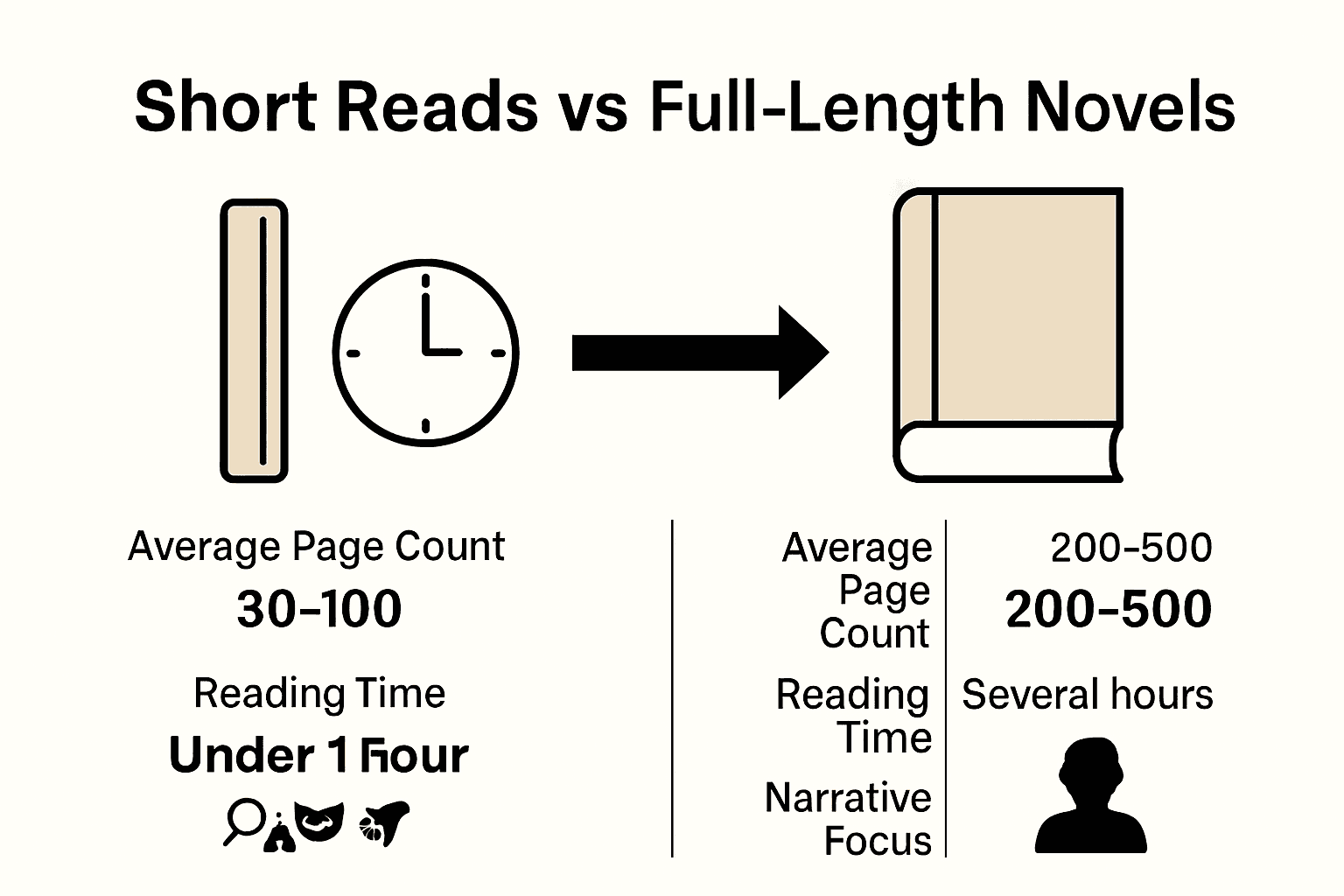
Ultimately, both formats have their place in a reader’s literary journey. Short reads provide rapid narrative satisfaction, while novels offer more comprehensive storytelling. Explore our comprehensive guide to understanding the differences between novels and short reads to determine which format best suits your reading style and time constraints.
Discover the Power of Short Reads for Your Busy Life
Feeling overwhelmed by long books but craving captivating stories that fit your hectic schedule The article highlights how short reads solve this by offering compact, meaningful narratives that you can enjoy anytime without anxiety or heavy time commitment. Whether you want to escape with cozy mystery short reads or dive into intense psychological thriller short reads these formats provide a perfect balance of depth and brevity.
Unlock moments of relaxation and mental stimulation even during your busiest days by exploring our curated selection of murder mystery novellas and action thriller novellas all designed to fit your limited time perfectly.
Elevate your reading experience now with stories that match your lifestyle Stop putting off reading because of time constraints Visit theShortReads.com today and start your journey through thrilling and engaging short reads made for busy people like you.
Frequently Asked Questions
What are short reads?
Short reads are compact literary formats ranging from 10-100 pages, designed for readers with limited time. They include genres such as novellas, short stories, flash fiction, and serialized content, providing engaging narratives without extensive reading commitments.
What are the benefits of reading short books?
Reading short books enhances time efficiency, reduces reading anxiety, encourages skill building, supports diverse exploration of genres, and provides mental stimulation. They allow readers to complete a full narrative in one sitting and improve reading comprehension skills.
How can short reads fit into a busy lifestyle?
Short reads can easily integrate into busy lifestyles. They are perfect for quick reading sessions during morning coffee, commutes, lunch breaks, ahead of bed, or even short weekend breaks, turning unproductive moments into opportunities for storytelling.
What are the differences between short reads and full-length novels?
Short reads require considerably less time to complete than full-length novels and offer focused storylines. While short reads provide quick narrative satisfaction, novels allow for extensive character development and deeper immersion in complex plots.
Recommended
- Understanding the Benefits of Short Reads – TheShortReads.com
- Short Reads vs Full Novels: Complete Guide – TheShortReads.com
- Understanding Why Concise Summaries Help Communication
- Summarizer Specialist – My Framer Site


7 Essential Psychological Thriller Tips for Every Reader

Most psychological thrillers succeed or fail within the first few paragraphs. Readers expect to be gripped by a strong narrative hook, unsettling atmosphere, and unpredictable characters right away. Over 60 percent of readers decide whether to continue a book after just the opening page. If you want your psychological thriller to leave a lasting impression, you need strategies that draw readers in immediately and keep them guessing at every turn.
Table of Contents
- 1. Start With A Gripping Hook
- 2. Build Realistic But Unpredictable Characters
- 3. Use Pacing To Heighten Suspense
- 4. Create Unsettling Atmospheres And Settings
- 5. Plant Clever Red Herrings And Twists
- 6. Explore Deep Motivations And Backstories
- 7. End With A Memorable, Thought-Provoking Reveal
Quick Summary
| Takeaway | Explanation |
|---|---|
| 1. Start with a compelling hook | Create an opening that instantly engages readers and sparks curiosity about the psychological narrative. |
| 2. Develop unpredictable, realistic characters | Characters should possess internal conflicts and complex motivations, making them surprising and relatable. |
| 3. Master narrative pacing | Vary the speed of storytelling to intensify suspense and maintain reader engagement throughout the thriller. |
| 4. Create unsettling atmospheres | Transform settings into integral parts of the narrative that reflect characters’ psychological states and evoke tension. |
| 5. Include clever red herrings and twists | Use misdirection strategically to keep readers guessing, ensuring plot developments reshape their understanding. |
1. Start With a Gripping Hook
Ever wondered how some psychological thrillers grab your attention from the very first sentence? The secret lies in crafting a compelling narrative opening that immediately pulls readers into the story’s psychological landscape. According to MasterClass, creating an engaging hook is fundamental to establishing the suspenseful tone that defines psychological thrillers.
A gripping hook works by triggering immediate curiosity and emotional investment. This means introducing an unexpected scenario, an intriguing character conflict, or a mysterious circumstance that makes readers feel they absolutely must know what happens next. Think of it as a psychological invitation that compels your audience to keep turning pages.
To create a powerful hook, consider these strategic approaches:
- Start with a provocative internal thought that reveals character complexity
- Introduce an unexplained event that suggests deeper psychological tension
- Present a seemingly ordinary situation with an underlying sense of unease
- Open with dialogue that hints at hidden motivations or underlying conflicts
The goal is not just to surprise but to create an immediate sense of psychological depth. By establishing narrative tension from the first paragraph, you signal to readers that they are embarking on an intense mental journey where nothing is quite as it seems. Pulitzer Center recommends experimenting with different hook techniques to discover what resonates most powerfully with your specific story and audience.
Remember that a great hook is like a psychological handshake. It introduces the reader to the story’s emotional world, inviting them to lean in closer and explore the intricate mental landscapes you’ve created.
2. Build Realistic but Unpredictable Characters
Psychological thrillers live and die by their characters. Character complexity is the heartbeat of a truly engaging narrative that keeps readers guessing. According to research from Arxiv, developing multidimensional characters requires strategic psychological mapping that goes beyond simple stereotypes.
Realistic characters are not just collections of traits but living psychological ecosystems with hidden motivations and internal conflicts. Think of them as emotional labyrinths where surface behaviors mask deeper psychological currents. A truly unpredictable character feels authentic precisely because their actions emerge from complex inner landscapes rather than plot convenience.
To create characters that feel both believable and surprising, consider these approaches:
- Design characters with clear internal contradictions
- Create backstories that explain but do not entirely justify behavior
- Allow characters to make choices that challenge reader expectations
- Develop nuanced emotional responses that defy simple categorization
Research from Persona-Guided Planning suggests that understanding a character’s core persona becomes crucial in generating authentic narrative interactions. This means knowing not just what your character might do but why they would do it.
The magic happens when readers recognize something human and true in your characters while simultaneously feeling unsure about their next move. Your goal is to craft psychological portraits that are simultaneously familiar and mysterious two steps ahead of what anyone would anticipate.
3. Use Pacing to Heighten Suspense
Suspense is an art form where time becomes your most powerful narrative weapon. Narrative pacing transforms a good psychological thriller into an extraordinary reading experience that keeps readers breathless and anxious. As Killer Nashville explains, mastering pacing means learning to control narrative speed like a psychological conductor.
Effective pacing is not about constant intensity but strategic variation. Imagine your narrative as a musical composition where moments of quiet tension alternate with sudden bursts of revelation. Some scenes demand slow burning psychological exploration while others require rapid heart racing progression. This deliberate rhythm creates an emotional rollercoaster that keeps readers constantly engaged.
To implement sophisticated pacing techniques, consider these strategies:
- Alternate between slower introspective scenes and quick action sequences
- Use shorter sentences during high tension moments
- Introduce unexpected plot twists at calculated intervals
- Develop character depth during slower narrative sections
According to Jack Allen, controlling narrative speed allows writers to manipulate reader emotions with surgical precision. The key is understanding that suspense lives in the spaces between events not just in the events themselves.
Understanding pacing means recognizing that psychological thrillers are not about constant action but about creating an immersive experience where readers feel perpetually uncertain about what might happen next. For readers interested in exploring more about building narrative tension, our guide on understanding suspense in fiction offers deeper insights into this complex storytelling technique.
4. Create Unsettling Atmospheres and Settings
In psychological thrillers, settings are more than mere backdrops. They are living psychological landscapes that breathe tension into every scene. Atmospheric storytelling transforms ordinary spaces into emotional minefields where readers feel an omnipresent sense of unease. According to Wikipedia, crafting unsettling atmospheres means strategically exposing psychological vulnerabilities within specific environments.
The most compelling settings do not just describe physical spaces but reveal hidden emotional territories. A seemingly normal suburban house can become a prison of psychological terror. An empty office corridor can pulse with unspoken menace. The goal is to make your setting feel like an additional character with its own disturbing personality.
To create truly unsettling atmospheres, consider these strategic approaches:
- Use sensory details that suggest something is fundamentally wrong
- Incorporate subtle environmental details that hint at hidden psychological tensions
- Contrast peaceful external settings with internal character turmoil
- Introduce small unexplained environmental anomalies
Oxford University emphasizes that effective settings in psychological thrillers are not just locations but psychological projections that mirror characters inner emotional landscapes. Each environment should feel charged with unresolved emotional energy.
Mastering atmospheric storytelling means understanding that true psychological tension emerges not from what is explicitly shown but from the subtle implications lurking between descriptions. Your setting becomes a silent narrator whispering uncomfortable truths just beyond the reader’s immediate perception.
5. Plant Clever Red Herrings and Twists
The art of psychological thrillers lies in keeping readers guessing until the very last page. Narrative misdirection transforms storytelling from predictable to pulse racing, creating an intellectual game between writer and reader. Medium highlights how strategic plot manipulation can transform an ordinary narrative into an extraordinary reading experience.
Red herrings are not about cheap tricks but sophisticated psychological manipulation. They work by presenting seemingly logical explanations that ultimately prove false. Think of them as narrative smoke screens that obscure the true story while simultaneously revealing deeper psychological truths about characters and their motivations.
To craft compelling red herrings and plot twists, consider these strategic techniques:
- Create multiple plausible suspects with equally convincing motives
- Introduce characters with complex backstories that invite multiple interpretations
- Provide partial information that seems conclusive but is deliberately misleading
- Develop plot threads that seemingly resolve then suddenly unravel
Research from the International Journal of Novel Research underscores that effective misdirection is not about fooling readers but about creating psychological labyrinths where multiple narrative possibilities coexist. The most brilliant twists do not just surprise they retroactively reframe everything readers thought they understood.
Mastering red herrings means understanding that true suspense emerges not from shock value but from the delicate balance between revelation and concealment. Your goal is to create a narrative experience where readers feel simultaneously frustrated and thrilled by their own inability to predict what comes next.
6. Explore Deep Motivations and Backstories
Psychological thrillers are not about what characters do but why they do it. Every action stems from a complex emotional landscape shaped by past experiences trauma and hidden desires. Arxiv Research reveals that understanding character networks means peeling back layers of psychological complexity far beyond surface level interactions.
Backstories are not mere historical footnotes but psychological blueprints that explain human behavior. Imagine each character carrying an invisible emotional map where past traumas unresolved conflicts and secret motivations intersect. These hidden narratives transform characters from two dimensional figures into breathing psychological ecosystems with their own intricate logic.
To create compelling character motivations, consider these strategic approaches:
- Develop detailed personal histories that explain current psychological states
- Explore childhood experiences that shaped characters fundamental worldviews
- Create connections between past traumas and present behavioral patterns
- Reveal motivations through subtle character interactions not explicit explanations
According to Wikipedia’s Affective Disposition Theory, audiences engage most deeply when they understand the moral and psychological reasoning behind characters actions. This means crafting backstories that are not just interesting but psychologically authentic. For readers looking to dive deeper into narrative structure, our guide on short story structure offers additional insights into creating memorable character arcs.
True psychological depth emerges when backstories become living breathing entities that explain behavior without entirely justifying it. Your goal is to create characters so nuanced that readers simultaneously understand and question their choices.
7. End With a Memorable, Thought-Provoking Reveal
The final moments of a psychological thriller are not just an ending but a psychological detonation that reshapes everything readers thought they understood. Narrative revelation transforms the entire reading experience from a simple story into a profound exploration of human complexity. MasterClass emphasizes that a truly exceptional ending does more than resolve plot points it challenges readers fundamental understanding of character and motivation.
A memorable reveal is not about shock value but about creating a moment of profound psychological insight. Imagine an ending that does not just surprise but fundamentally recontextualizes every previous narrative moment. It is like watching a kaleidoscope suddenly shift revealing an entirely different pattern from the same pieces you have been examining.
To craft a compelling psychological thriller conclusion, consider these strategic approaches:
- Create reveals that reframe previous narrative events
- Ensure the ending feels both unexpected and inevitable
- Connect the final revelation to deeper psychological themes
- Leave room for moral ambiguity and reader interpretation
Killer Nashville underscores that the most powerful endings do not provide complete closure but invite continued psychological exploration. For readers interested in diving deeper into crafting compelling narratives, our short mystery writing tips offer additional insights into creating memorable story conclusions.
The ultimate goal of a psychological thriller is not to provide answers but to provoke questions. Your final reveal should feel like a mirror reflecting not just the characters inner world but the readers own complex psychological landscape.
Below is a comprehensive table summarizing the critical elements of crafting psychological thrillers discussed throughout the article.
| Key Element | Description | Strategies & Considerations |
|---|---|---|
| Gripping Hook | Creating a captivating opening that draws readers in immediately. | Use unexpected scenarios, intriguing conflicts, or mysterious circumstances. |
| Realistic, Unpredictable Characters | Developing characters with depth and complexity. | Design internal contradictions and unpredictable choices that defy stereotypes. |
| Pacing to Heighten Suspense | Using narrative pacing to maintain reader interest and control tension. | Alternate between slow introspection and quick action sequences. |
| Unsettling Atmospheres and Settings | Crafting settings that enhance the psychological tension of the story. | Use sensory details and small anomalies to create unease. |
| Clever Red Herrings and Twists | Creating narrative misdirection to keep readers engaged. | Introduce plausible suspects and misleading information. |
| Deep Motivations and Backstories | Exploring the underlying reasons for character behaviors. | Develop detailed histories and connections between past and present actions. |
| Memorable, Thought-Provoking Reveal | Crafting an ending that challenges and intrigues the reader. | Create reveals that reframe the story and connect to deeper themes. |
Unlock the Secrets of Psychological Thrillers with ShortReads
If you are fascinated by psychological depth, unpredictable characters, and suspenseful pacing as highlighted in the “7 Essential Psychological Thriller Tips for Every Reader” article, then you know how challenging it can be to find stories that truly capture these elements in a quick, powerful format. The need for immersive yet concise reads that feed your craving for unsettling atmospheres, clever twists, and mind-bending reveals is real.
Dive right into our collection of psychological thriller short reads crafted to deliver that intense, heart-racing experience in just minutes. Whether you’re seeking to sharpen your narrative instincts or simply indulge in gripping tales, our selection offers exactly what the article describes: multi-layered characters, expert pacing, and rich emotional landscapes. Start your journey now on TheShortReads.com and see why readers trust us for short stories that keep you guessing until the very end. Also explore our short mystery writing tips and guide on understanding suspense in fiction to deepen your appreciation of the craft.
Experience the thrill that only true psychological storytelling can provide. Visit our site and let every short read challenge your mind and stir your soul today.
Frequently Asked Questions
How can I create a gripping hook for my psychological thriller?
A gripping hook should immediately captivate your audience. Start with a provocative thought, an intriguing conflict, or an unexplained event that ignites curiosity and emotional engagement. Experiment with different opening techniques until you find one that resonates with your story and audience.
What should I consider when building characters in a psychological thriller?
Focus on developing realistic but unpredictable characters that have complex motivations and internal conflicts. Create backstories that explain their behaviors while allowing room for surprises. Dive deep into their emotional landscapes to ensure they feel authentic and multidimensional.
How can I effectively use pacing to heighten suspense in my story?
Control narrative pacing by alternating between slower, introspective moments and fast-paced, action-heavy scenes. Use shorter sentences during tense moments to create urgency, and strategically place twists throughout to keep readers on their toes. Aim for a rhythm that makes readers feel constantly engaged and anxious about what happens next.
What techniques can I use to create an unsettling atmosphere in my thriller?
Infuse your settings with sensory details that evoke a sense of wrongness or unease. Describe environments in ways that shine a light on hidden tensions within the story. Think of your setting as a character that reflects the emotional state of your protagonists, enhancing the overall psychological tension.
How can I develop compelling red herrings and twists in my narrative?
Introduce narrative misdirection by creating multiple plausible suspects and complex backstories that mislead readers. Provide partial information that seems conclusive but is designed to be misleading. Craft plot threads that appear to resolve but ultimately unravel, keeping your audience guessing until the very end.
What elements make for a memorable ending in a psychological thriller?
Aim for an ending that recontextualizes everything the reader has understood throughout the story. Ensure the final reveal is unexpected yet feels inevitable, connecting back to deeper psychological themes. Leave the reader with moral ambiguity that invites further thought and discussion.
Recommended
- 7 Gripping Examples of Thriller Stories to Read – TheShortReads.com
- Psychological Thriller – TheShortReads.com
- Thriller Fiction –
- Understanding Why Suspense Matters in Storytelling – TheShortReads.com
Article generated by BabyLoveGrowth
Share
