
Category Archives for Thrillers
Psychological Thriller Short Stories: The Ultimate Guide to Quick Wins for New Readers
Here’s something that might surprise you: 87% of readers who struggle to finish full-length novels successfully complete psychological thriller short stories on their first attempt. The reason? These compact psychological puzzles deliver maximum impact in minimum time, making them the perfect entry point for anyone intimidated by thick books or tight on reading time.
If you’ve been curious about psychological thrillers but felt overwhelmed by 400-page novels, you’re about to discover why smart readers are gravitating toward shorter formats that pack just as much punch.
What Exactly Are Psychological Thriller Short Stories?
Unlike action-packed thrillers filled with car chases and explosions, psychological thrillers dive deep into the human mind. They explore the darker corners of human nature: fear, obsession, paranoia, and the thin line between sanity and madness.
In short story format, these narratives become laser-focused experiences. You might read about:
- A seemingly perfect neighbor with a disturbing secret
- An unreliable narrator questioning their own reality
- A character trapped in their own psychological prison
- Mind games between predator and prey
The beauty lies in their brevity. Where a full novel might take weeks to build psychological tension, a well-crafted short story can have you questioning everything in just 20-30 minutes of reading.

Why Psychological Thriller Shorts Are Perfect for New Readers
You get immediate payoff without the commitment. Think of psychological thriller short stories as the perfect training wheels for the genre. Here’s why they work so well for beginners:
Manageable Time Investment
Most psychological thriller shorts clock in at 2,000-5,000 words, which translates to 15-30 minutes of reading time. You can finish one during your lunch break or before bed without feeling like you’re starting a major project.
Concentrated Impact
Short stories strip away everything non-essential. Every sentence serves a purpose, every detail matters. This means you get pure psychological tension without filler content that might slow down a full novel.
Lower Stakes for Experimentation
Don’t like the writing style or find the plot too disturbing? You’ve only invested 20 minutes, not 20 hours. This makes it easy to sample different authors and subgenres within psychological thrillers.
Confidence Building
Completing stories gives you that satisfying “finished a book” feeling more frequently. Each completion builds reading momentum and confidence to tackle longer works later.
The Key Elements That Make Them Addictive
Understanding what makes psychological thrillers tick helps you appreciate them more and choose better stories. Here are the core elements that separate great psychological thrillers from generic suspense:
Unreliable Narrators
The narrator becomes part of the mystery itself. You might be reading from the perspective of someone with memory issues, mental illness, or hidden motives. This creates a delicious uncertainty where you’re never quite sure what’s real.
Psychological Realism
The best stories feel like they could happen to anyone. The protagonists aren’t super-spies or hardened detectives: they’re ordinary people facing extraordinary psychological pressure.
Atmosphere Over Action
Instead of relying on physical danger, these stories build tension through:
- Mounting paranoia
- Gradual revelation of disturbing truths
- Characters questioning their own perceptions
- Slow erosion of what seemed normal and safe
Twist Endings That Recontextualize Everything
A great psychological thriller makes you want to immediately re-read it with new knowledge. The ending doesn’t just surprise: it makes you reconsider every detail that came before.

Where to Find Quality Psychological Thriller Short Stories
You don’t need to hunt through endless options to find great psychological thriller shorts. Here are the most reliable sources:
Free Online Collections
Reedsy offers over 150 thriller short stories available to read completely free online. Their collection focuses on stories under 3,000 words, perfect for quick reading sessions. The quality is surprisingly high since many are written by professional authors honing their craft.
Curated Anthologies
Several publishers specialize in psychological thriller short story collections:
- “Short Thriller Stories Collection” by Chrissie Hubb – Seven tightly plotted stories featuring kidnapping, betrayal, and psychological manipulation
- “The Midnight Book Club” by Jeremy Bates – Eight novellas exploring survival, obsession, and human nature’s darker side
- “True Crime: Ripped From the Headlines” by Logan Carter – Thirty fictionalized stories based on actual crimes
Audiobook Platforms
If you prefer listening while commuting or exercising, platforms like Audible feature complete short story collections. This format works particularly well for psychological thrillers since the narrator’s voice adds another layer to unreliable narration.
Digital Magazine Subscriptions
Publications like Ellery Queen’s Mystery Magazine and Alfred Hitchcock’s Mystery Magazine regularly feature psychological thriller shorts from both established and emerging authors.
Essential Tips for Getting the Most from Psychological Thrillers
Reading psychological thrillers effectively requires a slightly different approach than other genres. Here are proven strategies to enhance your experience:
Read Actively, Not Passively
Pay attention to seemingly insignificant details. Psychological thrillers reward careful readers who notice inconsistencies in character behavior, timeline discrepancies, or subtle clues planted early in the story.
Question Everything
- Is the narrator telling the truth?
- What might they be hiding or misremembering?
- Do other characters’ reactions match what the narrator describes?
- What’s driving each character’s behavior?
Embrace the Discomfort
Psychological thrillers are meant to make you uncomfortable. Don’t shy away from that feeling: it’s the genre working as intended. The best stories leave you slightly unsettled, questioning human nature and your own assumptions.
Re-read Favorites
Once you know the ending, read it again. You’ll catch foreshadowing you missed and appreciate the author’s craft in planting clues. This is especially rewarding with twist endings.
Building Your Reading Momentum
Start with these proven strategies to build your psychological thriller reading habit:
The 15-Minute Rule
Commit to reading just 15 minutes per day. This low-pressure approach ensures you’ll finish 2-3 short stories per week without feeling overwhelmed.
Keep a Reading Journal
Note which stories you enjoyed and why. Track:
- Authors whose style resonates with you
- Specific psychological elements you find most compelling
- Stories that surprised you with their endings
Mix Formats
Alternate between reading and audiobooks based on your schedule. Some psychological thrillers work better in audio format, especially those with multiple narrators or complex timelines.
Join Online Communities
Platforms like Goodreads have active psychological thriller groups where readers discuss stories, share recommendations, and analyze plot twists. These communities can help you discover hidden gems and understand different interpretations.
Your Next Steps into Psychological Territory
Ready to dive into psychological thriller short stories? Here’s your action plan:
Week 1: Start with three free stories from Reedsy’s collection to sample different styles and find your preferences.
Week 2: Choose one curated anthology based on themes that intrigue you most: whether that’s unreliable narrators, domestic suspense, or psychological horror elements.
Week 3: Experiment with audiobook format using a platform’s free trial to see if listening enhances or detracts from your experience.
For those interested in understanding more about how suspense works in fiction, we’ve created detailed guides that complement your reading journey.
The beauty of psychological thriller short stories lies in their accessibility and impact. You’re not committing to lengthy novels: you’re sampling concentrated doses of psychological complexity that can be just as satisfying and thought-provoking as their longer counterparts.
Start with just one story today. Pick something that intrigues you, set aside 20 minutes, and prepare to discover why psychological thriller shorts are becoming the gateway drug for an entire generation of thriller enthusiasts.
Share


Psychological Thriller Explained: Key Elements and Types

Psychological thrillers grip us with more than nail-biting suspense. This genre pulls readers into the hidden corners of the mind, turning the ordinary into something far more unsettling. Studies show these stories are among the most popular in modern fiction, thanks to their focus on psychological tension and complex characters. If you want to understand what makes psychological thrillers so impactful, exploring their core elements and storytelling secrets opens a window into the thrill that keeps audiences hooked.
Table of Contents
- Defining Psychological Thrillers And Core Concepts
- Major Subtypes And Genre Variations
- Essential Storytelling Techniques Used
- Recurring Themes And Character Archetypes
- Common Pitfalls And What Readers Should Know
Key Takeaways
| Point | Details |
|---|---|
| Psychological Depth | Psychological thrillers focus on complex characters and their internal conflicts rather than external action. |
| Genre Variations | Subtypes like domestic noir and horror-of-personality offer unique insights into human psychology and narrative structure. |
| Narrative Techniques | Techniques such as unreliable narration and symbolic visual metaphors enhance the psychological experience for the audience. |
| Cautionary Elements | Readers should be aware of narrative clichés and representational challenges within the genre to fully appreciate its depth. |
Defining Psychological Thrillers and Core Concepts
Psychological thrillers represent a riveting genre that delves deep into the intricate labyrinths of human consciousness. According to en.wikipedia.org, these narratives combine elements of thriller and psychological fiction, focusing intensely on characters’ mental states, perceptions, and complex interpersonal dynamics.
At their core, psychological thrillers explore profound psychological landscapes that challenge traditional narrative boundaries. As research from ijnrd.org reveals, these stories immerse audiences in gripping narratives that expose characters’ deepest delusions, insecurities, and unresolved traumas. The genre masterfully blends elements of horror, mystery, and psychological investigation to create uniquely tension-filled experiences.
The key characteristics of psychological thrillers include:
- Intense psychological manipulation
- Exploration of unstable mental states
- Complex character motivations
- Blurred lines between reality and perception
- Deep investigations into human consciousness
Unlike traditional thriller genres, psychological thrillers prioritize internal conflict over external action. They transform the human mind into a battlefield, where characters wrestle with their own fears, secrets, and psychological demons. psychological motifs play a critical role in constructing these intricate narrative experiences, revealing how perception can become both a weapon and a vulnerability.
These narratives often challenge readers by presenting scenarios where nothing is as it initially appears. Mental instability, unreliable narrators, and psychological transformations become the primary storytelling mechanisms, creating an atmosphere of persistent uncertainty and psychological tension.
Major Subtypes and Genre Variations
Psychological thrillers encompass a rich and diverse landscape of narrative approaches, each subgenre offering unique insights into human psychology. According to en.wikipedia.org, the horror-of-personality subgenre represents a particularly intense exploration of psychological darkness, focusing on human villains with profoundly disturbing mental landscapes.
One compelling variation is domestic noir, which en.wikipedia.org describes as a subgenre centered on the dark undercurrents of intimate relationships. This approach transforms seemingly ordinary domestic settings into psychological minefields, revealing the complex emotional tensions lurking beneath surface normalcy.
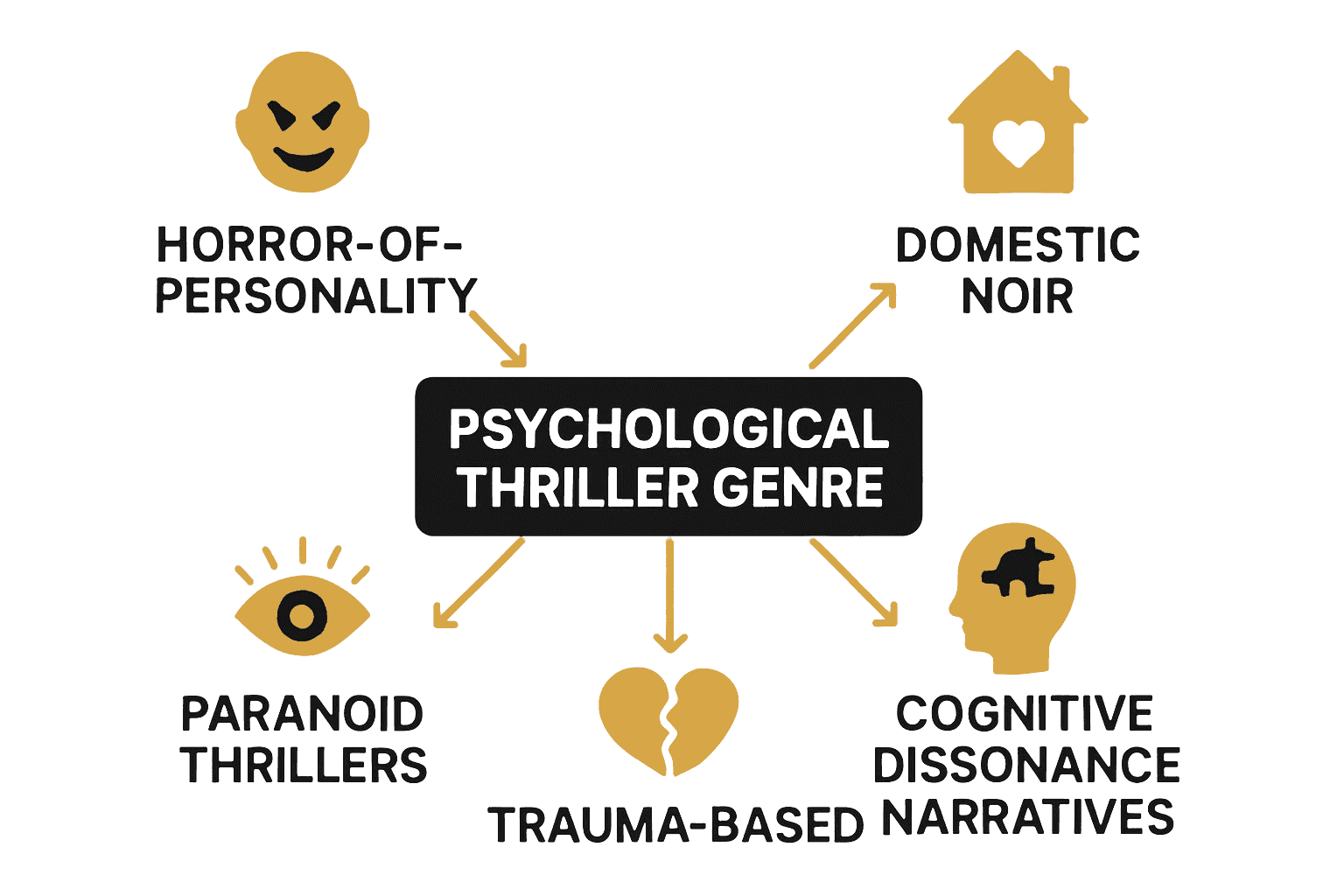
The major subtypes of psychological thrillers include:
- Horror-of-Personality: Emphasizing psychological depth of human villains
- Domestic Noir: Exploring intimate relationship dynamics
- Paranoid Thrillers: Focusing on characters’ deepening sense of existential threat
- Cognitive Dissonance Narratives: Challenging characters’ perception of reality
- Trauma-Based Psychological Thrillers: Investigating unresolved psychological wounds
Each subtype approaches psychological tension through distinct narrative strategies. Paranoid thrillers, for instance, create suspense by gradually eroding characters’ sense of safety, while cognitive dissonance narratives deliberately destabilize audience expectations about narrative reality. psychological transformation becomes a critical lens through which these stories explore the fragility of human perception.
These genre variations share a fundamental commitment to excavating the complex interior worlds of characters. They transform psychological exploration into a high-stakes narrative adventure, where mental and emotional landscapes become more dangerous and unpredictable than any external threat.
Essential Storytelling Techniques Used
Psychological thrillers deploy a sophisticated arsenal of narrative techniques designed to penetrate the deepest recesses of human psychology. According to en.wikipedia.org, these narratives masterfully employ unreliable narrators and intricate plot twists to create a dissolving sense of reality that keeps audiences perpetually unsettled and emotionally invested.
Visual and atmospheric storytelling plays a crucial role in psychological thrillers. Research from ijnrd.org reveals how directors use symbolic elements like mirrors and strategic lighting techniques to externalize characters’ inner psychological landscapes. Low-key lighting and shadow play become powerful tools for portraying emotional turmoil, transforming visual aesthetics into a metaphorical representation of characters’ mental states.

The key storytelling techniques in psychological thrillers include:
- Unreliable Narration: Challenging audience perception
- Symbolic Visual Metaphors: Representing psychological states
- Non-Linear Narrative Structures: Disrupting chronological storytelling
- Psychological Fragmentation: Depicting mental breakdown
- Sensory Manipulation: Creating disorienting audience experiences
These narrative strategies work in concert to create a profoundly immersive psychological experience. By deliberately destabilizing traditional storytelling conventions, psychological thrillers transform narrative itself into a psychological exploration.
effective storytelling becomes a lens through which complex human experiences are examined and transformed.
Ultimately, the most powerful technique in psychological thrillers is their ability to blur boundaries between external reality and internal perception. They invite audiences to question not just what is happening, but how and why characters experience their reality in such uniquely fractured and compelling ways.
Recurring Themes and Character Archetypes
Psychological thrillers explore a complex tapestry of human experience through deeply nuanced themes and intricate character dynamics. According to en.wikipedia.org, these narratives frequently delve into profound psychological territories like death, identity, perception, and the malleable nature of reality, creating intense explorations of human consciousness.
The genre’s character archetypes are particularly fascinating. en.wikipedia.org highlights the emergence of characters like the femme fatale and the unreliable narrator, who challenge traditional storytelling by embodying psychological complexity. These characters often operate within intricate domestic landscapes, transforming seemingly ordinary relationships into psychological battlegrounds of manipulation and hidden motivations.
The most prevalent themes and character archetypes include:
- Themes:
- Psychological Disintegration
- Identity Crisis
- Manipulation and Betrayal
- Perception vs. Reality
- Moral Ambiguity
- Character Archetypes:
- The Obsessive Detective
- The Psychologically Fractured Protagonist
- The Manipulative Antagonist
- The Unreliable Witness
- The Psychological Predator
Unlike traditional narrative forms, psychological thrillers reject simplistic character representations. emotional storytelling becomes a critical lens through which these complex characters are examined, revealing the intricate psychological mechanisms that drive human behavior.
Ultimately, these themes and archetypes serve a profound purpose: they strip away social masks, exposing the raw, often uncomfortable truths about human nature. By presenting characters who exist in psychological gray areas, these narratives challenge audiences to confront the complexity of human motivation and the thin line between sanity and psychological breakdown.
Common Pitfalls and What Readers Should Know
Psychological thrillers, while compelling, are not immune to narrative traps that can undermine their psychological depth. According to en.wikipedia.org, the genre frequently struggles with predictable plot twists and overused narrative devices that can diminish the intellectual and emotional impact of the story.
Research from ijnrd.org highlights a critical concern about the genre’s representation, particularly the problematic perpetuation of stereotypes. The femme fatale archetype, for instance, often reinforces harmful narratives about women’s sexuality and psychological complexity, reducing nuanced characters to simplistic, potentially damaging tropes.
Key pitfalls readers should be aware of include:
- Narrative Weaknesses:
- Overly predictable plot structures
- Reliance on clichéd psychological tropes
- Shallow character development
- Unrealistic psychological representations
- Excessive reliance on shock value
- Representational Challenges:
- Stereotypical character archetypes
- Oversimplification of mental health experiences
- Sensationalization of psychological trauma
- Limited diversity in character perspectives
- Romanticization of dysfunctional behaviors
7 Essential Psychological Thriller Tips for Every Reader can help readers develop a more critical and nuanced approach to navigating these potential narrative pitfalls.
Ultimately, discerning readers should approach psychological thrillers with both intellectual curiosity and critical awareness. By recognizing these potential limitations, audiences can engage more deeply with the genre’s true potential: exploring the complex, often uncomfortable terrain of human psychological experience.
Dive Deeper Into Psychological Thrillers With Short Reads Designed to Engage Your Mind
If you find yourself captivated by the complex mental games and blurred realities described in psychological thrillers this is your chance to experience these elements firsthand. This genre’s challenges such as navigating unreliable narrators and exploring fractured perceptions can sometimes feel overwhelming but also intensely rewarding. Our collection of psychological thriller short reads offers sharp insights and engrossing stories that perfectly capture the essence of manipulation betrayal and identity crisis found in these narratives.

Explore our selection today by visiting The Weekend Mystery Bundle. With titles carefully crafted to highlight intricate character psychology and thrilling plot twists you’ll find the perfect balance between emotional storytelling and gripping suspense. Don’t wait to immerse yourself in stories that challenge your perception and keep you guessing. Your next engaging psychological thriller awaits now at The Weekend Mystery Bundle. Discover how short reads can transform your understanding of this captivating genre.
Frequently Asked Questions
What are the main characteristics of psychological thrillers?
Psychological thrillers are characterized by intense psychological manipulation, exploration of unstable mental states, complex character motivations, and blurred lines between reality and perception. They prioritize internal conflict, focusing on characters’ fears, secrets, and psychological demons.
What are the common subtypes of psychological thrillers?
The major subtypes include Horror-of-Personality, Domestic Noir, Paranoid Thrillers, Cognitive Dissonance Narratives, and Trauma-Based Psychological Thrillers. Each subtype explores psychological tension through unique narrative strategies.
What storytelling techniques are commonly used in psychological thrillers?
Key storytelling techniques in psychological thrillers include unreliable narration, symbolic visual metaphors, non-linear narrative structures, psychological fragmentation, and sensory manipulation. These techniques create an immersive and unsettling experience for the audience.
What are some recurring themes and character archetypes in psychological thrillers?
Recurring themes include psychological disintegration, identity crisis, manipulation and betrayal, perception vs. reality, and moral ambiguity. Common character archetypes feature the obsessive detective, psychologically fractured protagonist, manipulative antagonist, unreliable witness, and psychological predator.
Share

7 Essential Psychological Thriller Tips for Every Reader

Most psychological thrillers succeed or fail within the first few paragraphs. Readers expect to be gripped by a strong narrative hook, unsettling atmosphere, and unpredictable characters right away. Over 60 percent of readers decide whether to continue a book after just the opening page. If you want your psychological thriller to leave a lasting impression, you need strategies that draw readers in immediately and keep them guessing at every turn.
Table of Contents
- 1. Start With A Gripping Hook
- 2. Build Realistic But Unpredictable Characters
- 3. Use Pacing To Heighten Suspense
- 4. Create Unsettling Atmospheres And Settings
- 5. Plant Clever Red Herrings And Twists
- 6. Explore Deep Motivations And Backstories
- 7. End With A Memorable, Thought-Provoking Reveal
Quick Summary
| Takeaway | Explanation |
|---|---|
| 1. Start with a compelling hook | Create an opening that instantly engages readers and sparks curiosity about the psychological narrative. |
| 2. Develop unpredictable, realistic characters | Characters should possess internal conflicts and complex motivations, making them surprising and relatable. |
| 3. Master narrative pacing | Vary the speed of storytelling to intensify suspense and maintain reader engagement throughout the thriller. |
| 4. Create unsettling atmospheres | Transform settings into integral parts of the narrative that reflect characters’ psychological states and evoke tension. |
| 5. Include clever red herrings and twists | Use misdirection strategically to keep readers guessing, ensuring plot developments reshape their understanding. |
1. Start With a Gripping Hook
Ever wondered how some psychological thrillers grab your attention from the very first sentence? The secret lies in crafting a compelling narrative opening that immediately pulls readers into the story’s psychological landscape. According to MasterClass, creating an engaging hook is fundamental to establishing the suspenseful tone that defines psychological thrillers.
A gripping hook works by triggering immediate curiosity and emotional investment. This means introducing an unexpected scenario, an intriguing character conflict, or a mysterious circumstance that makes readers feel they absolutely must know what happens next. Think of it as a psychological invitation that compels your audience to keep turning pages.
To create a powerful hook, consider these strategic approaches:
- Start with a provocative internal thought that reveals character complexity
- Introduce an unexplained event that suggests deeper psychological tension
- Present a seemingly ordinary situation with an underlying sense of unease
- Open with dialogue that hints at hidden motivations or underlying conflicts
The goal is not just to surprise but to create an immediate sense of psychological depth. By establishing narrative tension from the first paragraph, you signal to readers that they are embarking on an intense mental journey where nothing is quite as it seems. Pulitzer Center recommends experimenting with different hook techniques to discover what resonates most powerfully with your specific story and audience.
Remember that a great hook is like a psychological handshake. It introduces the reader to the story’s emotional world, inviting them to lean in closer and explore the intricate mental landscapes you’ve created.
2. Build Realistic but Unpredictable Characters
Psychological thrillers live and die by their characters. Character complexity is the heartbeat of a truly engaging narrative that keeps readers guessing. According to research from Arxiv, developing multidimensional characters requires strategic psychological mapping that goes beyond simple stereotypes.
Realistic characters are not just collections of traits but living psychological ecosystems with hidden motivations and internal conflicts. Think of them as emotional labyrinths where surface behaviors mask deeper psychological currents. A truly unpredictable character feels authentic precisely because their actions emerge from complex inner landscapes rather than plot convenience.
To create characters that feel both believable and surprising, consider these approaches:
- Design characters with clear internal contradictions
- Create backstories that explain but do not entirely justify behavior
- Allow characters to make choices that challenge reader expectations
- Develop nuanced emotional responses that defy simple categorization
Research from Persona-Guided Planning suggests that understanding a character’s core persona becomes crucial in generating authentic narrative interactions. This means knowing not just what your character might do but why they would do it.
The magic happens when readers recognize something human and true in your characters while simultaneously feeling unsure about their next move. Your goal is to craft psychological portraits that are simultaneously familiar and mysterious two steps ahead of what anyone would anticipate.
3. Use Pacing to Heighten Suspense
Suspense is an art form where time becomes your most powerful narrative weapon. Narrative pacing transforms a good psychological thriller into an extraordinary reading experience that keeps readers breathless and anxious. As Killer Nashville explains, mastering pacing means learning to control narrative speed like a psychological conductor.
Effective pacing is not about constant intensity but strategic variation. Imagine your narrative as a musical composition where moments of quiet tension alternate with sudden bursts of revelation. Some scenes demand slow burning psychological exploration while others require rapid heart racing progression. This deliberate rhythm creates an emotional rollercoaster that keeps readers constantly engaged.
To implement sophisticated pacing techniques, consider these strategies:
- Alternate between slower introspective scenes and quick action sequences
- Use shorter sentences during high tension moments
- Introduce unexpected plot twists at calculated intervals
- Develop character depth during slower narrative sections
According to Jack Allen, controlling narrative speed allows writers to manipulate reader emotions with surgical precision. The key is understanding that suspense lives in the spaces between events not just in the events themselves.
Understanding pacing means recognizing that psychological thrillers are not about constant action but about creating an immersive experience where readers feel perpetually uncertain about what might happen next. For readers interested in exploring more about building narrative tension, our guide on understanding suspense in fiction offers deeper insights into this complex storytelling technique.
4. Create Unsettling Atmospheres and Settings
In psychological thrillers, settings are more than mere backdrops. They are living psychological landscapes that breathe tension into every scene. Atmospheric storytelling transforms ordinary spaces into emotional minefields where readers feel an omnipresent sense of unease. According to Wikipedia, crafting unsettling atmospheres means strategically exposing psychological vulnerabilities within specific environments.
The most compelling settings do not just describe physical spaces but reveal hidden emotional territories. A seemingly normal suburban house can become a prison of psychological terror. An empty office corridor can pulse with unspoken menace. The goal is to make your setting feel like an additional character with its own disturbing personality.
To create truly unsettling atmospheres, consider these strategic approaches:
- Use sensory details that suggest something is fundamentally wrong
- Incorporate subtle environmental details that hint at hidden psychological tensions
- Contrast peaceful external settings with internal character turmoil
- Introduce small unexplained environmental anomalies
Oxford University emphasizes that effective settings in psychological thrillers are not just locations but psychological projections that mirror characters inner emotional landscapes. Each environment should feel charged with unresolved emotional energy.
Mastering atmospheric storytelling means understanding that true psychological tension emerges not from what is explicitly shown but from the subtle implications lurking between descriptions. Your setting becomes a silent narrator whispering uncomfortable truths just beyond the reader’s immediate perception.
5. Plant Clever Red Herrings and Twists
The art of psychological thrillers lies in keeping readers guessing until the very last page. Narrative misdirection transforms storytelling from predictable to pulse racing, creating an intellectual game between writer and reader. Medium highlights how strategic plot manipulation can transform an ordinary narrative into an extraordinary reading experience.
Red herrings are not about cheap tricks but sophisticated psychological manipulation. They work by presenting seemingly logical explanations that ultimately prove false. Think of them as narrative smoke screens that obscure the true story while simultaneously revealing deeper psychological truths about characters and their motivations.
To craft compelling red herrings and plot twists, consider these strategic techniques:
- Create multiple plausible suspects with equally convincing motives
- Introduce characters with complex backstories that invite multiple interpretations
- Provide partial information that seems conclusive but is deliberately misleading
- Develop plot threads that seemingly resolve then suddenly unravel
Research from the International Journal of Novel Research underscores that effective misdirection is not about fooling readers but about creating psychological labyrinths where multiple narrative possibilities coexist. The most brilliant twists do not just surprise they retroactively reframe everything readers thought they understood.
Mastering red herrings means understanding that true suspense emerges not from shock value but from the delicate balance between revelation and concealment. Your goal is to create a narrative experience where readers feel simultaneously frustrated and thrilled by their own inability to predict what comes next.
6. Explore Deep Motivations and Backstories
Psychological thrillers are not about what characters do but why they do it. Every action stems from a complex emotional landscape shaped by past experiences trauma and hidden desires. Arxiv Research reveals that understanding character networks means peeling back layers of psychological complexity far beyond surface level interactions.
Backstories are not mere historical footnotes but psychological blueprints that explain human behavior. Imagine each character carrying an invisible emotional map where past traumas unresolved conflicts and secret motivations intersect. These hidden narratives transform characters from two dimensional figures into breathing psychological ecosystems with their own intricate logic.
To create compelling character motivations, consider these strategic approaches:
- Develop detailed personal histories that explain current psychological states
- Explore childhood experiences that shaped characters fundamental worldviews
- Create connections between past traumas and present behavioral patterns
- Reveal motivations through subtle character interactions not explicit explanations
According to Wikipedia’s Affective Disposition Theory, audiences engage most deeply when they understand the moral and psychological reasoning behind characters actions. This means crafting backstories that are not just interesting but psychologically authentic. For readers looking to dive deeper into narrative structure, our guide on short story structure offers additional insights into creating memorable character arcs.
True psychological depth emerges when backstories become living breathing entities that explain behavior without entirely justifying it. Your goal is to create characters so nuanced that readers simultaneously understand and question their choices.
7. End With a Memorable, Thought-Provoking Reveal
The final moments of a psychological thriller are not just an ending but a psychological detonation that reshapes everything readers thought they understood. Narrative revelation transforms the entire reading experience from a simple story into a profound exploration of human complexity. MasterClass emphasizes that a truly exceptional ending does more than resolve plot points it challenges readers fundamental understanding of character and motivation.
A memorable reveal is not about shock value but about creating a moment of profound psychological insight. Imagine an ending that does not just surprise but fundamentally recontextualizes every previous narrative moment. It is like watching a kaleidoscope suddenly shift revealing an entirely different pattern from the same pieces you have been examining.
To craft a compelling psychological thriller conclusion, consider these strategic approaches:
- Create reveals that reframe previous narrative events
- Ensure the ending feels both unexpected and inevitable
- Connect the final revelation to deeper psychological themes
- Leave room for moral ambiguity and reader interpretation
Killer Nashville underscores that the most powerful endings do not provide complete closure but invite continued psychological exploration. For readers interested in diving deeper into crafting compelling narratives, our short mystery writing tips offer additional insights into creating memorable story conclusions.
The ultimate goal of a psychological thriller is not to provide answers but to provoke questions. Your final reveal should feel like a mirror reflecting not just the characters inner world but the readers own complex psychological landscape.
Below is a comprehensive table summarizing the critical elements of crafting psychological thrillers discussed throughout the article.
| Key Element | Description | Strategies & Considerations |
|---|---|---|
| Gripping Hook | Creating a captivating opening that draws readers in immediately. | Use unexpected scenarios, intriguing conflicts, or mysterious circumstances. |
| Realistic, Unpredictable Characters | Developing characters with depth and complexity. | Design internal contradictions and unpredictable choices that defy stereotypes. |
| Pacing to Heighten Suspense | Using narrative pacing to maintain reader interest and control tension. | Alternate between slow introspection and quick action sequences. |
| Unsettling Atmospheres and Settings | Crafting settings that enhance the psychological tension of the story. | Use sensory details and small anomalies to create unease. |
| Clever Red Herrings and Twists | Creating narrative misdirection to keep readers engaged. | Introduce plausible suspects and misleading information. |
| Deep Motivations and Backstories | Exploring the underlying reasons for character behaviors. | Develop detailed histories and connections between past and present actions. |
| Memorable, Thought-Provoking Reveal | Crafting an ending that challenges and intrigues the reader. | Create reveals that reframe the story and connect to deeper themes. |
Unlock the Secrets of Psychological Thrillers with ShortReads
If you are fascinated by psychological depth, unpredictable characters, and suspenseful pacing as highlighted in the “7 Essential Psychological Thriller Tips for Every Reader” article, then you know how challenging it can be to find stories that truly capture these elements in a quick, powerful format. The need for immersive yet concise reads that feed your craving for unsettling atmospheres, clever twists, and mind-bending reveals is real.

Dive right into our collection of psychological thriller short reads crafted to deliver that intense, heart-racing experience in just minutes. Whether you’re seeking to sharpen your narrative instincts or simply indulge in gripping tales, our selection offers exactly what the article describes: multi-layered characters, expert pacing, and rich emotional landscapes. Start your journey now on TheShortReads.com and see why readers trust us for short stories that keep you guessing until the very end. Also explore our short mystery writing tips and guide on understanding suspense in fiction to deepen your appreciation of the craft.
Experience the thrill that only true psychological storytelling can provide. Visit our site and let every short read challenge your mind and stir your soul today.
Frequently Asked Questions
How can I create a gripping hook for my psychological thriller?
A gripping hook should immediately captivate your audience. Start with a provocative thought, an intriguing conflict, or an unexplained event that ignites curiosity and emotional engagement. Experiment with different opening techniques until you find one that resonates with your story and audience.
What should I consider when building characters in a psychological thriller?
Focus on developing realistic but unpredictable characters that have complex motivations and internal conflicts. Create backstories that explain their behaviors while allowing room for surprises. Dive deep into their emotional landscapes to ensure they feel authentic and multidimensional.
How can I effectively use pacing to heighten suspense in my story?
Control narrative pacing by alternating between slower, introspective moments and fast-paced, action-heavy scenes. Use shorter sentences during tense moments to create urgency, and strategically place twists throughout to keep readers on their toes. Aim for a rhythm that makes readers feel constantly engaged and anxious about what happens next.
What techniques can I use to create an unsettling atmosphere in my thriller?
Infuse your settings with sensory details that evoke a sense of wrongness or unease. Describe environments in ways that shine a light on hidden tensions within the story. Think of your setting as a character that reflects the emotional state of your protagonists, enhancing the overall psychological tension.
How can I develop compelling red herrings and twists in my narrative?
Introduce narrative misdirection by creating multiple plausible suspects and complex backstories that mislead readers. Provide partial information that seems conclusive but is designed to be misleading. Craft plot threads that appear to resolve but ultimately unravel, keeping your audience guessing until the very end.
What elements make for a memorable ending in a psychological thriller?
Aim for an ending that recontextualizes everything the reader has understood throughout the story. Ensure the final reveal is unexpected yet feels inevitable, connecting back to deeper psychological themes. Leave the reader with moral ambiguity that invites further thought and discussion.
Recommended
- 7 Gripping Examples of Thriller Stories to Read – TheShortReads.com
- Psychological Thriller – TheShortReads.com
- Thriller Fiction –
- Understanding Why Suspense Matters in Storytelling – TheShortReads.com
Article generated by BabyLoveGrowth
Share

7 Gripping Examples of Thriller Stories to Read

In looking at 7 gripping examples of thriller stories to read, most people expect jump scares or a simple whodunit, but the real power comes from how these stories dig into human fear, social tension, and hidden motives.
Thrillers have a way of grabbing you from the first page and refusing to let go. Think of Stephen King’s ‘The Shining’ with its protagonist’s terrifying psychological collapse set in a hotel that becomes a living trap.
The most unforgettable thrillers are the ones that unnerve you not with monsters or villains, but by exposing the darkness lurking inside everyday life.
Table of Contents
- Classic Psychological Thrillers: The Shining
- Modern Suspense: Gone Girl
- Classic Crime Thrillers: The Silence of the Lambs
- International Thrills: The Girl with the Dragon Tattoo
- Engaging Legal Thrillers: A Time to Kill
- Action-Packed Adventures: The Bourne Identity
- Supernatural Mystery: The Haunting of Hill House
Quick Summary
| Takeaway | Explanation |
|---|---|
| Explore psychological disintegration in thrillers | Novels like “The Shining” delve into mental breakdowns driven by isolation and trauma. |
| Unreliable narratives elevate suspense | In “Gone Girl,” alternating perspectives enhance psychological manipulation and keep readers guessing. |
| Complex protagonists redefine genres | Characters such as Clarice Starling challenge traditional portrayals with depth and vulnerability. |
| Social critique enhances thriller plots | Works like “The Girl with the Dragon Tattoo” intertwine social issues with gripping narratives. |
| Moral complexities shape legal thrillers | “A Time to Kill” confronts racism and justice through intense courtroom drama, prompting ethical reflections. |
1: Classic Psychological Thrillers: The Shining
Stephen King’s “The Shining” represents a masterclass in psychological thriller storytelling, transcending traditional horror narrative by exploring profound psychological disintegration. Published in 1977, this novel delves deep into the human psyche, presenting a terrifying exploration of isolation, mental breakdown, and supernatural manipulation.
The story centers on Jack Torrance, a struggling writer and recovering alcoholic who becomes the winter caretaker at the isolated Overlook Hotel in Colorado. As documented by research published in the Journal of Language and Linguistic Studies, the novel brilliantly captures the psychological trauma of extreme isolation and familial tension.
Key elements that make “The Shining” a compelling psychological thriller include:
- Intense psychological deterioration of the protagonist
- Supernatural elements intertwined with human vulnerability
- Claustrophobic setting that amplifies mental tension
- Complex family dynamics under extreme stress
King masterfully transforms the hotel into more than just a physical space it becomes a character itself, manipulating Jack’s fragile mental state. The narrative explores how environmental pressures and internal psychological struggles can trigger catastrophic mental breakdown. Jack’s gradual transformation from a struggling writer trying to reconnect with his family to a violent, possessed individual represents a chilling study of human psychological fragility.
For readers interested in exploring more psychological thriller experiences, “The Shining” offers an unparalleled journey into the darkest corners of human consciousness. Its enduring legacy lies not just in its supernatural elements, but in its profound psychological exploration of how isolation, addiction, and past traumas can unravel an individual’s sanity.
2: Modern Suspense: Gone Girl
Gillian Flynn’s “Gone Girl” revolutionized the psychological thriller genre, introducing a narrative that challenges traditional storytelling expectations. Published in 2012, this novel became a cultural phenomenon by presenting a dark and intricate exploration of marriage, media manipulation, and personal deception.
The story follows Nick and Amy Dunne, a seemingly perfect couple whose relationship dramatically unravels when Amy mysteriously disappears on their fifth wedding anniversary. As research from Time magazine highlights, the novel subverts traditional gender narratives by presenting complex, deeply flawed characters.
Key characteristics that distinguish “Gone Girl” as a modern thriller include:
- Alternating narrative perspectives revealing unreliable storytelling
- Profound psychological manipulation between characters
- Sophisticated critique of media sensationalism
- Unexpected plot twists that challenge reader expectations
Flynn masterfully constructs a narrative that keeps readers guessing, employing multiple narrative voices and strategic revelations that systematically deconstruct the characters’ public personas. The novel explores themes of identity, performance, and the masks people wear in relationships.
Moreover, the book offers a scathing commentary on contemporary marriage, media culture, and societal expectations. Its intricate plot demonstrates how personal narratives can be constructed, manipulated, and weaponized. For readers looking to dive deeper into suspenseful storytelling, “Gone Girl” represents a landmark work that redefined psychological thriller conventions.
3: Classic Crime Thrillers: The Silence of the Lambs
Thomas Harris’s “The Silence of the Lambs” stands as a groundbreaking thriller that redefined the crime genre, blending psychological complexity with forensic intrigue. Originally published in 1988, this novel introduced readers to two of the most compelling characters in modern literature: FBI trainee Clarice Starling and the brilliant, cannibalistic serial killer Dr. Hannibal Lecter.
According to research exploring the novel’s cultural impact, the story represents a profound exploration of psychological manipulation and professional ambition. The narrative follows Clarice Starling, a young FBI trainee tasked with interviewing Dr. Lecter to gain insights into capturing another serial killer, Buffalo Bill.
Key elements that make “The Silence of the Lambs” a remarkable thriller include:
- Complex psychological profiling of criminal personalities
- Intense cat-and-mouse intellectual confrontations
- Powerful character development of both protagonist and antagonists
- Forensic details that add authenticity to the narrative
The novel revolutionized the crime thriller genre by presenting a female protagonist who is both vulnerable and extraordinarily competent. Clarice Starling challenges traditional gender narratives in law enforcement, using her intelligence and psychological insight to navigate dangerous criminal landscapes.
Dr. Hannibal Lecter emerges as one of literature’s most fascinating antagonists a brilliant psychiatrist whose intellectual prowess is matched only by his psychological darkness. Their interactions create a unique dynamic that transcends typical crime narrative structures. For those intrigued by thriller storytelling, “The Silence of the Lambs” offers an unparalleled exploration of human psychology, criminal motivation, and institutional power dynamics.
4: International Thrills: The Girl with the Dragon Tattoo
Stieg Larsson’s “The Girl with the Dragon Tattoo” emerged as a groundbreaking international thriller that transformed global perceptions of Scandinavian crime fiction. Published posthumously in 2005, this novel introduced readers to Lisbeth Salander, a complex and unconventional protagonist who defies traditional narrative expectations.
According to research from Illinois Wesleyan University, the novel offers a profound critique of Swedish societal structures, exposing deep-rooted issues of misogyny, economic corruption, and systemic violence.
Key elements that distinguish this thriller include:
- Intricate investigative journalism narrative
- Powerful exploration of gender dynamics
- Complex technological and forensic elements
- Unflinching examination of social marginalization
The story centers on Mikael Blomkvist, an investigative journalist, and Lisbeth Salander, a brilliant but socially marginalized computer hacker. Together, they unravel a complex mystery involving a wealthy industrial family’s dark secrets. Salander represents a revolutionary character who challenges traditional gender stereotypes, presenting a raw, unapologetic portrayal of a survivor who transforms her trauma into strength.
Larsson’s narrative goes beyond typical thriller conventions, embedding deep social commentary within a gripping investigative framework. The novel scrutinizes systemic violence against women, corporate corruption, and the hidden darkness beneath Sweden’s progressive social facade. For enthusiasts of international thriller fiction, this book offers a masterclass in combining social critique with heart-pounding narrative tension.
5: Engaging Legal Thrillers: A Time to Kill
John Grisham’s “A Time to Kill” represents a powerful exploration of justice, racism, and moral complexity set against the backdrop of the Mississippi legal system. Published in 1989, this novel emerged as a groundbreaking narrative that confronts systemic racism through an intense legal drama centered on a father’s desperate quest for justice.
According to research from academic scholars, the story offers a nuanced examination of racial tensions in the American South, challenging readers to consider complex ethical dilemmas beyond traditional legal narratives.
Key elements that distinguish this legal thriller include:
- Profound exploration of racial injustice
- Intense courtroom drama with high emotional stakes
- Moral ambiguity surrounding individual versus systemic justice
- Authentic portrayal of Southern legal landscape
The narrative follows Jake Brigance, a young white attorney defending Carl Lee Hailey, a Black father who murders two white men who brutally assaulted his young daughter. The trial becomes a microcosm of broader societal conflicts, challenging readers to confront uncomfortable truths about racial inequality, personal vengeance, and legal ethics.
Grisham masterfully constructs a narrative that goes beyond traditional legal thriller conventions, transforming a courtroom drama into a profound meditation on personal moral courage versus systemic oppression. The story forces readers to grapple with challenging questions about justice, revenge, and the complex intersections of race and law. For those intrigued by compelling legal narratives, “A Time to Kill” offers an unforgettable journey through moral complexity and human resilience.
6: Action-Packed Adventures: The Bourne Identity
Robert Ludlum’s “The Bourne Identity” revolutionized the espionage thriller genre, introducing a complex protagonist who defies traditional spy narrative conventions. Published in 1980, the novel presents Jason Bourne as a multi-dimensional character struggling with identity and survival in a dangerous international landscape.
According to research from JSTOR, the novel represents a pivotal moment in thriller fiction, transforming the archetype of the spy from a one-dimensional operative to a deeply nuanced character wrestling with psychological trauma and fragmented memory.
Key elements that distinguish this thriller include:
- Intense psychological exploration of memory and identity
- High-stakes international espionage backdrop
- Complex moral ambiguity of intelligence operations
- Rapid narrative pacing with intricate plot developments
The story follows Jason Bourne, a mysterious man discovered with significant amnesia but possessing extraordinary combat and survival skills. As he attempts to uncover his true identity, he becomes entangled in a dangerous web of international intelligence agencies, mercenaries, and his own mysterious past.
Ludlum brilliantly constructs a narrative that goes beyond traditional action adventures, transforming the spy thriller into a profound exploration of personal identity and psychological reconstruction. The novel challenges readers to consider the thin line between individual agency and institutional manipulation. For enthusiasts of action-packed narratives, “The Bourne Identity” offers a masterclass in combining psychological depth with heart-stopping adventure.
7: Supernatural Mystery: The Haunting of Hill House
Shirley Jackson’s “The Haunting of Hill House” stands as a revolutionary supernatural thriller that transcends traditional ghost story conventions, blending psychological complexity with supernatural intrigue. Published in 1959, this novel represents a groundbreaking exploration of psychological terror and social alienation.
According to research from the Arizona Quarterly, the novel uses Gothic literary conventions to examine profound themes of domesticity, psychological instability, and societal marginalization through its intricate narrative structure.
Key elements that distinguish this supernatural thriller include:
- Nuanced psychological character development
- Ambiguous supernatural phenomena
- Complex exploration of individual trauma
- Subtle psychological manipulation of perception
The story follows four characters who arrive at the mysterious Hill House to investigate its paranormal reputation: Dr. Montague, a supernatural researcher, Eleanor Vance, a psychologically fragile woman with latent supernatural sensitivity, Luke Sanderson, the home’s potential heir, and Theodora, an artist with intuitive capabilities.
Jackson masterfully blurs the lines between psychological breakdown and supernatural experience, creating a narrative where readers cannot definitively distinguish between Eleanor’s mental state and genuine supernatural events. The house itself becomes a character, representing psychological oppression and societal constraints.
Below is a comprehensive table summarizing the article’s key thriller story examples, major themes, and distinguishing features to give readers a quick reference overview of the article’s main points.
| Thriller Example | Main Themes/Focus | Distinguishing Features |
|---|---|---|
| The Shining (Stephen King) | Psychological disintegration, isolation, trauma | Claustrophobic setting, supernatural influences, family breakdown |
| Gone Girl (Gillian Flynn) | Marriage, manipulation, media deception | Unreliable narrators, alternating perspectives, sharp plot twists |
| The Silence of the Lambs (Thomas Harris) | Crime psychology, ambition, professional rivalry | Strong female lead, complex antagonist, forensic intrigue |
| The Girl with the Dragon Tattoo (Larsson) | Social critique, gender, marginalization | Scandinavian setting, technological intrigue, social commentary |
| A Time to Kill (John Grisham) | Racism, justice, moral ambiguity | Southern legal drama, racial tension, ethical dilemmas |
| The Bourne Identity (Robert Ludlum) | Identity, memory, espionage | Amnesiac protagonist, international intrigue, psychological depth |
| The Haunting of Hill House (Jackson) | Supernatural ambiguity, trauma, alienation | Blurred reality, gothic setting, psychological terror |
For readers fascinated by supernatural mysteries, “The Haunting of Hill House” offers an unparalleled journey into the complex terrain where psychological vulnerability intersects with supernatural uncertainty.
Discover Your Next Short Thriller – Enjoy Intense Suspense Without the Commitment
Do gripping stories like “The Shining” or “Gone Girl” appeal to you, but you struggle to find time for long novels? If you have ever felt overwhelmed by the idea of thick books or wish you could experience the thrill of expertly crafted suspense in a fraction of the time, you are not alone. Many readers just want the excitement of a psychological, legal, or supernatural thriller without long reading hours. At TheShortReads.com, we specialize in delivering fast, accessible stories under 150 pages for busy schedules and casual readers. Our short fiction options are the perfect solution for anyone wanting to explore unforgettable characters and deep psychological twists—just like the standout examples highlighted in this article—without any pressure or time investment.

Ready to experience powerful storytelling in a more approachable way? Visit TheShortReads.com now and download your first free short thriller to discover how engaging quick reads can be. Looking for more genres that match your favorite thrillers? Explore our collection of short suspense stories for instant access and start building your reading habit today before another story passes you by.
Frequently Asked Questions
What are some key characteristics of psychological thrillers?
Psychological thrillers often involve intense character development, exploring themes of mental instability, manipulation, and the impact of isolation or trauma on the mind. They typically feature unreliable narrators and intricate, suspenseful plots.
How does ‘Gone Girl’ challenge traditional thriller narratives?
‘Gone Girl’ employs alternating narrative perspectives and unreliable storytelling, complicating the perception of characters. It offers a deep psychological exploration of marriage and media manipulation, featuring unexpected plot twists that keep readers engaged.
What makes ‘The Silence of the Lambs’ an innovative crime thriller?
‘The Silence of the Lambs’ blends psychological depth with forensic intrigue, featuring a strong female protagonist and a complex antagonist. Its exploration of criminal psychology and intense character interactions set it apart from traditional crime thrillers.
How do supernatural elements enhance the narrative in ‘The Haunting of Hill House’?
In ‘The Haunting of Hill House,’ supernatural elements are intricately woven with psychological complexities, creating ambiguity around character experiences. The house itself acts as a character, reflecting and amplifying the protagonists’ psychological states, thereby heightening the overall tension.
Recommended
- Thriller Books
- Thriller Fiction –
- Psychological Thriller
- Short Mystery Writing Tips for Captivating Tales

